Follow Us on Google
By Chinwendu Obienyi
Following the formal announcement that the African Union (AU) has joined the Group of 20 top global economies, economic analysts have lauded the move and stated that this will enhance multilateralism and foster stronger economic growth to the continent.
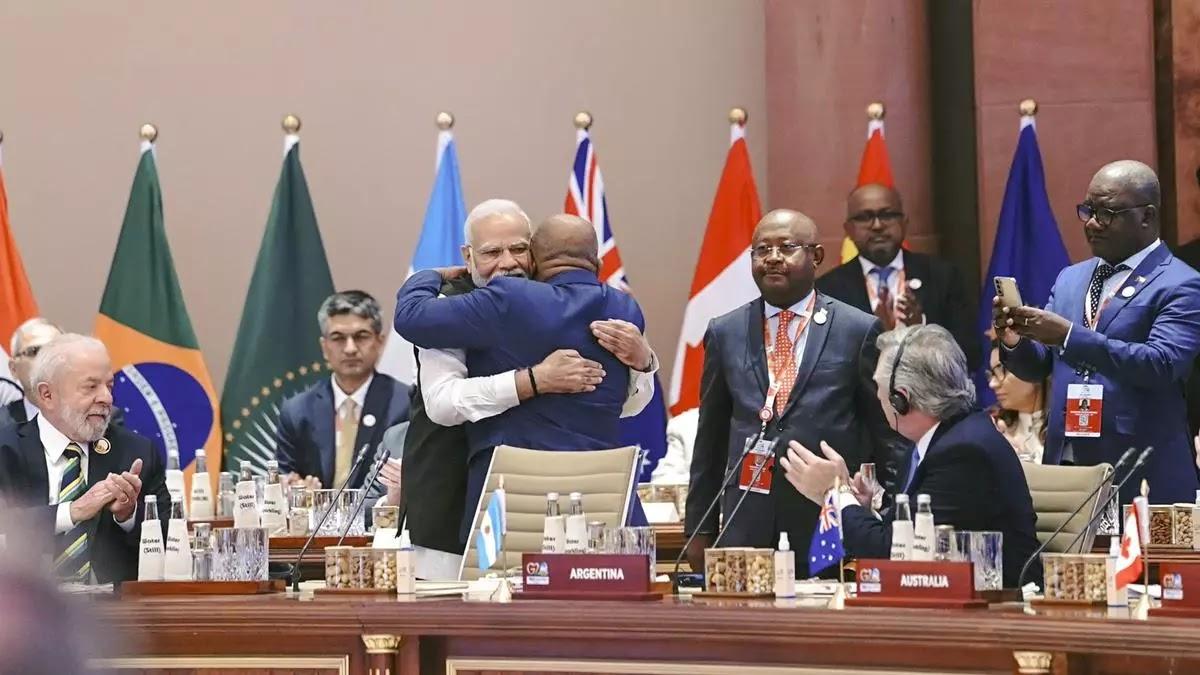
Prime Minister Narendra Modi of India had on Saturday declared that the African Union, comprising 55 members, joined as a permanent member of the G20 during the inaugural session of the mega Summit.
In his address, Modi emphasized, “In keeping with the sentiment of ‘sabka saath’ (with everyone), India had proposed that the African Union should be granted permanent membership of the G20. I believe we all are in agreement on this proposal.
Before we commence our work, I extend an invitation to the African Union president to assume their position as a permanent member”.
The addition of the AU is coming at a time when there are growing global rifts. It is worth noting that African Union member states collectively boast a GDP of nearly USD 3 trillion and a population of approximately 1.4 billion.
Reacting to the development, the chairperson of the African Union Commission, Moussa Faki Mahamat lauded the membership of the A.U into the G20 saying it will help the continent meet global challenges.
Disclosing this on his X (formerly Twitter) handle after the announcement of the permanent membership status of the African Union in the G20, he said, “I welcome the @AfricanUnion entry into the #G20 as a full member. This membership, for which we have long been advocating, will provide a propitious framework for amplifying advocacy in favour of the Continent and its effective contribution to meeting global challenges”.
Meanwhile, President Bola Tinubu, who is attending the Summit, remarked, “As a continent, we eagerly anticipate advancing our aspirations on the global stage through the G20 platform”.
In a policy brief by Development Reimagined, economic analysts noted that this development will enhance multilateralism and foster stronger economic growth while adding that closer relationships between the continent and the G20 will facilitate increased trade and cooperation, leading to mutually beneficial outcomes.
The policy brief said that this will benefit other G20 members through diverse perspectives and insights, without causing overcrowding or compromising donor-funded activities within the AU. Highlighting the past coordination efforts by African countries and institutions, they said that the C-10, comprising Algeria, Botswana, Cameroon, Egypt, Kenya, Nigeria, South Africa, Tanzania, the Central Bank of West African States (CBWAS), and the Central Bank of Central African States (CBCAS), played a pivotal role. Established in 2008, the C-10 aimed to monitor the impact of the global financial crisis on Africa, advocate for increased African participation in international financial institutions, and develop an African G20 engagement strategy.
“Despite its limitations and challenges, the C-10 made significant contributions to African representation in the G20. The committee collaborated with institutions like the AfDB, NEPAD, and the AU to promote African interests.
Their recommendations focused on increasing African voices in IFIs, scaling up investments in infrastructure and agriculture, developing follow-up mechanisms, enhancing transparency in project implementation, securing an official African seat at the G20, and advocating for IMF reform.
Hence, through these collective efforts, Africa can strengthen its global engagement, influence decision-making, and drive positive change for the continent’s development and prosperity”, the brief read.