Follow Us on Google
As UN women says exclusion cost Nigeria, others lost $1trn in 10 years
May increase to $1.5trn by 2025 if not tackled
From Juliana Taiwo-Obalonye, Abuja
The Minister of Women Affairs, Pauline Tallen, disclosed that when women and girls are shut out of technological innovation, it will come with massive cost.
Using UN Women 2022 Women’s Snap Reports, she disclosed that Nigeria and other countries w the world lost in one decade, $1 trillion to exclusion of women from the digital world, warning that the lose is likely to increase to $1.5 trillion by 2025 if action is taken.
She further noted that reversing this trend according to report will require tackling the problem of online violence, which 38 per cent of women had personally experienced.
Tallen therefore, called for gender-responsive approach to innovation, technology and digital education that can increase the awareness of women and girls regarding their rights and civic engagement to achieve the Sustainable Development Goals 2030 Agenda.
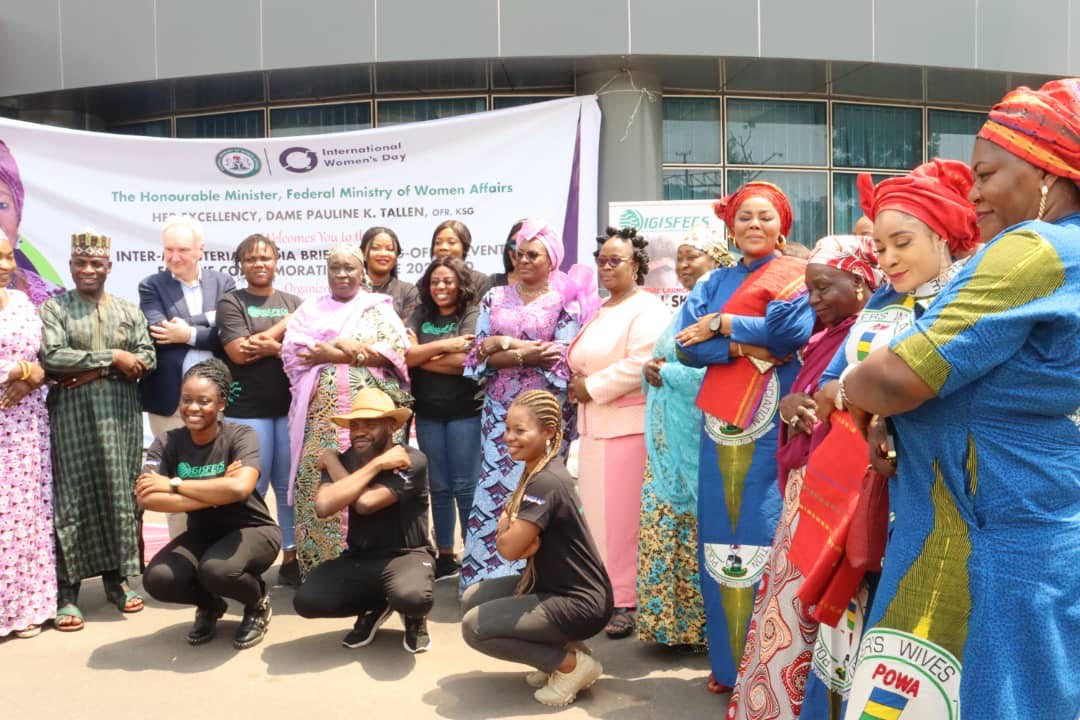
She stated this at the press briefing to usher in the 2023 Ministerial International Women’s Day (IWD), with the theme: “DigitalALL: Innovation and Technology for Gender Equality”.
The theme aligns with the priority theme for the upcoming 67th Session of the Commission on the Status of Women (CSW-67), “Innovation and technological change, and education in the digital age for achieving gender equality and the empowerment of all women and girls”.
The International Women’s Day is a Day set aside by United Nations (UN) in celebrating the historical, cultural, and political achievements of women. The day is observed in support of taking action against gender inequality around the world.
It is a day to appreciate the efforts of women in socio-economic development of the society. It is also a Day Organizations big and small comes together to show women just how valuable they are in today’s society.
According to Tallen, bringing women and other marginalized groups into technology, results in more creative solutions and has greater potential for innovations that meet women’s needs and promote gender equality.
“Their lack of inclusion, by contrast, comes with massive costs: according to the UN Women 2022 Women’s snap short report, women’s exclusion from the digital world has shaved $1 trillion from the gross domestic product of low- and middle-income countries in the last decade—a loss that will grow to $1.5 trillion by 2025 without action. Reversing this trend according to the report will require tackling the problem of online violence, which 38 per cent of women had personally experienced”, she said.
She added that a gender-responsive approach to innovation, technology and digital education can increase the awareness of women and girls regarding their rights and civic engagement. “Advancements in digital technology offer immense opportunities to address development and humanitarian challenges, and to achieve the 2030 Agenda’s Sustainable Development Goals. “Unfortunately, the opportunities of the digital revolution also present a risk of perpetuating existing patterns of gender inequality. Growing inequalities are becoming increasingly evident in the context of digital skills and access to technologies, with women being left behind as the result of this digital gender divide. The need for inclusive and transformative technology and digital education is therefore crucial for a sustainable future.”
The Minister expressed unhappiness that despite many achievements, women and girls also remain under-represented in science, technology, engineering, and mathematics (STEM) fields which she saw as male-dominated. With only 35 per cent and just 3 per cent women and girls studying information and communication technology, requires a paradigm shift in educational reforms and a long-term commitment to remove barriers.
She said: “Globally they are a minority of students in STEM education, at only 35 per cent, with just 3 per cent studying information and communication technology. This directly reflects the discrimination faced by women and girls around the world.”
Tallen said Nigeria needs educational reform, with new curricula that fosters girls’ curiosity in scientific discoveries from an early age, including science and technology subjects through primary school.
“I therefore ask that, Teachers and educational institutions be supported to consciously remove gender biases and stereotypes in our educational environments, textbooks and didactic materials. It starts with making women’s contributions to STEM visible, including through connecting young women and girls with STEM professionals and mentors.”
In his short speech, Permanent Secretary, Alhaji. Shehu Aliyu Shinkafi stressed that technology holds endless possibilities. “It has the power to expand opportunities and minds.”
The Permanent Secretary emphasized that “In our increasingly technological world, digital access, literacy and skills are imperative for everything from livelihoods to education, to participation in civic life.”
According to him, technology is increasingly being misused and weaponized, with women and girls disproportionately targeted.
The UN Women Country Representative in Nigeria and ECOWAS – Beatrice Eyong said demographics of Women and girls in digital inclusion is encouraging, noted that whilst there are many women and girls paving their way in the field of digital technology and innovation world, many continued to be excluded from significantly shaping the space because of pervasive patriarchal norms which limit women and girls access to learning and education.
She said this is why the UN is investing in providing digital solutions in agriculture, health and in the fight against gender based violence. She added that rural women can now market their products around the world without leaving their rural environment.
She said a lot can be achieved when women and girls are ICT-literate as it will fast track gender equity and equality. She mentioned that National Centre for Women Development (NCWDC) has already keyed into this, with its women empowerment training conducted online.
She disclosed that UN women trained women on how to make soap using online technology and the impact was greater than when it had physical training.
The UN Resident and Humanitarian Coordinator in Nigeria, Mathias Schmale, said using technology to promoting and advancing women causes is linked with SDGs 5 and 9, which is to achieve gender equality and empower all women and girls and build resilient infrastructure, promote sustainable industrialization and foster innovation, respectively.
He said technology can be used to improve the voting process especially for women.
The event also drew participants from Nigerian Armed Forces, Nigeria Police, Civil Defence Corps, Civil Society Organizations (CSOs), Non-Governmental Organizations (NGOs) among others.
The highpoint of the event was the announcement of ICT Training for 1500 Women and a demonstration of “Smart Bra” by “Women In ICT in Nigeria”. The innovative Bra could detect breast cancer if at early stage.
Goodwill messages came from UNFPA Rep in Nigeria, Ulla Mueller represented by Erica Goldson, as well as the DG of NITDA represented by Iklima Musa.
A minute silence was also observed in hour of women and girls who were killed in domestic violence.