Follow Us on Google
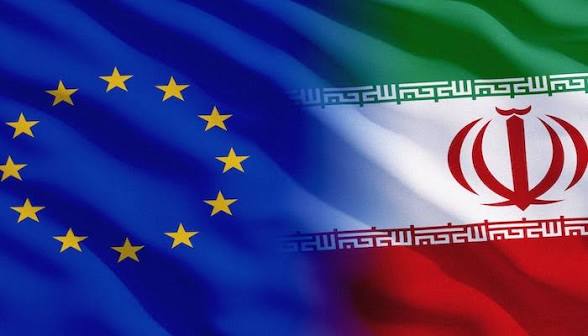
The European Union (EU) has imposed sanctions on two Iranian officials and a unit of the Islamic Revolutionary Guard Corps (IRGC), signalling a tougher response to actions that disrupted shipping activities in the Strait of Hormuz, a vital artery for global oil trade.
The sanctions, announced on Monday, are the first to be issued under the EU’s newly established freedom of navigation framework, a mechanism created to protect international shipping routes and deter actions that threaten maritime security.
In a statement, the bloc named the Hormozgan Provincial Command of the IRGC Navy, Mohammad Akbarzadeh, Deputy Commander for Political Affairs of the IRGC Navy, and Hamid Hosseini, a representative of Iran’s Oil, Gas and Petrochemical Products Exporters’ Union, as those affected by the measures.
The move follows heightened tensions in the Gulf after Iran attempted to shut down traffic through the Strait of Hormuz following the outbreak of hostilities sparked by U.S.-Israeli strikes on Iran on February 28. The development triggered concerns among major energy-consuming nations and market participants over the security of one of the world’s most critical energy corridors.
Announcing the decision in Cyprus, European Union foreign policy chief Kaja Kallas said member states agreed that the disruption of international shipping routes required a firm and coordinated response.
“Iran’s actions are unacceptable. In response, member states have approved sanctions against Iranian entities and individuals involved in disrupting transit through the Strait of Hormuz,” Kallas said.
Other News
She noted that the sanctions represent the first practical application of the EU’s freedom of navigation regime and suggested that similar measures could be deployed in future cases where international maritime trade is threatened.
The decision underscores growing concerns within Europe over the vulnerability of key global shipping routes amid rising geopolitical tensions in the Middle East. Policymakers fear that prolonged disruptions could affect energy supplies, increase transportation costs and place additional pressure on already fragile global supply chains.
The Strait of Hormuz occupies a unique position in the global energy market. Linking the Persian Gulf to international waters, the narrow passage serves as the main export route for crude oil and petroleum products from several major producing countries. Industry estimates show that about 20 per cent of global oil consumption passes through the waterway, making any disruption a matter of international economic significance.
By invoking its new sanctions mechanism, the EU is sending a clear message that threats to maritime security and the free movement of energy supplies will attract a coordinated response. The action also reflects broader efforts by Western governments to safeguard critical trade routes at a time when geopolitical tensions continue to reshape global energy and security dynamics.
While the sanctions are unlikely to immediately ease tensions between Iran and Western powers, they reinforce the strategic importance of keeping the Strait of Hormuz open and underscore the determination of major economies to protect the uninterrupted flow of global trade and energy supplies.