Follow Us on Google
From Fred Ezeh, Abuja
The European Union (EU) has called on the Ministries, Departments, and Agencies (MDAs) of the Federal Government to commit to the full implementation of the provisions of the National Disability Act.
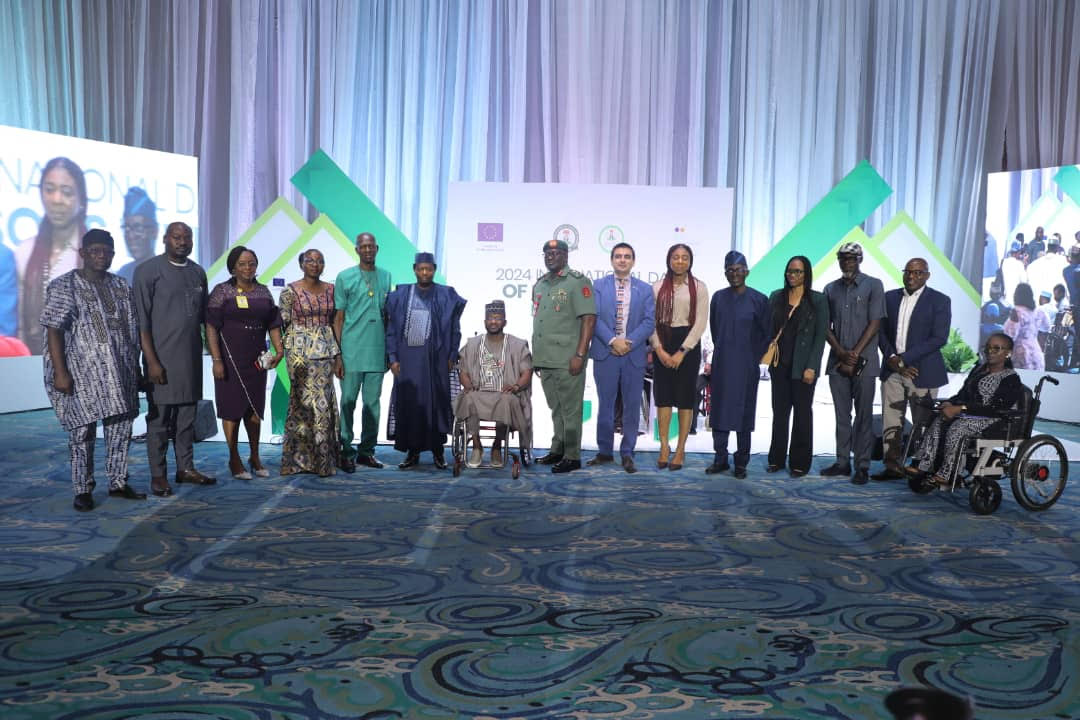
The call was made by Gautier Mignot, EU’s Ambassador-designate to Nigeria and ECOWAS, during a national dialogue held in Abuja to mark this year’s International Day of Persons with Disabilities.
The event, themed “Transformative Solutions to Disability-Inclusive Development in Nigeria,” was organised by the National Commission for Persons with Disabilities (NCPWD) and the Federal Ministry of Humanitarian Affairs and Poverty Alleviation, with EU support through the Rule of Law and Anti-Corruption (RoLAC) Programme, implemented by the International Institute for Democracy and Electoral Assistance (International IDEA).
The EU Ambassador, who was represented by Ruben Alba Aguilera, Head of the Governance, Security, and Migration Section at the EU Delegation to Nigeria and ECOWAS, emphasised that while the Act outlines comprehensive policies and practices to accommodate and empower persons with disabilities, fostering an inclusive environment that values diversity and promotes social equity, its impact remains null without effective implementation.
Though he expressed concern over the exclusion of persons with disabilities in development planning, he urged all levels of government and relevant stakeholders to allocate adequate resources to ensure the Act’s full implementation.
He said: “People with disabilities are being left behind in development. Inclusion is affirmed in the UN Convention on the Rights of Persons with Disabilities, but many interventions still fail to include people with disabilities.
“Societal barriers continue to place them at increased risk of violence, poverty, poorer health outcomes, and limited access to education and employment opportunities. This is not inevitable, and we must be deliberate about ensuring disability inclusion.”
Other News
Aguilera highlighted that over 35 million Nigerians live with disabilities, with 9 out of 10 living below the poverty line. “These individuals face daily struggles, and it is our collective responsibility to address their challenges,” he said.
While commending the government for passing the Disability Rights Law and establishing the National Commission for Persons with Disabilities (NCPWD), Aguilera stressed the need for swift implementation. “A law is only as effective as its implementation. We cannot rest on our laurels; it is time to act and dedicate sufficient resources to make this law effective,” he stated.
Prof. Nentawe Yilwatda, Minister of Humanitarian Affairs and Poverty Reduction, who was represented by Sunday Hezekiah, Director of the Special Needs Department, reiterated the need for an inclusive society and highlighted funding challenges for disability-related projects.
“While the Act mandates education, welfare, and other provisions for persons with disabilities, resources allocated by the National Assembly remain grossly inadequate,” he noted.
Chief Ayuba Gufwan, Executive Secretary of NCPWD, called for greater leadership and accountability in disability inclusion. “Today is a day for stocktaking: where are we coming from, where are we now, and where are we heading?” he asked.
Hon. Abba Isa, Senior Special Assistant to the President on Special Needs and Equal Opportunities, urged collaboration among policymakers, civil society organisations, and development partners to promote disability-inclusive development. “Awareness is key,” he said. “Ignorance of the law is no excuse; we must act now.”
Danladi Plang, Head of Programme for the RoLAC Programme, echoed the importance of inclusion. “Sustainable development cannot be achieved without integrating the needs of persons with disabilities in planning and programming,” he said.