Follow Us on Google
From Jude Chinedu, Enugu
Environmental rights activists have raised concerns that over 70 years of coal mining in Enugu State have brought little to no benefit to the miners, their families, or the local economy.
They argue that these decades of exploitation have left behind a legacy of environmental degradation and socioeconomic challenges.
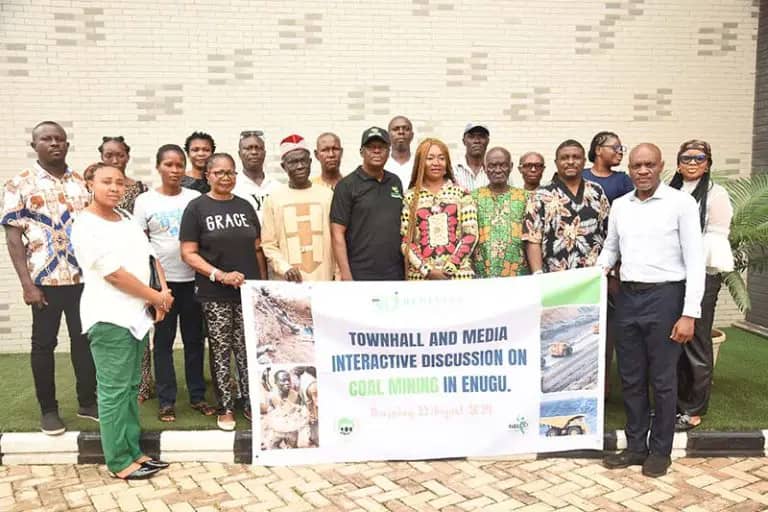
During a recent media interactive and town hall meeting organized by the Renevlyn Development Initiative (RDI), in collaboration with local partners such as the New Life Community Care Initiative (NELCCI), Neighborhood Environmental Watch (NEW) Foundation, Community Development Advocacy Foundation (CODAF), and Environmental Defenders Network (EDEN), the activists called on the Enugu State Government to champion a just energy transition that respects both the people and the environment.
The Executive Director of RDI, Philip Jakpor highlighted the negative consequences of coal mining, attributing them to a series of dubious dealings that ultimately led the Enugu State government to ban illegal mining activities in June 2023. Jakpor criticized coal mining as a “disinvestment” to local communities rather than an asset.
“While the ban on illegal mining was a positive step, we had hoped that the state government would collaborate with the Federal Government to conduct a comprehensive environmental audit. This would help ascertain the true health of the bedrock and ensure it continues to support life in Enugu. There are fears that due to the extensive underground mining, Enugu could be sitting on a ticking time bomb.”
Jakpor also expressed concerns about the state government’s actions, which appear to be geared toward resuming mining activities.
“The announcement by the Enugu State Government setting December as the deadline for mineral title holders to commence coal mining operations supports our fears. Locals have reported incidents of earth collapsing during farming, open pits, polluted groundwater, and communities being overrun by herdsmen, displacing the original landowners.”
Also, Jakpor raised suspicions about ongoing coal extraction activities, alleging that trucks laden with coal are seen leaving Enugu daily, without clear documentation.
The activists outlined several recommendations for the authorities: The Federal Government should initiate a comprehensive audit of post-coal mining activities in Enugu.
They urged the “decommissioning of abandoned coal mines to prevent further environmental degradation and potential loss of human life. Proper profiling and compensation should be provided for former miners or, if deceased, their families. There should be regular updates to Enugu citizens on the state of coal mining activities, and public disclosure of the Environmental Impact Assessment (EIA) conducted by selected firms.
Additionally, they called for transparency regarding any agreements between mining companies and the communities and urged clarification of the Enugu State Government’s role in coal extraction—whether it is merely a spectator, a collaborator, or if only certain government officials are involved.
They also recommended exploring renewable energy sources and supporting mining communities to form networks for sharing ideas, environmental monitoring, and reporting unsustainable practices by mining firms.
Afulike Okezie, Project Officer of NEW Foundation, stressed the broader implications of coal mining, stating, “We are dealing with an issue that affects not just the economy but the health and well-being of our communities and the sustainability of our environment. While historically significant, coal mining has left a complex legacy of both opportunities and challenges.”
Echoing these sentiments, Barrister Chima Williams, Executive Director of EDEN, urged government officials to consider the human impact. “Those in power must remember that they are responsible for managing resources that sustain our lives. The decommissioning of abandoned coal mines is not optional but essential.”
Ubrei Joe-Mariere, Director of Campaigns and Administration at CODAF, argued against further coal mining, especially given the global shift towards clean energy.
“Coal mining disrupts the social and economic lives of local communities and is a major cause of landslides and erosion. Large-scale mining primarily benefits multinational corporations, while the relationship between these firms and the communities they operate in is often strained.”