Follow Us on Google
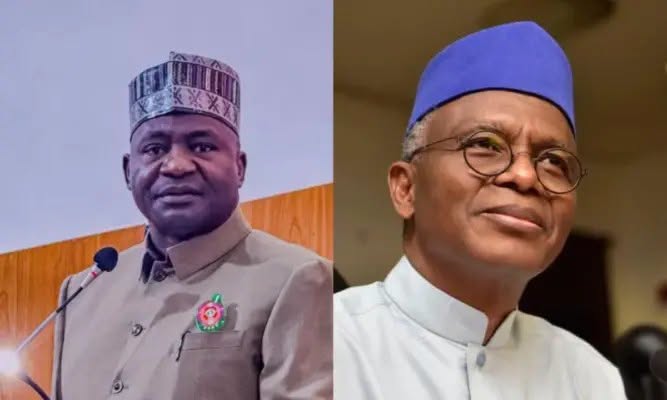
• APC chieftain: Musa’s remarks not about religion, Southern Kaduna alone
By Philip Nwosu and Paul Orude, Bauchi
The family of former Kaduna State governor, Nasir El-Rufai, has given Minister of Defence, Gen. Christopher Musa (retd.), seven days to substantiate his allegation that the former governor “deliberately planned” the killing of people in Southern Kaduna or publicly retract the claim and apologise.
But as the controversy over Musa’s remarks deepened, a chieftain of the All Progressives Congress (APC) in Bauchi State, Khamis Musa Darazo, has cautioned against giving the minister’s comments a religious or sectional interpretation, arguing that grievances against El-Rufai’s administration extended beyond Southern Kaduna.
The ultimatum followed Musa’s remarks during an appearance on a live television show where he claimed that El-Rufai’s eight-year administration, deepened divisions in Kaduna. He linked his policies to the security crisis that ravaged parts of the state.
In a statement issued on behalf of the former governor by his eldest son, Mohammed Bello El-Rufai, the family described the allegation as grave and unsubstantiated, insisting that an accusation of deliberate involvement in killings must be backed by evidence. He said “While General Musa (retd.) is entitled to hold and express his personal opinions, the El-Rufai family is equally entitled to demand that such serious allegations be substantiated with credible evidence.”
The family demanded that the minister either produce evidence to support his allegation or withdraw it through the same medium on which it was made. “Accordingly, General Musa (retd) is hereby given seven (7) days from the date of this statement to either provide evidence in support of his allegation or issue a full public retraction and apology.”
It warned that failure to comply would leave the family with “no option but to pursue all appropriate legal remedies available under the law.”
Musa, who hails from Southern Kaduna, had described the atmosphere in Kaduna under El-Rufai, who governed from 2015 to 2023, as “toxic”, accusing the former governor of pursuing policies that widened divisions in the state.
Asked whether people in Southern Kaduna remained unhappy with El-Rufai, Musa said: “If there is anything worse than unhappy, that’s it. We can never be happy with somebody who deliberately planned for the killing of our people.”
Pressed on the gravity of the allegation, the minister reportedly referred to past statements and videos involving El-Rufai, including the controversy over payments made in attempts to end cycles of violence involving herders.
However, Darazo, a supporter of President Bola Tinubu, said attempts to interpret Musa’s reference to “our people” as applying exclusively to Southern Kaduna or Christians distorted the wider context of the minister’s remarks.
“The reality is that the grievances surrounding El-Rufai’s style of governance were felt across Kaduna State and not exclusively by the people of Southern Kaduna,” Darazo told journalists in Bauchi.
He also rejected suggestions that Musa’s criticism was motivated by religion.
“The Minister did not call out Nasiru El-Rufai because he is a Muslim. That interpretation is completely misplaced.
“President Bola Ahmed Tinubu and Governor Uba Sani are both Muslims, yet both have continued to demonstrate efforts towards reducing division and promoting unity,” he said.
Other News
Darazo said Musa’s reference to “our people” should be understood as encompassing Kaduna residents generally.
“Our people can never mean only Southern Kaduna. It means the people of Kaduna State as a whole.
“Different communities experienced different challenges, and it is unfair to erase the experiences of others by presenting the matter as though it concerned only one section of the state,” he said.
The controversy has revived memories of one of the most turbulent periods of El-Rufai’s governorship, when repeated communal and armed attacks in Southern Kaduna triggered national outrage and fierce debate over the state government’s response.
In late 2016 and early 2017, killings across communities in the area generated criticism of the administration’s handling of the crisis. The Catholic Diocese of Kafanchan said at the time that its records showed 808 people were killed between 2011 and 2016, a figure disputed by government and security authorities.
El-Rufai’s approach attracted further controversy after his government acknowledged reaching out to some Fulani communities outside Nigeria in an attempt to halt what it described as reprisal attacks. Reports that compensation was paid to some herders became a major point of contention.
Gen. Martin Luther Agwai (retd), who headed a committee that examined the crisis, later said the panel recommended dialogue and compensation for all aggrieved parties rather than any single group.
The Southern Kaduna Peoples’ Union (SOKAPU) also repeatedly accused El-Rufai’s administration of failing to adequately protect communities.
The former governor, however, consistently rejected allegations that his administration encouraged the violence. He maintained that the crisis predated his government and blamed the failure of successive administrations to implement recommendations of previous commissions of inquiry for allowing the cycle of violence to persist.
His administration said it pursued dialogue and reconciliation, increased security deployments and sought the prosecution of suspected attackers. El-Rufai also said in 2017 that those behind the killings were being tracked and would face prosecution.
Musa, in his television appearance, contrasted El-Rufai’s tenure with that of Governor Uba Sani, arguing that the incumbent had taken steps to heal divisions and give different sections of Kaduna a greater sense of belonging.
Darazo similarly urged Nigerians not to turn the dispute into a religious or regional confrontation, saying the focus should remain on governance, peace and security.
“Kaduna belongs to all its people, and no community should be made to feel that its experience does not matter,” he said.
The exchange comes against the backdrop of El-Rufai’s estrangement from the APC and his emergence as a prominent figure in the opposition African Democratic Congress (ADC), adding a political dimension to a controversy now threatening to move from public debate to the courtroom.