Follow Us on Google
From Isaac Anumihe, Abuja
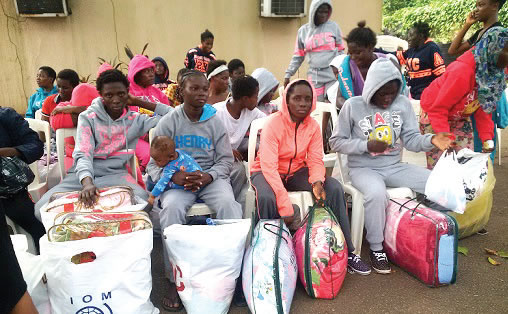
As Nigerians are being evacuated from different parts of the world including Sudan, the National Bureau of Statistics (NBS), said that Edo State recorded 52.4 per cent of returned migrants.
In a survey conducted by NBS, even in the face of extreme hardship suffered in the course of their migration, the returned migrants would want to travel back despite the risk.
The report which was obtained from the bureau’s website, revealed also that 68.2 per cent of the rural households send their children or wards to almajiri, out of which 98.6 per cent were sent to acquire quranic education and religious morals. Similarly, 47.7 per cent of the households who give out their members as house help do that to earn a living.
“In general, the key findings of the study revealed that the average age of the respondents is 27 years and about 60.1 per cent of them are from the urban area and 51.8 per cent have attended secondary education.
“The study further shows that about 24.9 per cent of the respondents indicated business as a reason for travelling abroad. However, 47.9 per cent gave hardship as the major reason for the return of migrants. Kano State recorded 39.0 per cent which is the highest number of returnees from abroad and 31.8 per cent agreed to detention as the major risk suffered by the returned migrants among others. The Edo state recorded 52.4 per cent of returned migrants who would want to travel back despite the risk suffered during their journey” NBS said.
Explaining why the survey was carried out, the statistics agency said that it was to showcase the dangers of irregular migration as well as government efforts towards combating the prevalence of irregular migration in Nigeria.
“The purpose of this study is to collect data and provide evidence on the awareness and perception of intending and returned migrants on the dangers of irregular migration as well as government efforts towards combating the prevalence of irregular migration in Nigeria. This evidence is expected to provide a database for policy formulation in line with the increasing demand for data-driving human development initiatives. Although irregular migration is mainly a political issue, but like the Almajiri and househelps phenomena, it is also a humanitarian question due to its intricate linkage with vulnerability. Therefore, the 2022 migration survey expanded its focus to cover the two other vulnerable groups namely, almajiri and househelps.
“It is expected that the insights provided in this study would enable policymakers to target interventions that address humanitarian needs and mitigate root causes of irregular movement across international borders as well as the state of almajiri and househelps. The survey data was collected through the system of National Integrated Survey for Households (NISH) which provided direct interactions with eligible respondents at the households with the help of questionnaires. A total of 2,400 households were sampled from six purposive states from each geopolitical zone, namely: Anambra, Edo, Lagos, Benue, Gombe, and Kano,” NBS, said.