Follow Us on Google
Governor Hope Uzodimma of Imo State held his audience spellbound. His eloquent and brilliant delivery of the keynote speech at the opening ceremony of the just-concluded All Nigerian Editors Conference (ANEC) gave me more goose pimples than the freezing air conditioning system in the Banquet Hall of the Presidential Villa, Abuja.
Nevertheless, I had thought that the governor would make atonement for the sins Nigerian politicians always commit during elections. He did not. Rather, he smartly attempted to turn the narrative against editors. Well, the theme of the conference, “Democratic Governance and National Cohesion: The Role of Editors”, gave room for that. The sub-theme was “Electoral Integrity and Trust Deficit: What Nigerians Expect in 2027”. Uzodimma titled his topic “2027: Editors as Catalysts of Democracy, National Cohesion, and Electoral Integrity”.
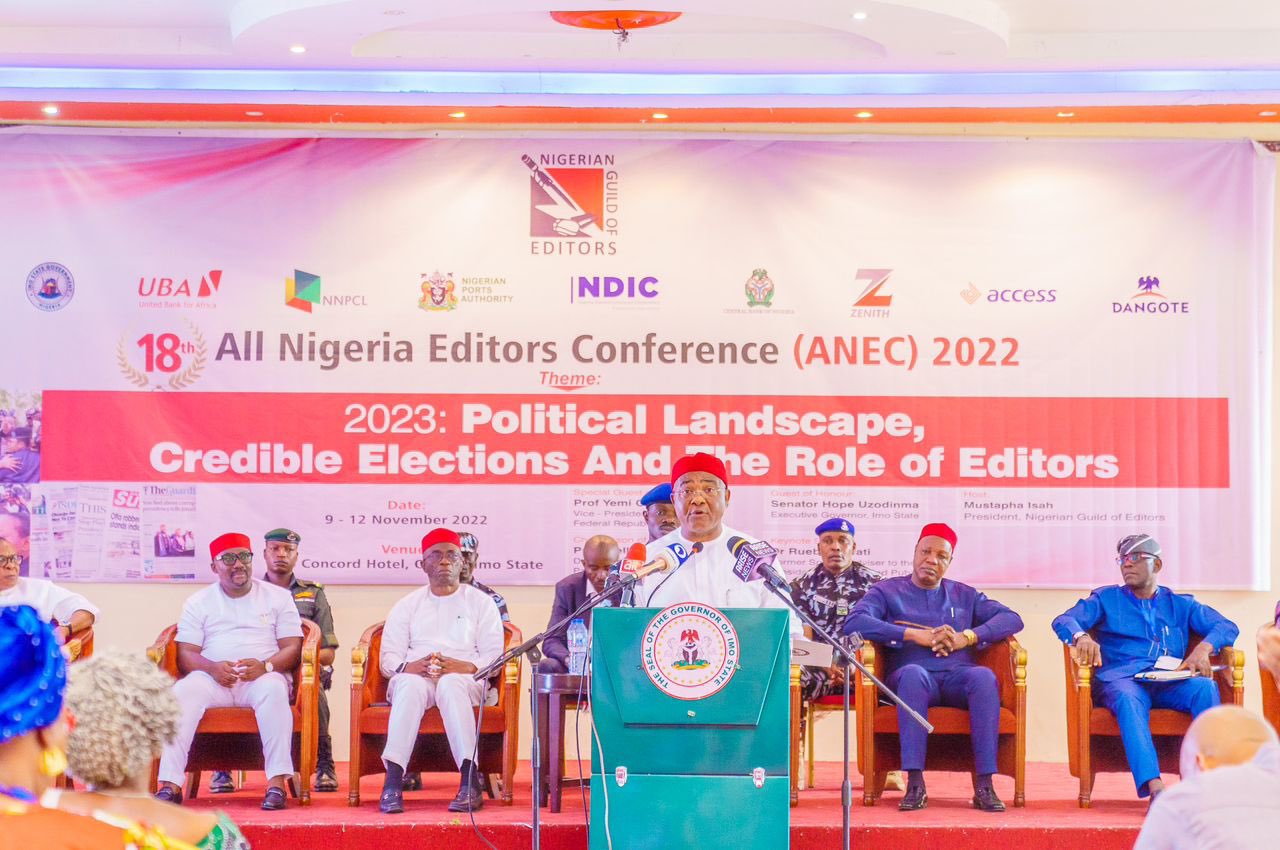
According to him, the role of editors as facilitators, amplifiers or catalysts is key to the success or otherwise of the 2027 election. “Your reports and comments paint a picture of tomorrow. Therefore, the picture you paint of 2027 is what Nigerians should expect,” he said. This is true to some extent.
For the 2023 elections, Uzodimma’s verdict is that the performance of the media was below expectations. “Under the guise of calling the election results based on returns from a few polling units, the credibility of the election was undermined. The people were lured by such reports to believe that the election was not free, fair and credible,” he said.
Pray, was the 2023 election free and credible? When Uzodimma said editors “feed polarization when they choose narratives that amplify division because division drives sales,” what does he mean? Could the media have suppressed news of the rants of ethnic bigots in high places who disparaged and threatened a section of the country because of election?
Journalists only mirror the society. They do not manufacture news. They wouldn’t have reported that the 2023 general election, for instance, was seamless and credible when it was not. They will not report that 2027 elections will be wonderful and transparent when there are no signs to that effect.
Editors cannot close their eyes when ballot boxes are snatched. They cannot pretend that all is well if suspicious technical glitches cripple the collation of election results. They cannot say that our elections have integrity when the majority of the electorate cannot exercise their franchise due to intimidation, harassment and some other electoral malpractices.
In the 2023 general election, over 93 million people registered to vote. But only 25 million, representing about 27 per cent, actually voted in the presidential poll. Many had come out to vote. But they were intimidated and chased away from the polling stations. Some voted, but their votes did not count because of the manipulation of the rigging machine.
Our politicians have no shame. They cause confusion in the electoral process and look for scapegoats to carry the can of their perfidy.
It cuts across many countries in Africa. Take Tanzania, for instance. That country used to be a beacon of stability and true democracy in Africa. But in the recent election held on October 29, 2025, the ruling Chama Cha Mapinduzi party recorded a tainted and questionable landslide victory. President Samia Suluhu Hassan got 97.66 per cent of the vote to secure her second-term mandate of five years. She first came to power in 2021 following the death in office of her predecessor, John Magufuli.
Meanwhile, this was an election where two key opposition figures were barred from contesting. Tundu Lissu, the leader of the main opposition party, Chadema, was not only arrested and charged with treason and cybercrime offences, his party was also disqualified from participating. Another opposition candidate, Luhaga Mpina, was also barred from contesting.
When the citizens protested the shenanigans, the police clamped down on them. Hundreds of them were reportedly killed. There were reports that the death toll could be over 1,000. More than 200 people were reportedly charged with treason and other protest-related offences.
In Cameroon, it was the same story. The 92-year-old Paul Biya was recently returned for his eighth consecutive term as President. The election, held on October 12 this year, saw the ruling party bulldozing its way to the presidency. Protests by the people against the outcome of the election were suppressed. Some protesters were even killed.
Other News
In Cote D’Ivoire, President Alassane Ouattara appeared to have read Biya’s book on how to manipulate the political and electoral system to win elections. He also dealt with the opposition and grabbed power in a contest that lacked fairness and credibility. Ouattara’s two main challengers: former President Laurent Gbagbo and Credit Suisse ex-CEO, Tidjane Thiam, were disqualified from the contest. He is now enjoying his fourth term in office.
For us in Nigeria, the 2027 elections appear primed to follow similar trends in some of these African countries. While the ruling All Progressives Congress (APC) has continued to welcome defectors, the opposition parties are systematically being decimated. The main opposition party, the Peoples Democratic Party (PDP), is the worst hit. Seen and unseen hands have laid landmines along its route to cohesion. The party is factionalised, with one faction led by Nyesom Wike, the Minister of the Federal Capital Territory (FCT). Wike is PDP in body but APC in soul. Belatedly, the PDP just expelled him and some others for anti-party activities at its recently held national convention in Ibadan.
Our smart politicians are now sowing the seed of rigging in the 2027 elections. With the PDP practically dead, the Labour Party factionalised and the African Democratic Congress (ADC) not finding its feet yet, the 2027 poll appears to be heading for a pre-determined outcome.
So far, it is not certain where Peter Obi, who embodies the hopes of many youths and some other Nigerians, will anchor his presidential ambition. He contested on the platform of the Labour Party in 2023. Today, that party is in a coma. In the ADC, Atiku Abubakar does not want to let go. He insists on contesting the presidency rather than stepping down for Obi. This will throw a spanner in the works for the opposition.
On the second day of the editors’ conference in Abuja, Obi gave his own perspective on the political landscape in Nigeria. According to him, Nigeria stands at a most critical crossroads today. He said, “Just two weeks ago, the President of the United States, Donald Trump, made a comment on social media referring to Nigeria as a ‘now disgraced country.’ He singled out the killings in our land without compunction, but in truth, he was merely echoing what many Nigerians of good conscience have been saying for years – often at the risk of being accused of de-marketing their own country. The reality is stark: Nigeria is facing existential challenges that demand our sober reflection.”
He said our disgrace was not defined by what others said, but by what we allowed to persist in our society. The path to national restoration, he added, was for us to search for the reasons for our afflictions and begin to confront them with honesty and courage.
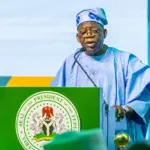
President Bola Tinubu alluded to this point when he highlighted what should be the role of editors in his opening remarks at the editors’ conference. According to him, throughout our history, journalism in Nigeria has been an instrument of national awakening.
“From the early newspapers that challenged colonial injustice to the principled voices that kept hope alive during the dark days of military dictatorship, the Nigerian press has stood at critical points in our nationhood to defend reason, dignity and progress. Many journalists endured intimidation, detention, and personal hardship in defence of the public good. Their sacrifices are part of the foundation upon which our democracy rests today. We honour them not only in memory but also by remaining committed to the values they upheld,” Tinubu said.
What are these values? They include truth, courage, transparency, objectivity, and holding government to account. Journalists are not trained to suppress news. They are taught to highlight it; to expose the best and the worst in our society. That is their own way of protecting national interests. .
Rather than pass the buck to editors, Uzodimma and co. should move for political and electoral reforms if they are serious about holding credible and transparent elections in 2027. They should ensure that electronic voting and electronic transmission of election results are made compulsory before the 2027 elections. They must give the Independent National Electoral Commission (INEC) true independence to conduct elections. They should also heed the calls for restructuring, especially devolution of powers. This will reduce the over-centralization of power at the centre and the attendant struggles by greedy politicians to grab power at all costs.
Beyond the editors, there are bloggers and sundry social media warriors who also witness what goes on in the name of elections in Nigeria. Even if editors of the traditional media withhold certain information, these citizen journalists will not.
Editors worth their salt will not even close their eyes to corruption and electoral malpractices. They will not fail to expose such issues as bribery, vote buying, intimidation of voters, and manipulation of election results.
Our greedy politicians are the ones who recruit thugs; bribe some security agents, voters, INEC officials, and judges. They should learn to behave themselves. That is the major route to electoral integrity in Nigeria, nay Africa.