Follow Us on Google
From Juliana Taiwo-Obalonye, Abuja
President Bola Tinubu has described the inauguration of the Economic Community of West African States (ECOWAS) new headquarters in Abuja as a symbol of “renewal, resilience and confidence” and urged member states to move beyond treating ECOWAS as primarily a market toward making it a regional production base.
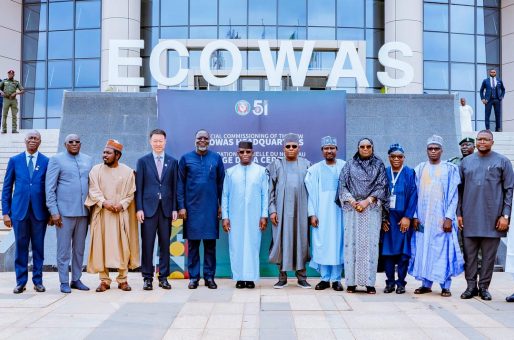
Speaking at the commissioning ceremony, Tinubu said the new complex, dubbed the “Eye of Africa,” renews the bloc’s covenant with integration, solidarity and shared prosperity that inspired ECOWAS more than five decades ago.
“Today marks not only the inauguration of an impressive landmark, but the renewal of a covenant, our covenant with the ideals of regional integration, solidarity and shared prosperity,” President Tinubu said in remarks read on his behalf by Vice President Kashim Shettima.
While praising ECOWAS as one of the world’s most respected regional economic communities for its progress in peace building, democratic governance and free movement, he warned that the region still faces serious threats: terrorism, violent extremism, economic vulnerability, food insecurity, climate change and public health challenges — all compounded by youthful demographic pressures.
“The hour has come to transform our regional market into a regional production base,” Tinubu said. “Our integration must increasingly be driven by what we produce rather than by what we consume, for a Community that consumes what it does not make will forever live at the mercy of the goodwill of others.”
He outlined a future agenda for ECOWAS focused on deeper industrialisation, stronger regional value chains, expanded intra regional trade, innovation, manufacturing and investment.
Other News
Addressing recent withdrawals of three member states from the bloc, the President said the crisis has shown that integration can no longer be seen only through an economic lens. “Regional integration can no longer be an economic imperative alone. It has become a comprehensive framework for our collective security, our political stability, our sustainable development and the welfare of our peoples,” he said, urging renewed dialogue and solidarity while keeping the door open to countries that have chosen to stand apart.
President Tinubu also commended Sierra Leonean President Julius Maada Bio, who chairs the ECOWAS Authority of Heads of State and Government, for steady leadership. He congratulated the ECOWAS Commission’s management for delivering the project and thanked the Government of the People’s Republic of China for financing the building, alongside contractors and local partners.
“May every decision taken within these walls advance the peace, the unity, the prosperity, and the dignity of the peoples of West Africa,” he said.
President Bio said the new headquarters offers member states an opportunity to renew their collective promise to some 450 million West Africans and to build a more effective regional body. “History does not remember generations for the buildings they construct, but for the lives they transform,” he said, praising Nigeria as “a great anchor” of ECOWAS and thanking China for the “generous donation.”
ECOWAS Commission President Omar Touray expressed gratitude to China and called the monument a symbol of regional partnership and an institutional centre for ECOWAS’s expanding mandate. “We are mindful of the task ahead and our collective responsibility of ensuring that the new headquarters serve as a centre of regional transformation and social stability,” he said.
China’s Ambassador to Nigeria and ECOWAS, Yu Dunhai, extended congratulations to West African leaders and peoples and described the inauguration as “another milestone in China’s commitment to Africa’s integration,” stressing that the partnership will rest on mutual trust and pragmatic cooperation that supports Africa’s autonomous development choices.
The new ECOWAS complex in Abuja, built with financial support from the Chinese government and constructed by Shaanxi Construction Engineering Group Company Limited, aims to centralise the bloc’s activities and provide a visible hub for diplomacy, coordination and regional policymaking.