Follow Us on Google

• Quarantined contacts get N100,000 weekly stipend Rivers suspected case tests negative
From Fred Ezeh, Abuja and Doris Obinna, Lagos
The number of persons placed under surveillance following Nigeria’s first confirmed Ebola case in the Federal Capital Territory (FCT) has risen from 44 to 53, prompting intensified contact tracing, tighter surveillance at Lagos airports and heightened emergency preparedness in hospitals across the country.
As part of measures to contain the infection, the Federal Government has also introduced a weekly stipend of N100,000 for individuals placed in isolation or quarantine, while the Nigeria Centre for Disease Control and Prevention (NCDC) confirmed that a suspected case reported in Rivers State had tested negative.
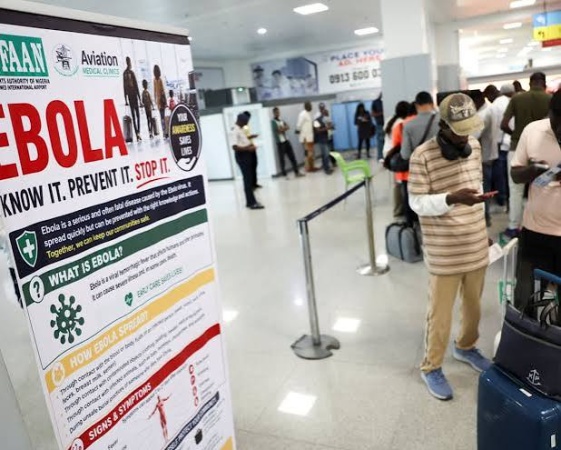
Lagos State Government, meanwhile, has stepped up passenger screening at the Murtala Muhammed International Airport and strengthened surveillance across health facilities, assuring residents that no suspected Ebola case had been recorded in the state.
The developments followed confirmation of an imported case of the Ebola Bundibugyo virus involving a 42-year-old woman who returned to Nigeria from Uganda through Addis Ababa on October 3.
Speaking at a press conference on Sunday, NCDC Director-General, Jide Idris, disclosed that nine additional contacts had been identified since the previous update, bringing the total number of persons requiring monitoring to 53.
He explained that the increase did not represent additional confirmed infections but reflected the continuing investigation into persons who might have been exposed to the patient.
“The monitoring period is 21 days after the last possible exposure. The contacts identified so far include people whose links to the confirmed case require assessment, such as healthcare workers, patients, caregivers, household members and other individuals who may have come into contact with the patient,” he said.
Idris stressed that contact tracing remained critical to preventing further transmission, as it enabled health authorities to identify potentially exposed persons, monitor their health and promptly investigate any symptoms consistent with Ebola.
He appealed to those identified during the exercise to cooperate fully with surveillance teams, disclose relevant information about their movements and possible exposure, and comply with public health instructions.
The NCDC chief also disclosed that the government had introduced emergency financial support for persons placed in isolation or quarantine following complaints about the economic burden associated with the containment measures.
According to him, some affected individuals had expressed concerns about feeding, accommodation and the welfare of their families while complying with restrictions imposed by health authorities.
“We are paying for their accommodation; we are paying for their feeding. Some of them are asking for a stipend to maintain their families. We are providing N100,000 per person per week just to maintain their comfort and feeding, because they were complaining,” he said.
Idris explained that the financial intervention was not originally included in the emergency response plan but became necessary to address the difficulties encountered by those affected.
He said the arrangement would be reviewed as the response progressed, adding that the government’s priority was to encourage compliance with isolation and quarantine requirements without exposing affected persons and their families to unnecessary hardship.
The NCDC Director-General warned that reluctance to disclose possible exposure or cooperate with health officials could undermine the containment effort and increase the possibility of undetected transmission.
Giving further details of the confirmed case, he said the patient developed symptoms on October 7 and subsequently sought treatment at private health facilities before the NCDC was notified on October 19.
Laboratory confirmation was obtained on October 20, following which the national emergency response was intensified.
The woman, who remains in isolation and is receiving treatment, has reportedly shown remarkable clinical improvement.
Idris said the recognition of the patient’s symptoms by healthcare workers and the activation of event-based surveillance were instrumental in identifying the infection and initiating the investigation.
He disclosed that experienced clinicians and case managers, including personnel involved in Nigeria’s 2014 Ebola response, had been mobilised to strengthen clinical management and infection prevention procedures.
The University of Abuja Teaching Hospital has been assessed as an isolation and treatment centre, while efforts are underway to strengthen isolation capacity at Karu General Hospital.
The NCDC and the African Centre of Excellence for Genomics of Infectious Diseases (ACEGID) have also completed phylogenetic sequencing as part of the investigation, while 500 donated laboratory testing kits have been added to the country’s stockpile.
Idris said the Federal Ministry of Health and Social Welfare, FCT health authorities, relevant government agencies and development partners were working together to improve surveillance, laboratory testing, patient management and public communication.
Against the backdrop of the confirmed infection in Abuja, Lagos State Government said it had intensified surveillance and screening at major entry points, particularly the Murtala Muhammed International Airport.
Other News
Commissioner for Health, Akin Abayomi, said the state had engaged airport management, Port Health Services and other aviation and public health stakeholders to strengthen passenger screening, information sharing, infection prevention and emergency response coordination.
He assured residents that no suspected Ebola case had been recorded in Lagos but cautioned that the absence of a case should not encourage complacency.
According to him, the government is reinforcing disease surveillance, public enlightenment and the preparedness of healthcare facilities to identify and respond promptly to any suspected infection.
Abayomi explained that Ebola is a severe and potentially fatal disease transmitted through direct contact with the blood and other body fluids of infected symptomatic persons, contaminated materials and infected animals.
He listed symptoms as fever, severe weakness, headache, muscle pain, sore throat, vomiting, diarrhoea and abdominal pain, noting that unexplained bleeding or bruising could occur in some patients.
The commissioner warned that the early symptoms of Ebola could resemble malaria and other common illnesses, making prompt medical assessment particularly important.
He advised persons experiencing fever to undergo a malaria rapid diagnostic test before taking antimalarial medication, adding that those who tested negative should seek further medical evaluation.
Travellers arriving from countries or areas experiencing Ebola transmission were also urged to cooperate with Port Health Services, provide accurate travel and health information and comply with screening and other public health requirements.
Abayomi said the state would continue to strengthen coordination with federal health authorities and other relevant agencies to ensure that suspicious symptoms or possible exposure were investigated without delay.
He urged residents to maintain proper hand hygiene, avoid direct contact with the body fluids of sick persons and stay away from sick or dead wild animals.
Anyone who suspects exposure to Ebola was advised to contact health authorities for guidance before visiting a healthcare facility to enable appropriate precautions to be arranged.
Residents can report suspected cases or exposure concerns through the Lagos emergency numbers, 112 or 767, or contact the Directorate of Epidemiology, Biosecurity and Global Health on 0802 316 9485.
Meanwhile, the NCDC has confirmed that a suspected Ebola case reported in Rivers State on October 23 tested negative following laboratory investigation.
The agency said the negative result underscored the importance of prompt reporting and testing, explaining that symptoms suggestive of Ebola could also be associated with other diseases.
It urged Nigerians not to mistake suspected infections for confirmed cases, stressing that surveillance must remain active across the country regardless of where the first confirmed infection was detected.
As part of nationwide preparedness, the agency directed hospitals and other healthcare facilities to strengthen screening and triage procedures, establish or prepare isolation areas and strictly enforce infection prevention and control measures.
Particular attention, it said, must be paid to hand hygiene, environmental cleaning, injection safety, sharps disposal, medical waste management and the proper availability and use of personal protective equipment.
Healthcare workers were also advised to isolate and report suspected cases immediately rather than delay necessary precautions while awaiting laboratory confirmation.
The agency warned that failure to recognise suspicious symptoms or observe infection prevention procedures could expose healthcare workers, patients and other hospital users to unnecessary risks.
Idris also expressed concern about misinformation and stigma, warning that unverified reports could discourage persons with symptoms or possible exposure from seeking medical attention or cooperating with contact tracers.
He urged Nigerians to rely on verified information from government and public health authorities and refrain from circulating alarming or misleading messages on social media.
Recalling Nigeria’s successful containment of the 2014 Ebola outbreak, the NCDC said early detection, rapid contact tracing, effective isolation, coordinated response and public cooperation remained essential to preventing widespread transmission.
With 53 contacts now under monitoring, the agency said its immediate priority was to identify any additional exposed persons, complete the mandatory 21-day monitoring period and ensure that suspected infections were promptly investigated.
It assured Nigerians that further updates would be provided as investigations progressed, while urging residents across the country to remain vigilant without giving in to panic.