Follow Us on Google
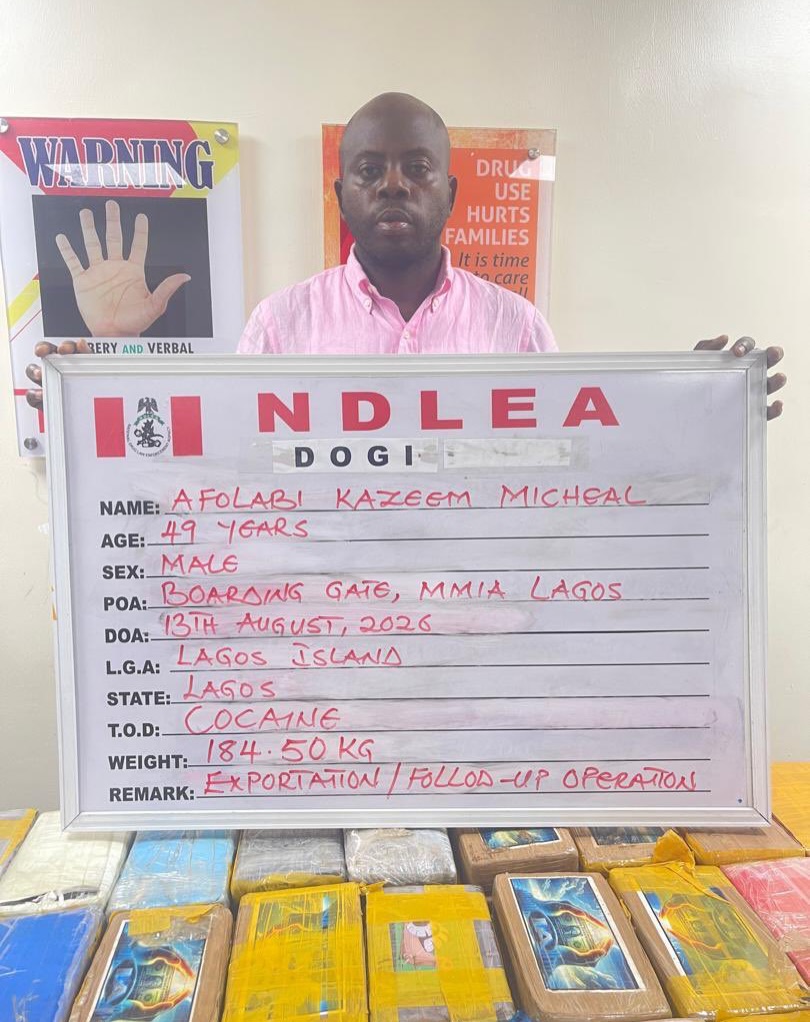
Conflicting court orders have emerged over the continued detention of Lagos social media influencer and businessman Afolabi Michael Kazeem, popularly known as KC Luxury, following his arrest by operatives of the National Drug Law Enforcement Agency (NDLEA) over an alleged cocaine trafficking investigation.
While an order issued by the Federal High Court sitting in Lagos on August 20, 2026, authorised the NDLEA to extend Kazeem’s detention for 30 days and granted an interim order preserving funds in his Providus Bank account and other BVN-linked accounts, another Federal High Court sitting in Lagos has also directed the agency to produce him in court and respond to his fundamental rights challenge.
The apparent contradiction has thrown fresh legal uncertainty into the case, with the two proceedings raising different questions over the legality of Kazeem’s continued detention.
In the first proceeding, Suit No. FHC/LAG/MISC/1199/2026, the Federal Republic of Nigeria, through the NDLEA, sought judicial authorisation to extend Kazeem’s detention after he was allegedly implicated in the seizure of 184.5 kilogrammes of cocaine at the DHL/NAHCO premises in Ikeja, Lagos, on August 3.
The application, dated August 14 and heard on August 20 before Justice Akintayo Aluko, sought an extension of Kazeem’s detention for 30 days to enable the agency to conduct further investigations into his alleged involvement in drug trafficking.
The NDLEA also asked the court for an interim preservatory order over funds in Providus Bank account number 4005905755 and other accounts linked to Kazeem’s Bank Verification Number (BVN), pending the conclusion of its investigation and/or prosecution.
In an enrolled order made on August 20, Justice Aluko granted all three substantive reliefs sought by the NDLEA and adjourned the matter until September 17, 2026, for a report on the investigation.
The order effectively gave the agency judicial authority to continue holding Kazeem for the period sought while its investigation continued.
However, in a separate fundamental rights proceeding instituted by Kazeem, another Federal High Court sitting in Lagos directed the NDLEA to produce him in court and explain why he should not be released or admitted to bail.
The second application was brought under the Fundamental Rights (Enforcement Procedure) Rules 2009 by Kazeem through his counsel, Abdulakeem Labi-Lawal, SAN.
In the application, Kazeem alleged that he had been arrested by NDLEA operatives on August 13 at the Murtala Muhammed International Airport, Lagos, while preparing to travel to Paris, and had remained in custody without being formally charged.
His father, Eric Afolabi, who deposed to the supporting affidavit, alleged that the NDLEA had neither informed his son of the specific offence for which he was arrested nor brought him before a competent court.
Following the hearing of the ex parte application, Justice Friday Ogazi directed the NDLEA to respond to the allegations within five days of service and ordered the agency to produce Kazeem in court on the next adjourned date.
The court also directed that the ex parte motion, enrolled order and other accompanying processes be served on the NDLEA within four working days.
The matter was adjourned until September 9, 2026, for the hearing of the substantive fundamental rights application.
Other News
Kazeem is challenging the legality of his arrest and continued detention, alleging violations of his constitutional rights to personal liberty, dignity and privacy.
He is seeking an order directing his immediate release or, alternatively, his admission to bail on liberal terms pending the filing of any criminal charge against him.
The influencer also alleged that NDLEA operatives searched his residence at Movamo Court, Banana Island, Lagos, after his arrest without showing him or members of his family a search warrant.
According to the affidavit, the search yielded nothing incriminating.
Kazeem further alleged that the operatives seized his iPhone 15 and demanded access to the device, allegedly under threat of bodily harm. He maintained that the phone contained private information belonging to him and his wife and that no narcotics, drug-related transactions or communications linking him to an offence were discovered.
He also accused the agency of taking and circulating photographs and videos of him while in custody, allegedly portraying him as a criminal before trial or conviction.
On the basis of the alleged violations, he is seeking N100 million in damages over the alleged publication of his photographs and videos, N50 million for alleged unlawful arrest and detention, and N40 million for alleged invasion of the privacy of his home and telephone.
He is equally asking the court to order the return of several items allegedly seized from him, including €8,000, £3,000, a Patek Philippe Nautilus wristwatch, an Audemars Piguet wristwatch with three bangles, a Hermès handbag, a Hermès Birkin travel bag, a Louis Vuitton travel box, an iPhone 15, a Lexus RX350 and a 2024 Toyota Hilux.
Kazeem maintains that the items were not acquired from the proceeds of narcotics or other criminal activity.
He also raised concerns about his health, alleging that he suffers from acute and severe asthma and requires medical treatment that he claims cannot be adequately provided at the facility where he is being detained.
On its part, the NDLEA has linked Kazeem’s arrest to an investigation into the seizure of 184.5 kilogrammes of cocaine, alleging that the consignment was connected to an international drug trafficking network using Nigeria as a transit point for shipments to the United Kingdom, Europe and Asia.
The agency also said its investigation resulted in the seizure of foreign currencies and luxury items and led to searches connected with the suspect.
However, none of the allegations of drug trafficking against Kazeem has been established by the court.
The August 20 order in the NDLEA’s investigation proceedings expressly authorised a 30-day extension of detention, while the subsequent fundamental rights proceedings challenge the continued detention and require the agency to produce Kazeem before the court.