Follow Us on Google

By Jeff Unaegbu, Research Fellow, Institute of African Studies, University of Nigeria, Nsukka
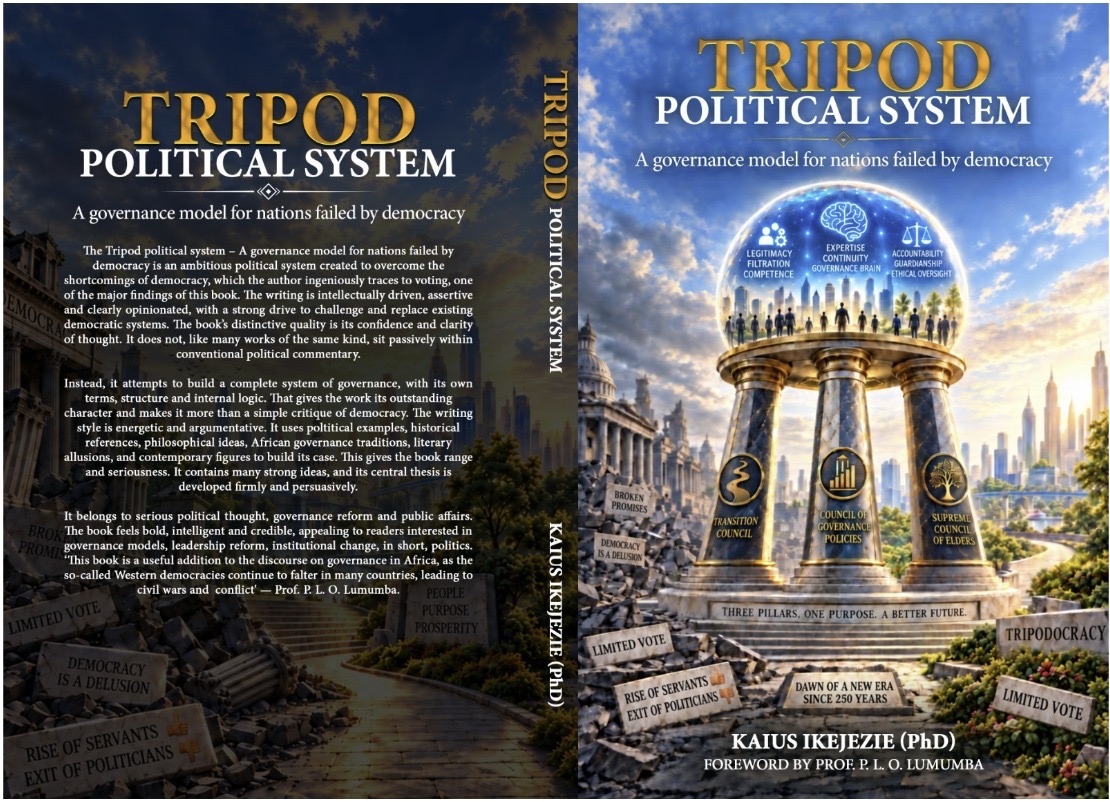
Have you ever settled down to read a book and, as the words spark your imagination and rouse your curiosity, realised the experience is unfamiliar, completely new, and utterly different, yet still whole? This is exactly the jamais vu situation you may find yourself in while reading Kaius Ikejezie’s Tripod Political System: A Governance Model for Nations Failed by Democracy (America and Nigeria as Case Studies). Few contemporary works of political thought rival this book’s intellectual audacity, penetrating wisdom, philosophical acuity, analytical depth, and practical ingenuity, introducing a wealth of original political ideas.It is a work of a genius.
Ambitious, original, and persuasive, the book diagnoses electoral democracy’s failures while offering a credible, result-oriented alternative. It examines existing systems, draws on indigenous governance traditions, constructs a new institutional architecture, anticipates objections, and proposes implementation pathways.
Published in the United Kingdom in 2026 by BritLit Publishing Hub, the book presents original ideas across over 200 pages, offering advanced knowledge. Ikejezie’s tripodismadapts governance to environmental experience, addressing democracy’s weaknesses and corruption. Beyond the testimonials from peopleof knowledge and power, which serve as an appetiser for this full and hearty meal, Prof. P. L. O. Lumumba’s Foreword propels the argument, noting that Nigeria and America require a new political model after democracy’s failures.
In five chapters, the book presents a detailed political blueprint. Chapter One argues that democracy is inherently limited: voting may select representatives but cannot reliably identify the most capable leader, as elections often reward wealth, visibility, party machinery, and emotional appeal over judgment, character, and competence. Chapter Two examines epistocracy and technocracy, noting that technocracy ‘struggles to adequately incorporate human values, cultural considerations and ethical principles that cannot be easily quantified’ (p. 46). It also introduces the Igbo Umunna system, praised for its ‘efficiency, longevity, the absence of corruption, and adaptation without disappearing,’ though its expansion beyond village-level governance remains uncertain (p. 54). Chapter Three unveils the Tripod system, which we will examine later, while Chapter Four develops the Chief Servant’s role and dedicates some space to Peter Obi, the Chief Servant in a wrong political system, whose towering achievements were dissipated by succeeding democratic governments. Chapter Five addresses barriers, limitations, and recommendations, producing a more complete and practical blueprint.
What then is this tripod political system? The tripod political system rests on three institutions with distinct roles. The Transition Council manages handovers, oversees legislative elections, vets Chief Servant candidates, administers the Smart Test, and prepares successful candidates before inauguration. It prevents outgoing leaders from controlling transitions. The Council of Governance Policies, the system’s ‘brain,’develops research-based policies, converts the incoming Chief Servant’s vision into long-term plans, and provides forecasts, policy options, and institutional knowledge. The Supreme Council of Elders guards governance rather than governing; it monitors constitutional compliance; questions misconduct and may demand explanations or recommend resignation or impeachment. It is meant to resist corruption and scrutinise questionable procurement, inflated contracts, and manipulated tendering. Together, these councils strengthen leadership selection, policy continuity, and checks and balances. However, their independence, transparency, and accountability are to be verified in a concrete situation. Professional records and good character alone cannot prevent corruption; enforceable rules, public scrutiny,and appeal mechanisms.
The three legs provide a more developed institutional framework than a general appeal for meritocracy, addressing leadership selection, policy continuity, and accountability. However, their effectiveness depends on the councils’ independence, transparency, and answerability. While the author trusts members’ professional records and character, institutions also require enforceable rules, public scrutiny, appeal mechanisms, and consequences for abuse.
Dr Ikejezie addresses this concern by explaining the Tripod system’s three legs. Again, the Transition Council conducts the limited election, administers the Smart Test, and prepares the incoming Chief Servant. The Council of Government Policies supplies blueprints and liaises with the Chief Servant and Senior Servants, equivalent to ministers. The Supreme Council of Elders serves as watchdog and constitutional guarantor. Having excelled over other contenders in the majority party, thesoon-to-be Chief Servant owes no favours to anyone, thereby reducing corruption and its associated ills.
Other News
The Chief Servant gives the model its distinctive political language. Rather than president or prime minister, the head of the executive branch of government is called “Chief Servant” or “Servant-in-Chief,” signallinghumility and framing authority as a public trust. Selected through track-record assessment, testing, training, and institutional oversight, the Chief Servant implements policies developed by the Council of Governance Policies. Ikejezie also challenges political honorifics, arguing that leaders should address citizens respectfully. However, changing titles alone cannot prevent arrogance; citizens must retain reliable means to question leaders, access information, and contest decisions.
The chapter on Peter Obi is among the book’s most vivid sections. Ikejezie presents Obi’s Anambra governorship as an example of fiscal restraint and public-service leadership, citing savings, debt repayment, investments in education and healthcare, infrastructure, security, and attraction of businesses. He argues that Obi’s successor failed to preserve or build upon these achievements, illustrating the Tripod’s concern with administrative discontinuity. The case study also adds balance: Ikejezie questions whether Obi’s emphasis on saving reduced investment and job creation, whether he sufficiently cultivated younger leaders, and whether maintenance systems were established for the assets and services created during his administration.
The conclusion identifies barriers to adopting the Tripod system, including public attachment to voting, elite resistance, institutional fragility, and fears that unelected bodies could become authoritarian or captured. It also acknowledges internal limitations: over-reliance on tests, concentration of power in the Transition Council, technocratic detachment, age restrictions on the Elders’ Council, and implementation complexity. Further proposals on resource governance, a mixed economy, income limits, party structures, fixed terms, public appraisals, defection restrictions, and gender or ethnic balancing demonstrate practical ambition.
Ikejezie clarifies how the three institutions in the tripod idea are intended to cooperate, gives the Chief Servant a defined role, tests the model against a political example, and acknowledges obstacles and limitations. Its central contribution remains its insistence that leadership selection and continuity deserve serious scrutiny.
The Tripod depends not only on the quality of its candidates but on the openness, independence and accountability of the bodies that select and supervise them. Like all political ideas, implementation holds the greater power.
This book reflects Dr Ikejezie’s years of learning and teaching philosophy. As his biography in the volume explains, he ‘proved to be a tree like the Pando that makes a forest.’The description is apt. Only a highly gifted and deeply informed thinker could produce a political system so full of ‘insightful ideas, minutely detailed, covering every ramification of governance, while also anticipating future challenges and proposing solutions. The author asks: ‘Who grapples with all that?’ The answer, as the text suggests, is ‘Only those with Ikejezie’s mental and intellectual prowess’ (p. 198).
In my view, the book is best read as both a bold proposal for constitutional debate and a finished blueprint. It challenges readers to look beyond the ballot and ask how governments can promote competence, ethical service and policy continuity without weakening citizens’ ability to hold power to account.