Follow Us on Google
•Flood submerges Anambra communities, residents groan, farmers forced into early harvest
From Aloysius Attah, Onitsha
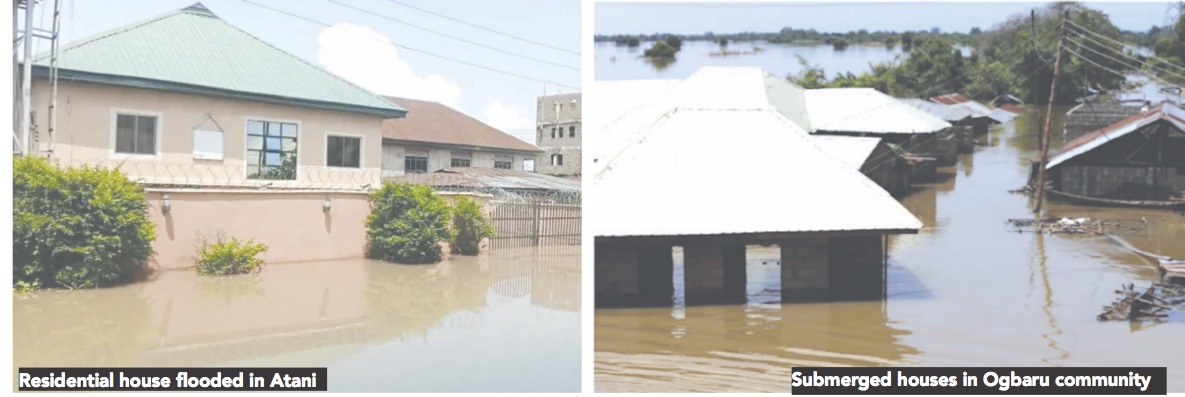
Residents of many riverine communities in Anambra State are living a flood disaster. Communities in Ogbaru Local Government are already counting their losses as no fewer than 15 of them were, last week, submerged after the River Niger overflowed its banks.
On Sunday, September 13, 2025, the Federal Government warned that 32 locations in 11 states might experience heavy rainfall leading to flooding between September 14 and 18. It cautioned that rising water levels in River Gongola, River Benue and River Niger posed additional risks, warning that communities situated on the flood plains were especially vulnerable. Government urged stakeholders and residents to take urgent preventive measures to stay safe.
True to prediction, less than 24 hours after the warning, 15 of the 16 communities in Ogbaru came under flood surge as River Niger overflowed its tributaries and submerged farmlands, markets, schools, churches, private and public buildings.
The situation forced the Anambra State Emergency Management Agency (SEMA) to step up mobilisation efforts, opening holding centres across vulnerable local government areas. The agency urged residents of riverine communities, particularly in Ogbaru, Anambra East, Anambra West, Awka North, Ekwusigo, Ihiala and Onitsha South to move to higher ground for safety.
But residents of Ogbaru lamented that the state government and its agencies have always neglected them only to take fire-brigade efforts when the damage has occurred. A community leader, Okwudili Obazie, said the flood had caused disastrous impact on life and livelihoods and displaced residents of the area, altering normal daily activities.
He stated that Ogbaru was the worst hit because it was the last coastal area from where the flood enters parts of Rivers and Bayelsa states, among others, emptying into the Atlantic Ocean: “Government’s fire-brigade approach will not solve the disaster and trauma. Its failure to put in place sustainable measures to check the menace of yearly flooding in worst-affected areas is lamentable.”
He advocated review of the State Emergency Management Agency law to provide for the recurring annual flood disaster that affects the riverine communities: “The expected law should make it relevant to the present situation to accommodate a budget allocation to mitigate flood disaster.
“The new ANSEMA law should accommodate the rehabilitation and empowerment programme for women and girls as well as other victims of all ages who are the worst victims of the recurring natural disaster. Hectares of rice farm were recently destroyed by flood and, till date, there is no form of assistance for the victims.
“There should be inclusive arrangements in the adoption of measures to tackle flood menace, narrating how physically-challenged persons are the worst victims since they are often forgotten during emergency rescue operations, with the result that any of them suffer loss of life and/or property. Many of the aged died due to either neglect or the inherent rampant diseases during the flood crisis.”
Federal Government had in April predicted heavy rains and floods in 30 States and the Federal Capital Territory (FCT). Minister of Water Resources and Sanitation, Joseph Utsev said coastal and riverine flooding would be experienced in some parts of the South-South geopolitical zone of the country due to a rise in sea level.
He listed the high-flood risk states to include Abia, Adamawa, Akwa Ibom, Anambra, Bauchi, Bayelsa, Benue, Borno, Cross-River, Delta, Ebonyi, Edo, Gombe, Imo, Jigawa, Kebbi, Kogi and Kwara. Others are Lagos, Nasarawa, Niger, Ogun, Ondo, Osun, Oyo, Rivers, Sokoto, Taraba, Yobe, Zamfara and the FCT.
Utsev, who spoke during the public presentation of the Annual Flood Outlook by the Nigeria Hydrological Services Agency (NIHSA) in Abuja, revealed that 1,249 communities in 176 local governments in 30 states and the FCT fall within high-risk flood zones this year: “Additional 2,187 communities in 293 LGs face moderate flood risks. Key risk areas include Abia, Benue, Lagos, Bayelsa, Rivers and Jigawa.”
Last month, the National Flood Early Warning Systems Centre (NFEW), Federal Ministry of Environment, predicted heavy rainfall over a five-day period that may trigger flooding in 76 locations of 19 states including Anambra.
Commissioner for Environment, Felix Odimegwu, said: “Deputy Governor, Dr. Onyekachukwu Ibezim, is coordinating the state’s flood response in collaboration with the United Nations Development Programme (UNDP) and the Federal Government. The Flood Management Committee chaired by the deputy governor is upgrading the holding camps while the respective local government council chairmen are on top of the game in ensuring that the impact is minimal.
“The joint efforts of the state government and UNDP include clearing blocked drainages, enforcing the ‘Operation Clear Your Waterways’ directive and advancing plans for long-term dredging of the River Niger.
But some villagers told Daily Sun that they were yet to take delivery of any relief materials from government or any agencies: “The entire 15 out of the 16 communities have been affected by the flooding and no one has come here to see us or maybe they are on their way to Ogbaru.”
Meanwhile, areas not yet affected by the flooding such as Okpoko saw villagers making early harvest of their crops to save them from being washed away.