Follow Us on Google
From Adesuwa Tsan, Abuja
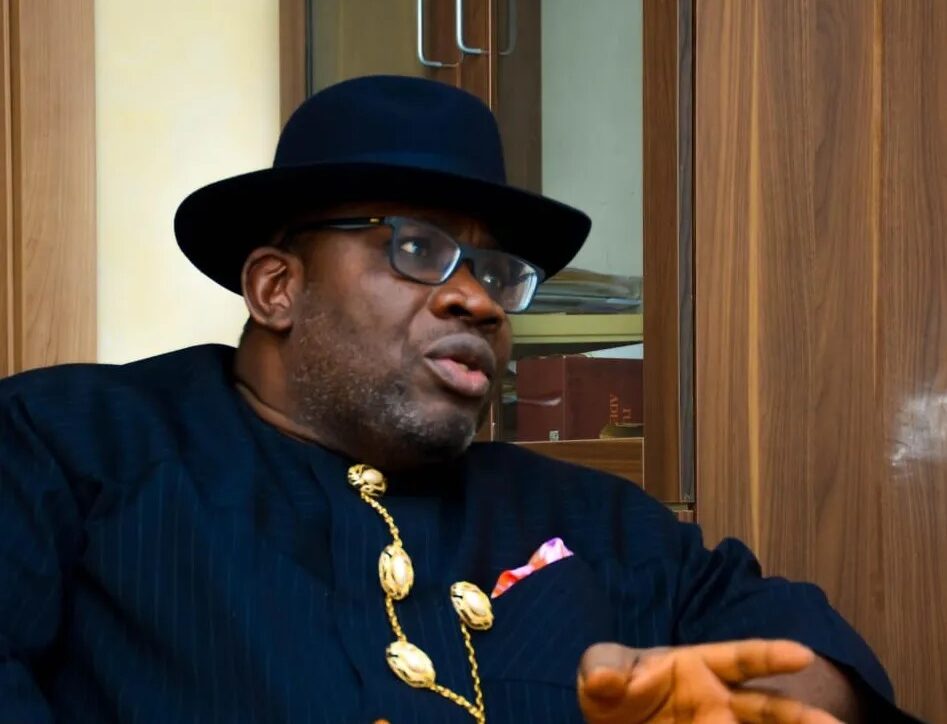
Senator Seriake Dickson yesterday called on the Conference (Harmonisation) Committee of the National Assembly to adopt in full the version of the Electoral Act amendment bill passed by the House of Representatives, warning that the Senate’s altered clause on electronic transmission of election results could undermine the credibility of future polls.
Speaking at a press conference in Abuja, the former Bayelsa State Governor said the House version best reflects the consensus reached by lawmakers, the Independent National Electoral Commission (INEC), consultants, and other stakeholders after nearly two years of extensive work on the proposed amendments.
He explained that as a member of the Senate Committee on Electoral Matters, he had been deeply involved in the amendment process, which he described as rigorous, consultative, and far-reaching.
“For almost two years, as a member of the Senate Committee on Electoral Matters, we worked extensively on amendments to the electoral laws. We held workshops, joint sessions with the House of Representatives, meetings with INEC, the technical committee, consultants, and other stakeholders, as well as public hearings in Abuja and Lagos,” he said.
According to him, the process culminated in a comprehensive framework, unanimously agreed upon at the joint committee level, especially on the central issue of electronic transmission of election results.
“We all agreed, crucially with INEC, on a framework that would regulate the conduct of elections in this country moving forward,” he said.
However, Dickson said the final legislative process was disrupted by a personal tragedy, which kept him away from the Senate at a critical moment. “But we could not conclude the process before tragedy struck. The Deputy Governor of my state collapsed suddenly and died, throwing the entire state and my family into mourning,” he said.
He added that the emergency Senate sitting on Tuesday was the first plenary he attended since the burial.
“Yesterday was the first time I attended a Senate sitting since his burial. Despite my personal state, I attended the emergency session because of its importance,” he said.
Dickson said he was alarmed to learn that while the House of Representatives passed the jointly agreed document without any changes, the Senate altered a key clause, weakening the provisions on electronic transmission.
“While I was still in Bayelsa, I was shocked to learn that the House of Representatives, which received the same document, passed it without any alteration. But the Senate delayed and later removed a very crucial clause that had been unanimously agreed upon at the joint committee level, replacing it with a weaker provision from the previous law,” he said.
“That development shocked me, though I was not surprised when civil society organisations raised alarm and Nigerians expressed outrage. This was why the Senate leadership convened the emergency session,” the former governor added.
Other News
Although the controversial clause was restored, he said the addition of a proviso allowing manual results to serve as primary evidence where electronic transmission fails remained deeply troubling.
“The clause was brought back, but with a proviso stating that where electronic transmission fails, manual results would serve as the primary evidence. That proviso is what many Nigerians are rightly concerned about,” he said.
Dickson therefore urged members of the harmonisation committee to jettison the Senate’s version and adopt the House position in full.
“My message to Nigerians is clear: I call on the members of the Conference Committee to adopt the House version in its entirety. That version reflects what the joint committees, consultants, and INEC agreed upon,” the lawmaker stated.
He stressed that INEC had already assured lawmakers of its technical capacity to transmit election results electronically, insisting that the law must compel the commission to fully deploy the required technology.
“INEC assured us at the committee level of its capacity to transmit results electronically. If the law makes it compulsory, then it is INEC’s duty to acquire and deploy the necessary technology across the country.”
“The issue of electronic transmission has become central to electoral integrity because manipulation often occurs at collation centres, not just at polling units. Once results are transmitted immediately after polling, it becomes difficult to alter them,” he said.
While acknowledging that the Senate version uses the word “shall,” he warned that the accompanying proviso could be exploited, warning that “exceptions should never become the norm.”
Beyond legislative advocacy, Dickson appealed to Nigerians to remain committed to the democratic process and resist apathy.
“I call on Nigerians not to give up on democracy. The fight for free, fair, and credible elections is ongoing. The prize for liberty is eternal vigilance,” he said.
“Citizens must continue to mobilise, sensitise, and participate fully in elections. Go to your polling stations, cast your votes, and insist that presiding officers comply with the law by transmitting results electronically,” he said.
Dickson also called on INEC to use its operational guidelines to entrench electronic transmission as the standard practice.
“I also urge INEC, through its guidelines and manuals, to ensure that electronic transmission remains the general rule, and not a cover for subverting the democratic wishes of the Nigerian people,” he stated, adding, “I commend Nigerians for their vigilance, and I urge resilience. Just because institutions are not perfect does not mean we should abandon the democratic struggle.”