Follow Us on Google
By Femi osofisan
Across a ritual-infused solo at Theatre in the Mill and a vibrant Afrobeat tribute in Centenary Square, Keke weaves Afro-contemporary movement, storytelling, and communal rhythm into two standout moments of the festival.
At BAFA 2025, one of the North’s leading celebrations of African and diasporic creativity , Afro-diasporic movement artist Joachim Keke delivered two performances that captured the breadth and depth of his choreographic voice. Moving between the intimate black-box setting of Theatre in the Mill and the expansive openness of Centenary Square, Keke demonstrated an impressive ability to command radically different performance environments while maintaining a steady emotional and artistic centre. Across both works, he emerged as an artist grounded in ritual subtlety yet fully capable of igniting large, energetic public audiences.
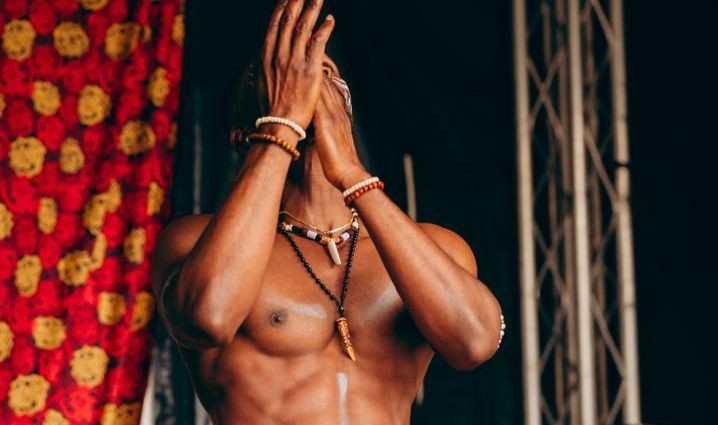
At Theatre in the Mill, Keke presented a contemplative study of relationality and collective breath. Entering the space with painted markings across his face and torso, he brought a quiet ceremonial gravity into his opening gestures. His movement language favoured restraint, with grounded footwork, carefully held pauses, and slow, spiralled transitions shaped more by breath than by outward display. The stillness, at times lingering longer than expected, formed part of the work’s meditative logic. The audience remained notably silent throughout, leaning into the work’s contemplative stillness.
Rather than illustrating the concept of Ubuntu in a literal sense, Keke threaded West African movement textures through contemporary forms to evoke interdependence, memory, and shared presence. His downward-reaching gestures followed by steady ascents suggested ancestral invocation and quiet renewal. A separate review in The Nation later described the performance as “dancing Ubuntu into being,” a sentiment that echoed strongly in the room.
Later in Centenary Square, where close to 2,000 people gathered for the festival’s closing celebration, Keke shifted into an electrifying homage to Afrobeat’s political and cultural lineage. Drawing from the propulsive energy of Fela Kuti and the contemporary dynamism of Burna Boy and joined by spoken-word artist Ibquake, he delivered a performance that felt both celebratory and grounded in a deep cultural logic.
Dressed in vivid red-and-white patterned trousers and bold body markings, he commanded the outdoor stage with charisma and certainty. His movement balanced sharp, syncopated Afrobeat rhythms with the elastic phrasing of Afro-fusion and contemporary diasporic dance. What could easily have veered into pure spectacle instead carried intention and clarity, honouring Afrobeat’s history while extending its relevance into Bradford’s present cultural landscape.
The audience’s response underscored the performance’s impact. Spectators mirrored his gestures, clapped in unison, and joined spontaneous call-and-response sequences — a reminder of Afrobeat’s enduring ability to collapse the distance between performer and public. Ibquake’s spoken-word tribute to African resilience grounded the choreography in narrative, while Keke’s physicality amplified its emotional weight. For a moment, Centenary Square became a shared ritual environment, transformed through collective energy and diasporic movement.
Taken together, the two BAFA performances revealed Keke’s remarkable artistic agility. Few performers transition so seamlessly between the introspective quiet of a ritual-driven work and the expansive charge of a large-scale outdoor celebration. His movement vocabulary, rooted in Afro-diasporic traditions yet open to contemporary reinterpretation, places him among a growing cohort of UK-based artists reshaping the landscape of diasporic performance. Still, the blend of nuance, embodiment, and communal invitation remains distinctly his.
Beyond individual achievement, Keke’s contribution to BAFA 2025 speaks to a wider cultural moment. The festival marked a renewed visibility for African diasporic arts across the North, and his performances added depth and texture to that narrative. His work offered audiences a vision of dance that is deeply rooted yet expansively modern choreography where tradition meets innovation, and where ritual meets revelry.
By the festival’s close, it was clear that Keke’s presence stood among BAFA’s most thoughtfully realised and culturally resonant moments, affirming his significance within the region’s evolving artistic landscape and marking him as a performer whose influence is likely to reach far beyond Bradford.