Follow Us on Google
By Uche Usim
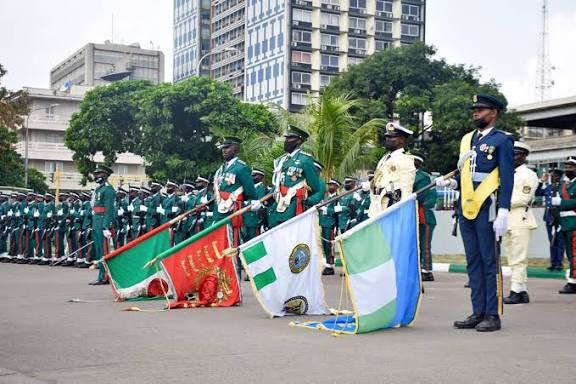
Nigeria’s Ministry of Defence is set to receive N3.154 trillion in 2026, in federal government’s commitment to bolstering national security by fortifying the nation’s modern warfare muscle and generally modernising the country’s military capabilities. The allocation is designed to sustain a sprawling armed forces while equipping them with advanced technology and infrastructure.
The bulk of the budget, N2.39 trillion, is earmarked for personnel costs, covering salaries, allowances and benefits for soldiers across the Nigerian Army, Navy and Air Force. Capital expenditure is projected at N464.5 billion, funding the purchase of aircraft, ships, weaponry and the modernisation of military infrastructure. Overhead costs, including daily operations, fuel, and maintenance, are pegged at N297 billion.
The Nigerian Army is the biggest beneficiary, receiving N1.5 trillion in total. Personnel costs alone exceed N1.25 trillion, while capital investments include N16.45 billion for arms, N15.53 billion for ammunition, and N13.44 billion for unmanned aerial systems.
The Army is also allocating over N10.9 billion for international training and nearly N6.8 billion for local training programs to maintain professional standards. Fuel, uniforms, medical care, and welfare packages further add to the Army’s expenditure, with motor vehicle fuel costing nearly N5.8 billion and medical expenses topping N7 billion.
The Nigerian Navy will receive N443.9 billion, focusing on maritime security and defense. Significant allocations include N27.6 billion for defense equipment and N14 billion for fuel to power its sea vessels.
The Air Force is granted N407.1 billion, with N27.6 billion set aside for attack helicopters and N15.6 billion for aircraft maintenance. The service has also budgeted N3.68 billion for uniforms and accoutrements.
Other News
Beyond the main military services, specialised agencies and missions receive dedicated funding. Defence Missions, which cover Nigeria’s global diplomatic and operational footprint, will draw N83.5 billion. The Defence Intelligence Agency is allocated N68.8 billion for national security intelligence operations, while the Defence Space Administration receives N37.3 billion for space-based innovation, including N1.08 billion for a defense incident response platform.
The National Centre for Control of Small Arms and Light Weapons is budgeted at N11.1 billion, reflecting ongoing concerns over small arms proliferation.
Operational and infrastructural costs also feature prominently. The Ministry headquarters alone will spend N455 million on plant and generator fuel. Barracks rehabilitation projects will receive nearly N5 billion, targeting facilities in Ogoja, Birnin Kebbi, and Ede. Welfare packages for personnel are supported with N802 million, ensuring soldiers’ wellbeing alongside operational readiness.
Education and leadership training are not overlooked. The Nigerian Defence Academy will receive N40.4 billion to train future officers, while the Command and Staff College, Jaji, is budgeted at N35.9 billion. The National Defence College is allocated N29.3 billion, underlining a commitment to strategic military leadership and professional development.
Analysts describe managing the Ministry of Defence’s budget as akin to running a high-tech industrial city that never sleeps. The “citizens” are the soldiers whose welfare and salaries dominate spending, the “machinery” represents the sophisticated and costly weapons and aircraft, and the “utilities” cover the massive operational and maintenance costs that keep the force agile and battle-ready.
As Nigeria navigates evolving security threats at home and abroad, the budget indicates that a well-equipped, well-trained, and resilient military capable of defending the nation’s sovereignty is essential, even as the country prepares for the challenges of the 21st century.