Follow Us on Google
• Traders bemoan low patronage as prospective customers lament prohibitive cost
• We’re hopeful we’ll have better sales by Monday, Tuesday –Sellers
By Kehinde Aderemi
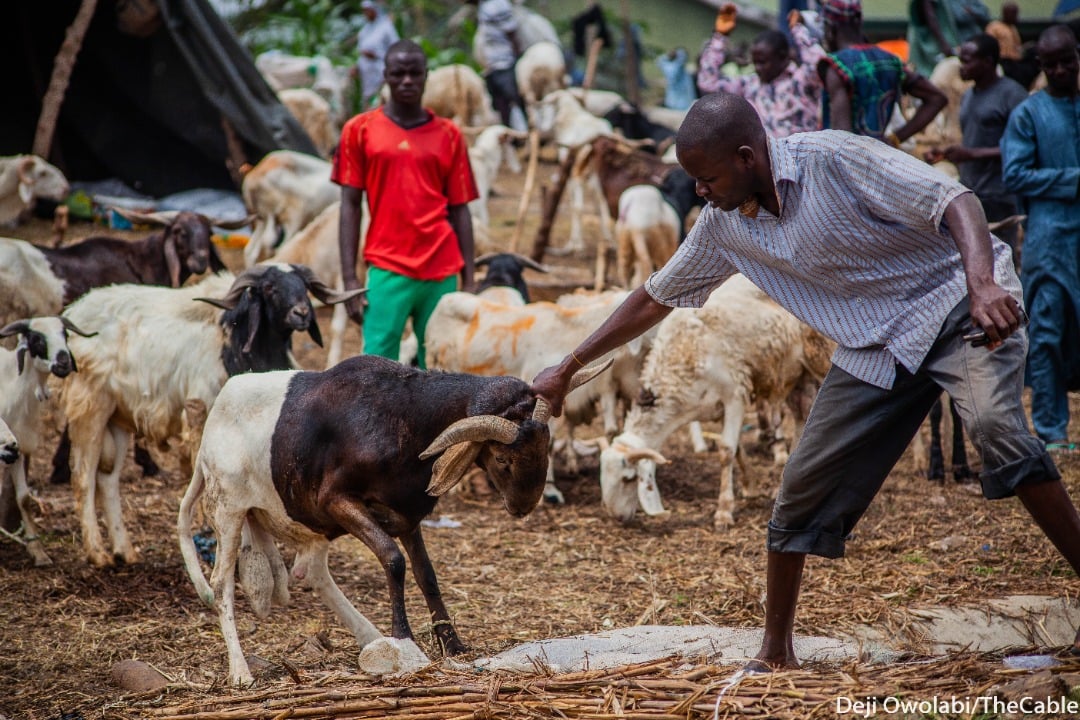
From Kara in Lagos to Sabo in Ikorodu, Alaba Rago and Gbagada, Ibadan, Oyo Kwara and Ilorin, Kaduna and Kano, the scene is the same across Nigeria. This week, millions of rams are on display in many markets from state to state.
In different markets in Lagos, a large number of rams are everywhere, in regular markets and in temporary, makeshift ram pens scattered in several parts of town, bleating, horns curled, wool matted from long journeys across the country.

They arrived in trucks that crawled down battered highways from Borno, Yobe, Katsina, Kano, Sokoto, their journey timed precisely for the Muslim calendar’s most anticipated celebration—Eid Al-Adha, otherwise known as Eid- el-Kabir.
For all the rams on display, the usual pre-festival excitement is still muted and the rams pens, though rowdy, are still dull.

The buyers of these rams are still fewer as the atmosphere is still heavy with question hanging in the air in every market: who can afford the Ileya rams this year?
With less than five days to the festival, Nigeria’s ram markets have become a live tableau of the country’s economic strain. Sellers who staked their income on this season are watching sales stalled.

Meanwhile, buyers who have kept the religious tradition of worship for decades are also walking away empty-handed or settling for something far smaller than they planned.
With the present hike in the prices of rams, it is no doubt that this year’s festival season is marked by contradictions.
There are many rams in the markets across Nigeria, but there are also a shortage of purchasing power among the people.

Every year, especially in the two weeks leading to the Eid, the demand for rams increases because traders invest heavily in the business.
They borrow money, pooling resources, and transporting animals hundreds of kilometres south to Lagos, Ibadan, Port Harcourt, and other cities and states.
The expectation, Saturday Sun gathered, is that for 10 to 14 days, sales will be brisk enough to clear stock and yield profit that sustains families until the next season. But with the present situation in the market, that may not be feasible.
Chairman of the Lagos State Ram Sellers Association, Alhaji Abubakar Langa, expressed concern over low patronage. He was at the Gbagada rams pens when the reporter met with him.
According to him, rams sales were very much higher by this time last year. He explained further that the reason for the low sales is nothing but the poor state of the economy.
Alhaji Langa also highlighted the difficulties encountered on the roads before they get the rams to Lagos State.
“By this time last year, I had sold more than 60 per cent of my stock. But as at today, sales are still very low. Customers are coming, but they are asking for prices and leaving. They say the same thing—‘it is too expensive.’
“We are not the ones making rams expensive. We are also victims. The cost of bringing these rams from Borno to Lagos is huge. Diesel is expensive. The trucks charge more. And the roads are bad. A journey that should take three days now takes five or six. During that time, we feed the rams, we pay for security, and some die on the way. When a ram dies in transit, that is our capital gone.
“The journey from Maiduguri to Lagos was pure trauma. Trucks break down on pothole-riddled stretches of the A3 and A2 highways.
“At night, the risk of armed robbery and kidnappers forces drivers to travel in convoys. We also pay informal levies at checkpoints. We see hell. Some rams die. Others arrive injured. All of that loss is added to the price you see here,” he stated.
The leader of the ram sellers also appealed to the Federal Government to help fix the roads, stabilise fuel prices, and secure the highways.
“If the roads are good, we spend less on diesel and less time on the road. The rams arrive healthier, and we can sell at prices that ordinary Muslims can afford. Right now, it feels like we are being punished for trying to provide an animal for worship.
Other News
“We all know that the Lagos market is the largest receiving point for rams and other livestock in the South-West.
“This year, members of the association brought in over 500,000 rams. Prices range from ₦300,000 for smaller, leaner rams to N2 million for large, well-fed breeds with symmetrical horns and thick wool. That is the kind of rams that are preferred for ceremonial slaughter and for display as a sign of status,” he said.
Lagos-based farmer and businessman, Alhaji Hammed Otufowora stated that the high cost of rams in 2026 is not limited to Nigeria.
According to him, the high cost in prices of rams also reflects a convergence of domestic and global economic pressures that have hit livestock trading hard.
He stated also that animal feed costs have risen sharply in the North-East and North Central, where most of Nigeria’s rams are reared.
“One of the major factors affecting the prices of rams this year is the spate of insecurity.
“Insecurity has disrupted grazing patterns and limited access to farmland. Farmers who produce maize chaff, and millet have also increased prices to compensate for reduced output and higher transport costs.
“Insecurity along key livestock corridors has raised the risk. Banditry in Zamfara and Katsina, kidnapping in Niger State, and parts of Kogi and Kwara States mean transporters and truck drivers would always hire armed escorts or pay unofficial fees. Those costs, as far as I am concerned, are not absorbed by traders—they are passed to the buyers.
“For instance, a 50kg bag of feed that sold for ₦8,000 last year now goes for ₦14,000 in many markets. Fuel prices remain elevated due to global energy market volatility. The protracted conflict between Iran and Israel in mid-2026 disrupted oil supply routes in the Middle East, pushing Brent crude prices above $95 per barrel.
“Despite being an oil producer, Nigeria still imports over 80 per cent of its refined petroleum products. The effect of this is usually immediate at the pump. Diesel, which powers livestock trucks, now sells for over ₦1,200 per litre in most parts of the country.
“Currency depreciation has also become another issue even as the increasing cost of veterinary inputs. Although rams are bred locally, vaccines, de-wormers and nutritional supplements are often imported and priced in dollars. A weak naira means traders spend more to keep animals healthy and market-ready,” he said.
He pointed out also that Nigeria’s livestock value chain remains largely informal and fragmented.
“You cannot store a ram in a warehouse and wait for prices to improve. Once Eid passes, the value of unsold stock drops by 40-60 per cent. That creates a situation where traders are forced to sell at whatever price they can get in the last 48 hours, but until then, they hold out, hoping for a turnaround.
“There is no cold chain, no modern holding facilities near urban centres, and no subsidised transport system for livestock. Every trader bears the full risk. Until that changes, we will continue to see this cycle where festivals become a period of financial distress for both consumers and small-scale traders,” Alhaji Otufowora stated
Last Tuesday, a Lagos- based Surveyor, Mr. Abiodun Adams, visited Sabo Market in Ikorodu to buy a ram. He left without buying. He narrated his experiences, even as he added that buyers are making difficult decisions.
“For many, Eid Al-Adha is not optional—it is a religious and social expectation. But the math no longer adds up. The ram I wanted to buy was sold for ₦300,000. Last year, I bought a similar one for ₦180,000. I couldn’t justify spending that much.
“The issue of high cost is not limited to rams alone. The situation in Iran has affected the global economy, and Nigeria is not exempted. Everything is connected. When diesel goes up, food goes up. When food goes up, everything else follows. The economy is biting every Nigerian, and we can only pray for a better situation.” he noted.
He called on the federal government to create designated ram markets across the country during the season and to consider subsidies for rams during major religious festivals.
“Government can subsidise rams for Muslims during Eid, just like they sometimes subsidise rice or flour during Christmas. It doesn’t have to be free, but a 20 to 30 per cent reduction would make a huge difference,” he said.
Adams is not alone. Across Lagos, Abuja, and Kano, the pattern is the same. Buyers circle the pens, ask for prices, and walk away.
Some are pooling resources with relatives to buy one large ram jointly. Others are switching to goats or sheep, which cost between ₦80,000 and ₦150,000 but do not carry the same cultural weight for many during Eid Al-Adha.
A ram seller, Umar Yisa said the prices of rams vary according to the location. He said rams sold in Kara and Alaba Rago would be cheaper than the ones in Ikorodu or any other place in Lagos. He added also that the reason for the slight changes is centred on the locations.
Yisa explained further that many of the customers he had attended to on Wednesday paid the little they had on them with promises to balance up before the Eid when they would be allowed to take home their rams.
According to him, the rams are measured by their sizes. He pointed to some of the rams, whose process, he noted, start from between N600,000 and N700, 000. Some cost even more, he added.
“I have sold more than five rams here today, but their owners would later come for them before the Eid,” he stated.
A cow seller, Abubakar Muhammed, said the situation in the market now is not predictable.
He noted that the prices of cows are always higher, especially during festive periods, but he was sure that he would still record maximum sales. Muhammed also stated that the lesser cows in his pens are sold for N1.3 million.
“I have cows here that are worth over N2 million, depending on their sizes and the demand and timing.
“During festivals like this, we are always conscious of the timing because that is a major factor in the business. But I am hopeful that by Monday or Tuesday, we shall record more sales,” he said.
From the situation in the rams market now, it seems the hope of both the rams and cow sellers lie in a last-minute surge in sales. For the buyers, the hope is that prices will reduce as the festival approaches.
“Eid should be a time of joy, not a time of stress for both the buyer and the seller. We are ready to sell our rams to our customers. But we just need the environment to make it possible. And until that environment changes, Nigeria’s ram markets will remain a place of abundance and anxiety—a place where rams are everywhere, but celebration feels just out of reach,” Yisa stated.