Follow Us on Google
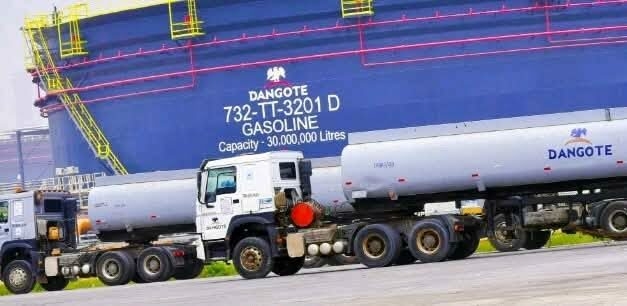
…Refinery suspends coastal loading, raises price to N1,265/litre, N1.67m/MT
The battle for control of Nigeria’s petrol supply chain is taking a new turn, with Dangote Petroleum Refinery restricting coastal loading for marketers holding import permits.
The development could reshape how marketers evacuate petrol from the refinery, forcing affected operators to rely on trucks instead of vessels to move products to their depots.
Marketers fear the change will increase their distribution costs and eventually feed into the price paid by consumers.
Coastal loading is the process of pumping refined petroleum products, such as petrol and diesel, directly onto ships or marine vessels at a coastal plant to transport them by sea to other private or regional depots.
Some of the affected marketers who spoke to Daily Sun in confidence lamented that the refinery’s latest policy was injurious to their businesses as it would swell their operating costs.
They explained that the refinery told them to opt for gantry loading, which requires them to bring their trucks to the plant to load.
“The refinery has told us that since we have import permits, we should go and use our licences to import rather than opt for the coastal option.
“Unfortunately, it is the final consumer who will bear the brunt of these policies because whatever we buy is what we will sell. At the end of the day, we will factor in those costs”, source told Daily Sun.
The issue has been further heightened by the latest data from the Nigerian Midstream and Downstream Petroleum Regulatory Authority (NMDPRA), which showed a sharp rise in petrol imports in July, even as domestic refinery supplies declined.
The regulator’s July 2026 Fact Sheet showed that average daily PMS imports increased by nine per cent month-on-month, from 18.1 million litres in June to 19.7 million litres in July. In contrast, daily domestic PMS supply dropped by 21 per cent, from 32.5 million litres in June to 25.8 million litres in July.
The figures mean imported petrol accounted for about 43.3 per cent of total PMS receipts in July, compared with 35.8 per cent in June and just 12.4 per cent in May.
The sharp reversal has now intensified questions over how Nigeria should manage petrol imports as large-scale domestic refining capacity comes on stream.
Chief Executive Officer of the Centre for the Promotion of Private Enterprise (CPPE), Mr. Muda Yusuf, said the import surge should prompt a review of the regulatory framework governing petroleum-product imports, arguing that imports should primarily be used to address genuine and independently verified supply gaps.
Yusuf said the concern was not with imports required to address refinery outages, seasonal demand spikes, quality gaps or strategic-stock replenishment, but with the issuance of import permits without transparent evidence that domestic refiners cannot meet the relevant demand.
He argued that the regulator should publish a product-by-product assessment of supply and demand before approving significant import volumes and give qualified domestic refiners an opportunity to meet any verified shortfall.
According to him, import permits should be restricted to the quantified residual gap and for a defined period, while permit approvals, actual landings and domestic evacuation volumes should be made public.
Yusuf said such an approach would not amount to protecting a monopoly or shutting out competition, but would create a rules-based market in which domestic refiners have a fair opportunity to compete while imports remain available when genuinely required.
His position comes as the latest NMDPRA figures show that the import surge has coincided with a decline in domestic PMS supply.
From May to July, imported PMS rose from 5.9 million litres per day to 19.7 million litres per day, while domestic PMS supply declined from 41.5 million litres per day to 25.8 million litres per day.
For Yusuf, the development raises concerns beyond the immediate availability of petrol, particularly its implications for foreign exchange, domestic employment, industrialisation and investment.
He argued that where domestic supply is available and commercially viable, excessive imports could weaken refinery utilisation and transfer demand, income and employment abroad.
He also warned that uncertainty over import policy could undermine investment in refining, storage, logistics and related infrastructure, given the scale and long-term nature of capital required for such projects.
Other News
However, Yusuf stressed that support for domestic refining should not translate into protection for inefficiency or monopoly pricing.
He advocated what he described as a balanced framework of “domestic supply first, competition always, imports only for verified gaps.”
Under such a framework, domestic refiners would have to demonstrate actual deliverable volumes rather than merely installed capacity, while domestic and imported products would be subjected to the same quality requirements and domestic supply would remain subject to competitive pricing.
The CPPE chief also called for stronger competition oversight to prevent abuse of market dominance and ensure that the shift towards domestic refining does not leave consumers exposed to excessive pricing.
The intervention adds another dimension to the disagreement between Dangote Refinery and the NMDPRA over the continued issuance of import licences.
Dangote has argued that the rising imports are making it increasingly difficult to plan production and manage inventory, as imported products compete with locally refined petrol.
In a statement last Wednesday, the refinery said imported PMS accounted for about 43 per cent of fuel supplied to the Nigerian market in July, despite the availability of substantial domestic refining capacity.
The company said the situation had forced it to increase exports of surplus petroleum products, not because domestic demand could not be met, but because uncertainty over future import volumes made it commercially unsustainable to hold excess inventory indefinitely.
The refinery said it had consistently maintained sufficient inventory and reserved product volumes to guarantee uninterrupted fuel supply across the country.
It, however, said limited visibility on future import volumes had complicated demand forecasting and inventory management.
“However, in an environment where significant volumes of imported PMS continue to enter the market through licences issued by the regulator, and where there is limited visibility on future import volumes, it becomes commercially unsustainable to continue holding excess inventory indefinitely,” the refinery said.
The company called for greater transparency in petrol import volumes, improved market coordination and policies that prioritise local refining, strengthen energy security, conserve foreign exchange and maximise the economic benefits of Nigeria’s refining capacity.
But the NMDPRA data also provide an important counterpoint to the argument that imports have become largely unnecessary.
While domestic refinery supply accounted for 56.7 per cent of PMS receipts in July, the sharp month-on-month decline in domestic supply and corresponding increase in imports suggest that the market continues to rely on imports as a balancing mechanism when local availability falls.
The central industry question, therefore, is whether the July figures represent a temporary supply adjustment or evidence of a structural problem in the transition to domestic refining.
For marketers, import licences provide an alternative source of supply and a hedge against domestic supply disruptions. For domestic refiners, however, large-scale imports can create inventory and demand-planning challenges, particularly when local production is sufficient to meet a substantial portion of the market.
The issue has become even more commercially significant following Dangote’s latest price adjustment.
The refinery increased its PMS gantry price to N1,265 per litre effective August 29, from N1,200, representing a N65 per litre increase.
It also raised its coastal PMS price from N1,582,380 per metric tonne to N1,669,545 per metric tonne, an increase of N87,165 per metric tonne.
According to the price change circular, the revised prices apply to PMS purchased through both gantry and coastal supply channels.
The refinery directed customers to return existing Automated Truck Loading tickets for repricing and said new volume contracts would be issued to facilitate the immediate resumption of loading under the revised commercial terms.
With petrol imports accounting for 43.3 per cent of July receipts, domestic PMS supply falling sharply and the country’s largest refinery restricting coastal loading for marketers with import permits, the downstream market is now confronting a broader policy choice.