Follow Us on Google
By Steve Agbota
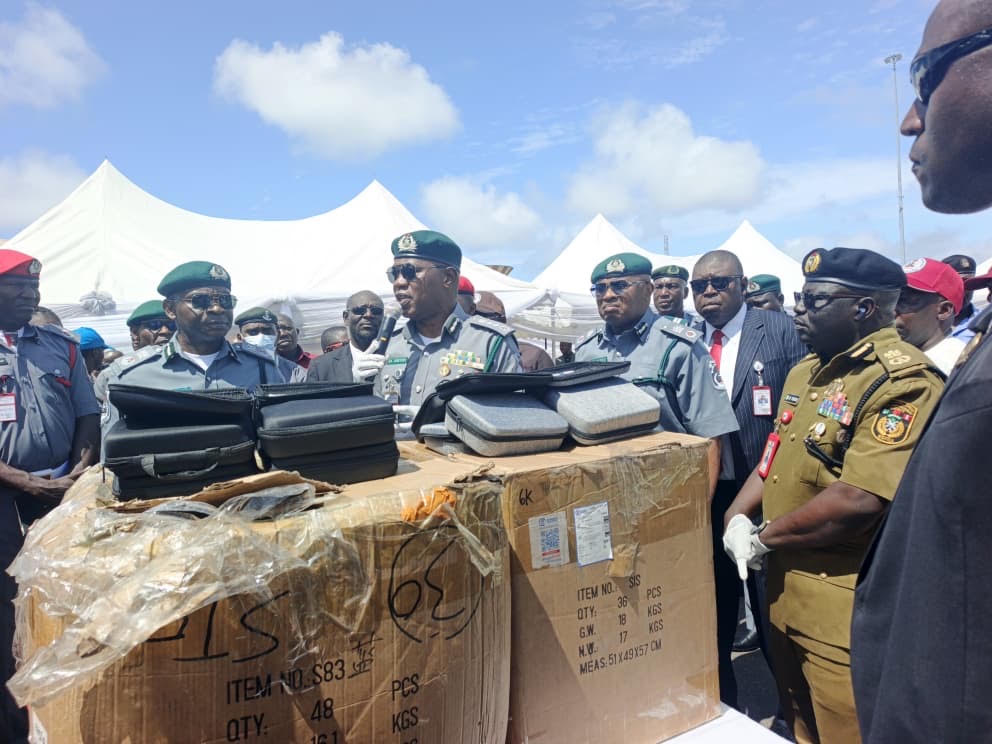
The Nigeria Customs Service (NCS), Apapa Area Command has intercepted illegal consignments with a combined Duty Paid Value (DPV) of ₦43.59 billion, including more than 7.6 tonnes of cannabis, 169,998 bottles of codeine syrup, security-sensitive drones and expired food, pharmaceuticals and household products concealed in 12 containers at the port.
The Comptroller-General of Customs, Bashir Adewale Adeniyi, disclosed this during a press briefing at Apapa Port, Lagos, saying the seizures underscored Customs’ growing role in protecting national security and safeguarding Nigerians from dangerous and prohibited imports.
Adeniyi said the Nigeria Customs Service Act, 2023, had expanded the responsibilities of the Service beyond revenue collection to include securing the supply chain, protecting Nigeria’s borders and ensuring that dangerous goods did not enter the country.
“The Nigeria Customs Service Act, 2023, charges this Service with more than the collection of revenue. It places on us the security of the supply chain, the protection of the border and the safety of what enters this country,” he said.
According to him, while Customs revenue performance was publicly measured, another critical part of its responsibility was preventing harmful and security-threatening consignments from reaching the Nigerian market.
“Revenue is the part of our work that is counted each quarter publicly. The other part is measured in what never reaches the street, and it is that part I am reporting today,” Adeniyi added.
The Customs boss said the seizures were the product of sustained intelligence-led operations by the Apapa Area Command, supported by improved cargo profiling, risk assessment and inter-agency cooperation.
He explained that the Service had in recent years strengthened its ability to identify high-risk consignments before physical examination, using trade data and intelligence to target suspicious shipments.
Adeniyi said the deployment of the B’Odogwu platform had enhanced the Service’s cargo profiling and risk-assessment capabilities, while the establishment of an INTERPOL Data Centre at the Customs headquarters in Abuja had further expanded access to international security intelligence.
He said that the centre, established in July, is the eighth INTERPOL data centre on the African continent and gives Customs officers access to more than 152 international databases.
He said Customs had also intensified cooperation with the National Drug Law Enforcement Agency, (NDLEA); National Agency for Food and Drug Administration and Control (NAFDAC); Office of the National Security Adviser (ONSA); and international security partners.
He said the development was necessary because criminal syndicates were increasingly concealing prohibited goods inside otherwise legitimate consignments.
“Narcotics, controlled pharmaceuticals, restricted equipment and unsafe goods arrive in the same containers, through the same agents, under the same false declarations, and they are frequently handled by the same syndicates,” he said.
He added that the methods of concealment had also become more sophisticated.
He added that narcotics are now packed among vehicle spare parts and used vehicles, controlled drugs concealed beneath household goods, while restricted equipment could be declared as ordinary electronics.
“A container of that kind will pass an untargeted inspection without difficulty, not as a targeted one,” he said.
The CGC said Customs had therefore shifted emphasis towards intelligence-led targeting rather than relying solely on random physical inspection.
He said among the most significant interceptions were three containers containing a combined 15,245 parcels of cannabis sativa weighing 7,624kg, or more than 7.6 tonnes.
“One 40-foot container, with number HAMU 3086682, contained 4,777 parcels of cannabis sativa weighing 2,388.5kg, concealed alongside assorted automobile spare parts, coffee mix, oats and three vehicles. Another 40-foot container, FANU 1933352, contained 8,287 parcels of cannabis weighing 4,145kg, alongside three vehicles.
“A third container, MSKU 3941778, contained 2,181 parcels of cannabis weighing 1,090.5kg, in addition to foreign parboiled rice, automobile spare parts, lithium batteries, a photovoltaic combiner box, turmeric, mangala fish and butterfly fish. Customs also intercepted a 40-foot container, TCKU 7653306, containing 1,700 cartons of codeine syrup, amounting to 169,998 bottles, concealed under household items,” he said.
Adeniyi described the interception as particularly significant given the longstanding national concern over the abuse of codeine and other controlled substances.
He said the volume of codeine in the single container could have sustained illicit distribution for a considerable period.
The cannabis seizures, according to him, were achieved through collaboration between Customs, the NDLEA and international security partners, with intelligence subjected to cargo profiling, documentary scrutiny and targeted examination.
He commended the NDLEA and international partners for their cooperation in disrupting the shipment.
“Another security-sensitive consignment intercepted by the Service contained 108 units of high-definition dual-camera drones. The drones, found in container MSKU 9282528, were extracted for further scrutiny because of their potential security implications,” he said.
Adeniyi stressed that Customs was not opposed to the legitimate importation and use of drones but warned that restricted and security-sensitive equipment must meet all regulatory requirements before clearance.
“Drones have lawful uses, and this Service does not quarrel with them. But equipment of this kind, in the wrong hands, becomes a means of surveillance, of reconnaissance and of delivery,” he said.
He warned importers against attempting to bring in security-sensitive equipment without the required approvals and documentation.
“Restricted and security-sensitive equipment requires the appropriate security approvals, end-user certificates and documentation before clearance. Consignments of that character that arrive without them will be detained,” Adeniyi stated.
The Customs boss declared that the nation’s seaports would not be allowed to become channels through which dangerous capabilities reach criminal or hostile elements.
The operation also uncovered 1,282 bales of used clothing in three separate 40-foot containers.
The containers, numbered MRKU 6185100, MRKU 5535966 and SEKU 4685299, contained 425, 435 and 422 bales respectively.
In addition, Customs intercepted five containers loaded with expired products intended for consumption or household use.
According to him, these included expired tomato ketchup, expired antiseptic liquid, expired vaginal tablets and expired disposable nappies.
A 20-foot container, SUDU 7593139, was fully loaded with expired tomato ketchup, while PCIU 2834954 contained expired antiseptic liquid.
“Another 40-foot container, ZCSU 8749546, was loaded with expired vaginal tablets, while containers PONU 7890827 and MSKU 1524590 contained expired disposable nappies,” he said.
Adeniyi said the interception of expired products was particularly disturbing because some were intended for human consumption or direct application to the body.
“These are products applied to the body and consumed by households. Their importation after expiry places children, women and other consumers at risk of harm they have no means of detecting at the point of purchase,” he said.
The Customs boss assured legitimate importers that the enforcement drive was not intended to frustrate lawful trade, stressing that the Service would continue to facilitate the movement of compliant cargo while intensifying scrutiny of high-risk shipments.
He warned smugglers and other operators involved in false declarations, concealment, undervaluation or the importation of prohibited goods that Customs would continue to target their activities.
“No port, border station or logistics channel will be permitted to serve as a safe haven,” Adeniyi declared.
He urged importers uncertain about the classification, valuation or origin of their goods to use the Customs Advance Ruling mechanism before shipment rather than waiting until their consignments arrived at the port.
He also encouraged compliant businesses to enrol in the Authorised Economic Operator (AEO), programme, which provides more predictable clearance and fewer interventions for operators with sustained compliance records.
“Compliance is not an obstacle to business; it is an advantage over competitors who lack it,” he said.
Adeniyi commended officers and men of the Apapa Area Command for what he described as their vigilance and professionalism, while also appreciating the NDLEA, NAFDAC and international security partners for their support.
He said the Customs Service remained committed to ensuring that Nigeria’s ports served legitimate commerce, industrial growth and national prosperity rather than becoming transit points for narcotics, controlled drugs, dangerous equipment or unsafe products.
“Our ports must serve lawful commerce, industrial growth and the prosperity of this country. They must not serve as transit points for narcotics, for controlled drugs, for equipment that threatens our security, or for goods that endanger the health of Nigerians,” he said.