Follow Us on Google

… As CGC labels defaulting contractors economic saboteurs
By Steve Agbota
The Nigeria Customs Service (NCS) on Friday commenced the release of 98 out of more than 300 containers of electricity transmission equipment abandoned at Nigerian ports for between 14 and 20 years, following a presidential directive to accelerate the rehabilitation of the country’s power infrastructure.
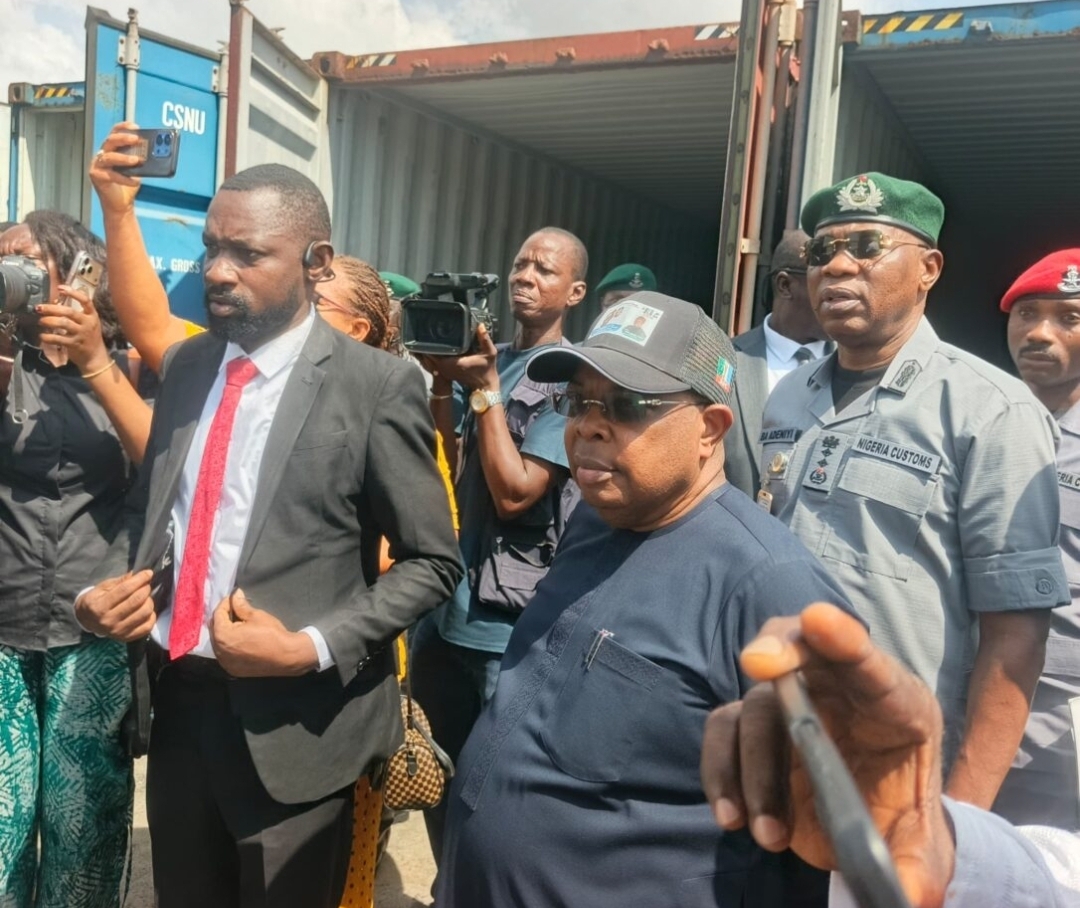
The Comptroller-General of Customs, Adewale Adeniyi, disclosed this at a joint press briefing with the Minister of Power, Joseph Tegbe, during the flag-off of the evacuation of the first batch of 44 containers at ENL Consortium Terminal.
Adeniyi said the exercise formed part of a wider government initiative to recover more than 300 containers of critical electricity sector equipment that had remained uncleared at various ports, including Apapa and Tin Can Island.
“The consignments contained high-capacity transformers, electrical cables, switchgears and other transmission equipment imported for government-backed electricity projects through the Federal Ministry of Power, the Transmission Company of Nigeria (TCN), Niger Delta Power Holding Company and other government agencies.
“The clearance followed a presentation by the Minister of Power to the Federal Executive Council, after which President Bola Ahmed Tinubu directed the immediate release of the equipment and instructed relevant government agencies to resolve all outstanding charges and administrative bottlenecks.
“In line with that presidential directive, the Service has commenced the immediate clearance of more than 200 containers of power equipment. Today, I’m here with the Honourable Minister of Power to flag off the release of the first 44 containers from ENL Terminal. Another 54 containers at other terminals, in Tin Can and other ports, would also be released in turn,” he explained.
According to Adeniyi, the Service was working with the Federal Ministry of Power, TCN, Niger Delta Power Holding Company, Nigerian Bulk Electricity Trading and other stakeholders to ensure that the clearance exercise was completed without further delay.
He said Customs had introduced special measures to facilitate the evacuation, including priority processing of the consignments, dedicated officers for joint examination and the application of approved waivers on relevant charges accumulated while the equipment remained at the ports.
He specifically acknowledged the Minister of Finance and Coordinating Minister of the Economy, Wale Edun, for approving waivers on administrative charges, while appreciating the Minister of Marine and Blue Economy, Adegboyega Oyetola, for facilitating waivers on demurrage charges through engagements with terminal operators.
He also commended Adelabu for his commitment to resolving the prolonged problem, noting that the cooperation of the various ministries and government agencies had made the clearance exercise possible.
He said that following evacuation, technical experts would examine the equipment to establish their condition and determine which could still be deployed for electricity projects across the country.
He explained that serviceable equipment would be allocated to ongoing and stalled transmission projects, including transmission corridors and substations, while obsolete materials would be disposed of in line with existing regulations.
However, Adeniyi said the exercise had exposed a disturbing practice among some contractors handling government projects, who import equipment with public funds but abandon the consignments at the ports without executing the projects for which they were procured.
He described such contractors as economic saboteurs, arguing that their actions had deprived Nigerians of electricity, employment opportunities and other economic benefits expected from the projects.
“The problem was not peculiar to the power sector, as similar cases had been identified involving consignments imported under government programmes and donations from international organisations and donor agencies, including equipment meant for critical health interventions,” he said.
He warned that the Customs Service would no longer tolerate such practices, adding that it would work with supervising ministries and relevant oversight agencies to identify the contractors responsible and ensure they were held accountable.
“Some contractors deny Nigerians the electricity, the jobs and the services these projects were meant to deliver. Contractors who accept government projects, are paid for them and fail to deliver, while abandoning projects at the ports, should henceforth be regarded as economic saboteurs,” he said.
He added that Customs would make available relevant information on abandoned government consignments to enable the appropriate authorities take action against contractors found culpable.
Speaking at the event, the Minister of Power, Joseph Tegbe, described the release of the equipment as a major step towards revitalising Nigeria’s electricity transmission infrastructure, which has suffered years of stagnation.
He said that the prolonged abandonment of the equipment had affected the expansion and rehabilitation of the national transmission network, with some transmission projects remaining uncompleted for nearly two decades.
He explained that the equipment had originally been procured to expand the transmission network, strengthen substations and improve the country’s capacity to evacuate electricity generated from power plants to consumers.
According to him, the consequences of the prolonged delay had been enormous, as valuable equipment remained uninstalled while public funds used for their procurement were tied down.
He noted that existing substations had continued to operate under pressure because the additional facilities and equipment intended to support them were unavailable, while prolonged storage had exposed the imported materials to possible deterioration.
He said the situation had contributed to operational inefficiencies, increased pressure on existing infrastructure, avoidable interruptions in electricity supply and difficulties for businesses and public institutions that depend on reliable power.
Tegbe expressed appreciation to President Tinubu for approving the release of the containers and directing the necessary inter-ministerial collaboration to overcome the administrative and financial obstacles that had prevented their evacuation.
He particularly commended the Comptroller-General of Customs and officers of the Service for their cooperation, describing their intervention as exceptional.
He disclosed that 98 out of the initial 300 containers had received approval for release, describing the development as the first major step towards recovering the stranded equipment and returning them to productive use.
He said the immediate priority was to translate the approval into physical evacuation while ensuring that all necessary procedures, including the return of empty containers to shipping lines, were properly completed.
Tegbe explained that the Ministry, working with TCN and other technical stakeholders, had already commenced the process of identifying the intended projects for the equipment.
He said engineers would inspect the recovered materials, assess their physical condition and conduct the necessary technical tests before determining which ones could be deployed.
According to him, some of the equipment, particularly relatively new materials, had already been identified for specific projects following an assessment by TCN’s engineering department.
He listed Kaduna, Ajaokuta, Lokoja and Enugu among locations expected to benefit from the deployment, adding that other parts of the country would also receive equipment in line with the requirements of their respective transmission projects.
The Minister said the intervention would help improve the capacity of the transmission network, strengthen electricity evacuation from generation facilities, provide greater flexibility in network operations and reduce interruptions associated with overloading.
He added that the deployment of the recovered equipment would also improve voltage performance and strengthen electricity supply to homes, businesses and essential public institutions.
Tegbe said the government was determined to ensure that the recovered equipment did not suffer another round of abandonment, promising that a structured project management approach would be adopted to facilitate their installation and commissioning.
He also disclosed that the Ministry was strengthening coordination among relevant agencies to ensure that future procurement processes were properly aligned with project implementation timelines, thereby preventing a recurrence of the situation.
While expressing optimism that the first batch of containers would be physically evacuated immediately, the Minister said the government was targeting the evacuation of the remaining consignments within the next one month.
Meanwhile, terminal operators have pledged their support for the Federal Government’s intervention, assuring the Ministry of Power and Customs that they were ready to facilitate the immediate evacuation of the stranded equipment.