Follow Us on Google
The news struck like thunder, like Thunder Balogun’s badly missed last minute, equalising goal against Ghana, Nigeria’s soccer enemy of my Ghanaian childhood! I cried listening to it on radio. It hit me with the profound shock and finality of a referee’s final whistle in my beloved football game, a closing chapter: Dr. Christopher Kolade, every Nigerian’s father, grandfather, elder statesman, diplomat, broadcaster, corporate titan, and our nation’s very own moral compass, had journeyed home. For a man who had spent his life as a voice of clarity and integrity—a voice whose diction was, as one admirer put it, “eloquently exquisite”—the subsequent outpouring of grief on social media was a cacophony of heartfelt tributes, a digital wake of respect and shared memory. It was on platforms like Facebook that the multifaceted legacy of “CK” was truly laid bare, moving from the realm of public record into the intimate mosaic of personal impact.
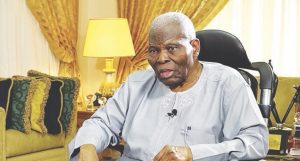
The collective mourning was less about the fact of his death at a ripe age, and more about the quality of the life he lived, a life that touched every sector of Nigerian society.
The Icon of Integrity and Competence
Across the spectrum of tributes, the words “integrity,” “competence,” and “principle” were the inescapable anchors. Dare Babarinsa, a veteran journalist and privileged colleague on the Olusegun Obasanjo Presidential Library (OOPL) implementation board, spoke with a reverence born of close association. He recalled Kolade’s presence as one that “exuded authority, sagacity, and capacity,” positioning him as the “measuring rod of competence and integrity in public service” across his stations as Director General of the Nigerian Broadcasting Corporation (NBC), Managing Director of Cadbury Nigeria Plc, and High Commissioner to the Court of St. James. Babarinsa’s gratitude for “the privilege of learning from this great man” echoed the sentiments of a nation that saw Kolade as a walking academy of professional excellence.
This view of Kolade as an institutional builder was reinforced by Abubakar Bukola Saraki, the former Senate President, who received the news of the “elder statesman, veteran broadcaster, boardroom guru, with shock.” Saraki’s tribute honed in on the consistency of Kolade’s character: “always principled, humble, and profoundly dedicated to the progress of our nation.” Similarly, Bayo Komo offered a concise salute: “Rest in peace Dr Christopher Kolade, an epitome of integrity… A proud Ijesha man.”
The Quintessential Communicator and Mentor
Perhaps nowhere was Kolade’s meticulousness more keenly felt than in the realm of communication, a field he defined with an almost legendary attention to detail. Victor Oladokun, who served under Kolade at Cadbury Nigeria Limited in various managerial roles, offered a brilliant, instructive anecdote that became an immediate favourite among readers. Oladokun recalled drafting a corporate media release only to have CK call him in to face a draft “covered in red ink.” Kolade’s lesson was swift and crystal clear: “Now, go back to your office, and write it just like you’ve explained,” adding the timeless advice, “By the way, cut out the big words. Keep It Short & Simple.” For Oladokun and countless others, Kolade wasn’t just a boss; he was a master class in the power of clarity.
This theme of mentorship transcended corporate walls. Theo John-Phillips, a former student at the Lagos Business School (LBS), celebrated Kolade’s teaching prowess: “His grasp of English grammar used to astound me and he was such a good teacher.” Phillips lamented that Kolade’s capacity to “hold a very engaging conversation… is a dying art these days,” confirming CK’s status as a rare intellectual and conversational gem. Even in his refusal to court the limelight, Kolade taught. Timothy-Crown Aderibigbe detailed the struggle to get Kolade to consent to an interview, saying he felt “there was nothing to celebrate.” Aderibigbe’s team’s persistence, which led to a profile of “a man who depicted simplicity and integrity,” inadvertently became a lesson in the humility of true greatness.
The Humane Leader and Compassionate Soul
Other News
Beyond the boardroom and the broadcasting studio, the most moving tributes unveiled the tender, deeply human side of Dr. Kolade—the compassionate soul and faithful man. Timi Edwin, who runs the CrimsonBow Sickle Cell Initiative, shared a deeply personal, heart-rending narrative. Kolade was not just a benefactor who gave the organisation their “first $1,000,000,” but a hands-on mentor who “hosted a board meeting for us in your living room, teaching us what true leadership and structure look like.”
Edwin’s tribute was doubly poignant as it revealed Kolade’s own private pain, endured with extraordinary grace. She hailed his “strength beyond words,” noting that he carried on with “grace and faith” despite “losing your two biological children to sickle cell in their 30s.” This personal tragedy only magnified his commitment to humanity, showing a man who knew loss yet remained a pillar of belief and care, even visiting Edwin to “soothe my broken heart when I lost my mum.”
This fatherly warmth resonated with ‘Bunmi Oke, who called Kolade a “father to so many of us.” She cherished the “prayers and guidance for over 30 years,” and was privileged to receive a “birthday blessing from him in person this May 2025.” Her prayer to learn from his “humility that I pray to learn from him for life” encapsulated the profound impact of his quiet leadership.
The Nigerian Spirit, Refined and Radiant
The tributes culminated in a beautiful, almost poetic appreciation of Dr. Kolade as the embodiment of an ideal Nigerian character. Veteran broadcaster Rufai Oseni offered a tribute that was a study in contrasts, positioning Kolade as the unchanging moral constant: “In content and character, he remains the same—be it sunny or rainy.” Oseni declared that Kolade’s “red blood cells carry the green and white of Nigeria,” describing him as “Nigeria—refined, resilient, and radiant.” He concluded that to “sit at the same table with him is not just a privilege—it is a lesson. A lesson in humility, in wisdom, in quiet strength.”
Anikeade Funke Treasure captured the mythical status Kolade held in broadcasting, citing an encounter where he sternly corrected a presenter’s mispronunciation—a story that reflected the “awe he inspired and the reverence he commanded.” She saw his passing as signalling “the end of an era in Nigerian broadcasting—a man of class, composure, dignity, decorum, respectable and distinguished in every way, and unforgettable in the service of the nation.”
Kayode D. Olatunbosun synthesized the lessons from the life of the great man, noting that Kolade “asked God only that he might teach, who then became broadcaster, business leader, diplomat, mentor, yet never lost respect for people, never abandoned integrity.” He taught that “leadership is not the highest office, but how you hold the office, how you treat those around you.”
As the digital tributes eventually fade into the archives, the collective memory remains luminous. Dr. Christopher Kolade’s life, as evidenced by the heartfelt tributes of those who knew him from the highest echelons of power to the most personal moments of grief, was a monument to the enduring power of character over celebrity. He didn’t just teach us how to lead or how to speak; he taught us how to be—with humility, principle, and an unwavering moral compass. He lived fully, and in his death, he leaves behind not just sorrow, but a well-lit path for those who dare to follow the light of integrity. May the valiant soul of this great countryman, this Nigerian saint of a man, rest in perfect peace.