Follow Us on Google

With Okorie Uguru
Ethiopia is a country of mystery, history and culture. Almost every part of the country captures these. From the country’s fast developing capital, Addis Ababa to exotic ancient places like Axum, Lalibela and Bahir Dar, there is always this surreal sense when walking through them, listening to the lugubrious songs echoing from the monasteries, reliving their history, and also experiencing the people.
This is the fascination that Ethiopia holds and keeps capturing the interest of tourists. Every year, millions troop into the country to experience it.
The ancient city of Gondar is one of the best tourist offerings of Ethiopia to the world. It is located in North Western Ethiopia, in the Amhara region. Like other parts of the country, the area spreads on a high altitude landscape, at about 2,133 metres above sea level. To get to Gondar, about 654 kilometres from Addis Ababa, one needs a little above one hour trip from the country’s capital by air.
In this modern era, most inter-city journeys in Ethiopia are done by air due to the rugged terrain and the mountain ranges.
However, Gondar remains one of the most intriguing cities in Ethiopia. It is a very ancient city that captures the spirituality, religious ceremony and tumultuous political history of the country. Most tourists visit Gondar for two main reasons: to be part of the annual religious festival of Timket (Epiphany) and also to visit the ancient castles of Gondar popularly referred to as the Camelot Castles because of the ancient grandeur the castles capture.
Timket Festival
Timket (Epiphany) is a unique, solemn religious festival in Gondar where culture, tradition, history, and the spirituality of the Ethiopian people come alive. The Timket Festival is a UNESCO inscribed as an Intangible Cultural Heritage of Humanity at the global level.
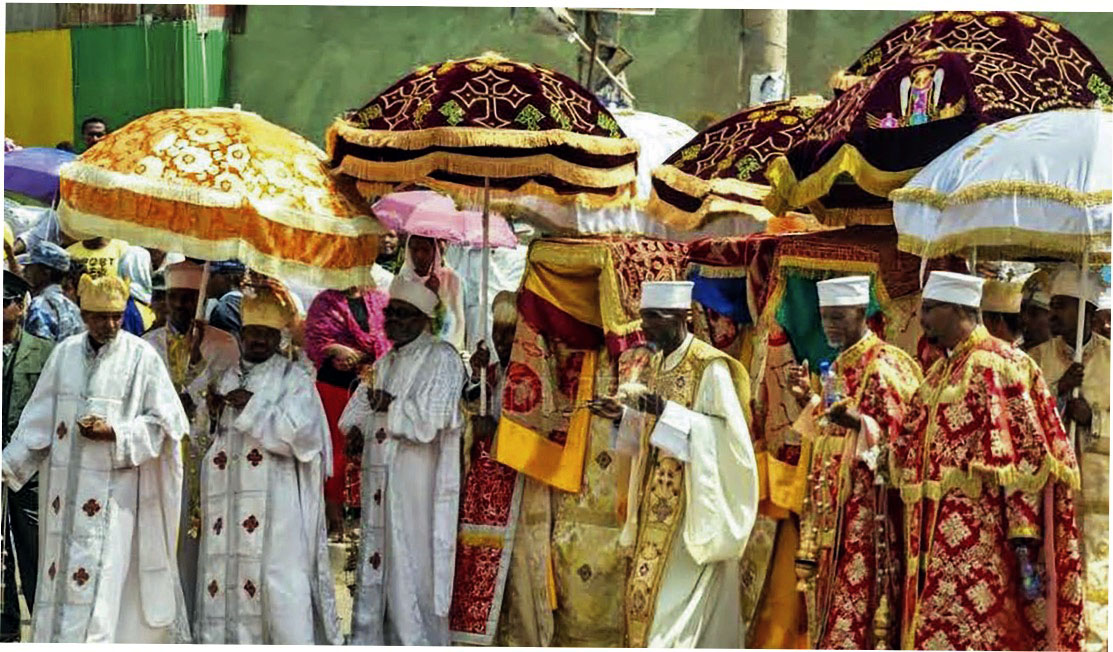
Every year, members of the Ethiopian Orthodox Church hold the festival to celebrate the baptism of Jesus Christ by John the Baptist in River Jordan. The festivities start on Ketera, which is the eve of Timket, when the Tabots — replicas of the Ark of the Covenant, are carried from churches to nearby water sources in a procession. Dressed in dazzling white traditional attire with colourful umbrellas shading priests, the streets turn to one huge arena of celebration.
The heart of the festival is the dawn ceremony, where priests bless the water, symbolising the renewal of faith. Pilgrims and worshippers then partake in symbolic baptisms, a ritual that brings people together in spiritual harmony.
The festival is not just about the religious activities but the spectacle it created for tourists. Traditional dances, melodious hymns, and the sight of thousands in white garments create an atmosphere of peace.
Aside from participating in the religious ceremony of Timket, Gondar boasts of about 44 ancient churches and monasteries, all part of the Ethiopian Orthodox Churches. It is also a very spiritually satisfying experience to tour some of these ancient churches. Some of these churches can be sighted en route Gondar, usually distinguished by being located within thick vegetations that can be likened to a forest.
Every monastery has a special day they go for celebrations annually, and several of the members walk long distances to be part of it.
The Gondar Castles
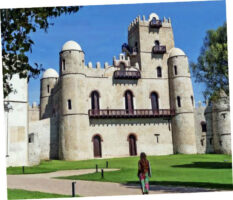
The Gondar Castles are referred to as the ‘Camelot of Africa’. Gondar, during the medieval 17th century, served as the capital of both the Ethiopian Empire and the subsequent Begemder Province.
Tourists troop to the modern city of Gondar because of its many picturesque ruins in Fasil Ghebbi (the Royal Enclosure), from which the emperors once reigned. In the enclosure are many royal castles and palaces.
It started in the medieval era, between the 16th and 17th centuries, when King Fasilidas chose Gondar, an obscure village, to be the site of his empire’s new capital.
According to history, during that period a family was only allowed to dwell in a particular place for just seven generations, after which the eighth generation was expected to move and settle in another village. This practice was done for health reasons like preventing overcrowding, as well as political reasons.
For the royal family, each emperor or king is expected to build his own castle. Gondar has about 20 palaces, royal buildings, highly decorated churches, monasteries and unique public and private buildings.
One of the foremost castles in the city is still the Fasilides’ or the Fasil Ghebbi Palace, which consists of eight components within a 900 metre-long wall, which are: the Castle of Emperor Fasilidas; the Castle of Emperor Iyasu; the Library of Tzadich Yohannes; the Chancellery of Tzadich Yohannes; the Castle of Emperor David; the Palace of Menteweb and Banqueting Hall of the Emperor Bekaffa.
He became an emperor in 1632 and was a member of the Solomonic dynasty. His throne was known as Alam Sagad, meaning “to whom the world bows.’’
Building the City of Gondar, which is now a United Nations Educational, Scientific and Cultural Organisation (UNESCO) World Heritage site, is commonly credited to him.
In the enclosure you can still see the remains of the Castle of Iyasu, commonly referred to as Iyasu the Great, whose throne was known as Adyam Sagad, meaning “to whom the confines of the earth bow.” He lived between 1654 and 1706 and was also a member of the Solomonic dynasty.
Bakaffa’s Palace in Fasil Ghebbi -the royal enclosure- The left side served as a stable for horses and these horses are kept according to the rank of the owners while the right side is the palace.
In addition to the intriguing visits to sites in Gondar, tourists always look forward to dining in Gondar. Among the top places tourists could have Ethiopian meals are the Goha Hotels built on a hill that overlooks the city. Goha Hotel has both dining and accommodation facilities.
For outdoor dining, the Four Sisters Restaurant is acclaimed by most tourists as the best in the ancient city. An experience at the restaurant leaves one with memories.
The Four Sisters Restaurant, according to the co-owners, who are actually four sisters, was aimed at providing the highest quality cuisine in Gondar at a reasonable price. The restaurant provides both traditional and Western food in an enjoyable atmosphere.
The biggest draw of the Four Sisters Restaurant is the traditional dance performance after the meals that leave guests entertained and happy.
Gondar is a taste of ancient experience that lingers long after the tour is completed.