Follow Us on Google
• Say party leaders are old wine in new bottles
By Omoniyi Salaudeen
The recent unveiling of the African Democratic Congress (ADC) as the platform for the new emerging coalition group to contest the 2027 general elections marked a significant milestone in the efforts to form a formidable force against the ruling All Progressives Congress (APC) and President Bola Ahmed Tinubu.
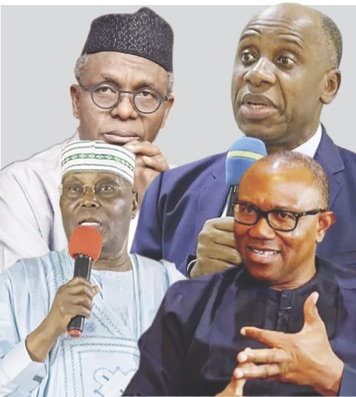
Prominent among the dramatis personae who led the new alliance formation included former Vice Peesident Atiku Abubakar, the presidential candidate of the Peoples Democratic Party (PDP) in the 2023 elections, his counterpart in the Labour Party (LP) and erstwhile governor of Anambra State, Peter Obi, the immediate past governor of Kaduna State, Nasir El-Rufai, the Minister of Transport under the Buhari administration, Rotimi Amaechi, who chaired the Nigeria Governors’ Forum while holding sway in Rivers State, Osun State former governor, Rauf Aregbesola, and former Senate President David Mark.
At the high profile event held at Yar’Adua Centre, Abuja, the group elected Mark and Aregbesola as interim National Chairman and Secretary respectively. Ignoring the myths around each of these key figures who had dominated the political space for decades, the new alliance force made a made a bold statement, declaring its commitment to rescuing Nigerians from bad governance.
The coming together of the opposition parties under the banner of ADC is an unfolding new political subterfuge aimed to leverage the perceived public discontent with the hardship being experienced in the country under the present government. Since the adoption of ADC as a platform, this initiative has been characterized by rapidly changing power scheming or permutations, reflecting the diversity of interests by the strange bedfellows that coalesced to form the new merger alliance.
Permutations
By sustaining a strident campaign against the Tinubu administration, the-Atiku-led opposition is strategically planning to reenact the past experience of former President Goodluck Jonathan whose re-election bid was truncated by the then newly formed APC. Consequently, they have adopted “rescue mission” as a political slogan to appeal to public sentiments.
The alliance arrangement that culminated in the formation of APC as a formidable opposition is already a familiar story. Its formation in 2013, through a merger alliance, was a strategic masterstroke that fundamentally altered Nigeria’s political landscape and directly led to the defeat of the incumbent President Goodluck Jonathan in the 2015 general election.
The defeat highlighted the combination of two significant political forces: Muhammadu Buhari’s stronghold in Northern Nigeria and Bola Ahmed Tinubu’s political machinery and influence in the Southwest. Buhari, a former military Head of State, with a massive and loyal following, particularly in the core Northern states, had contested the presidency in 2003, 2007, and 2011, consistently securing millions of votes, predominantly from the North, even when his party, the Congress for Progressive change (CPC) lacked strong national structures. His reputation as a disciplined and anti-corruption crusader resonated deeply with a segment of the Northern electorate.
Bola Tinubu, a former Governor of Lagos State and the leader of the Action Congress of Nigeria (ACN) widely recognised as a master political strategist and networker, had equally meticulously built a formidable political structure across the Southwest geopolitical zone. Understanding that the fragmented opposition could never defeat the entrenched Peoples Democratic Party (PDP), he was instrumental in pushing for the merger of opposition parties, leading to the formation of APC in February 2013 through the merger of the defunct ACN, CPC, the All Nigeria Peoples Party (ANPP) which also had significant presence in parts of the North and a faction of the All Progressives Grand Alliance (APGA). A significant number of governors and legislators from the then-ruling PDP, who felt marginalized within their party (dubbed the “New PDP”), later defected to the APC, further strengthening the new party’s national appeal and electoral machinery. The combined strength of Buhari ‘s strong following in the North and Tinubu’s ability to deliver a substantial majority of votes from the populous Southwest, a region crucial for national victory, created an electoral synergy that the PDP could not withstand.
The 2015 election was historic, as it marked the first time in Nigeria’s democratic history that an opposition party successfully unseated an incumbent ruling party, leading to a peaceful transfer of power.
This significant event occurred at a time of growing public discontent with the PDP’s long reign, particularly regarding issues of insecurity (Boko Haram insurgency) and corruption. The APC effectively capitalized on the “Change” mantra to rally these sentiments.
Rumoured Atiku/Obi ticket
Atiku and Obi are believed to be planning a similar strategic alliance to give Tinubu a dose of his own medicine. There is a widespread rumour that Obi has conceded to be Atiku’s running in the 2027 presidential race, hoping to leverage their combined voting strength to oust Tinubu. However, Obi has debunked the insinuation, insisting on contesting the presidential election.
Like the change slogan that heralded the Buhari administration in 2015, the phrase “mission to rescue” Nigeria from bad governance” sounds highly appealing and evokes strong emotions, precisely because it touches on the deep-seated frustrations and aspirations of the populace.
But due to the immediate past experience as well as political history, a sizeable portion of the populace views such pronouncements with scepticism. They see it as strategic manoeuvres designed to win votes rather than genuine, actionable blueprints for radical improvement. Therefore, the challenge for the ADC or coalition using this rhetoric is to prove that their mission is different and that their actions will genuinely match their words.
Nigerians across all demographics are acutely aware of the challenges posed by the current economic hardship, insecurity, corruption, poor infrastructure, and inadequate social services. And, of course, a “rescue mission” speaks directly to these pains and offers a glimmer of hope.
A rescue mission promises to wipe away the past and usher in a new era. Whereas, in reality, the actual implementation is far more intricate.
Like the “Change” mantra of the APC in 2015, which promised to tackle corruption, rescue mission is heavy on rhetoric but light on concrete and implementable plans. Its appeal is generalized, focusing on the desire for good governance rather than a detailed roadmap of how it will be achieved, or who specifically will lead that charge beyond the top candidate.
Critics argue that the primary goal of such appeals is to win elections, rather than a deep, ideological commitment to fundamental societal transformation. They believe that once in power, the complexities of governance and the pressures of the political system will ultimately dilute the “rescue” agenda.
Trust deficit
Secondly, many of the leading figures in the coalition have trust deficit, being the same old faces that led Nigeria to the current dismal state of the economy. The coalition is like the ‘old wine in new bottles”.
Atiku Abubakar, Peter Obi, Nasir El-Rufai, Rotimi Amaechi, Rauf Aregbesola, Aminu Tambuwal, David Mark, among others – are largely established figures who have been active in Nigerian politics for many years, often at the highest levels. There are no prominent new faces among the leading forces. This is different from the change people are yearning for. Many Nigerians are yearning for a new alternative and a fundamental shift in political culture, leadership style, and policy approach.
Therefore, critics argue that the coalition is simply a recombination of the same political class that has governed Nigeria for decades, perpetuating the same issues.
This time, people are genuinely hoping for a completely fresh set of leaders untainted by past political baggage. This coalition of veteran politicians is seen as a dilution of the third force narrative which has been long canvassed. The composition of strange bedfellows also carries the risk of differing ideological stances, potentially threatening the coalition’s unity down the line. While the experience of these old renegades may be valuable for building a formidable political machinery, the absence of new faces may also temper the enthusiasm of some who desire radical change.
The question many observers are asking is: if these same individuals couldn’t deliver the desired change within their previous dominant parties, what makes this new platform different?
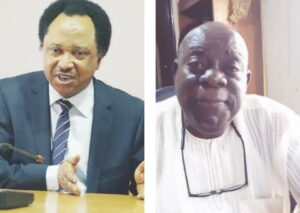
Senator Shehu Sani, who represented Kaduna Central Senatorial District in the 8th National Assembly, described the faces behind the coalition as wreckers of the nation’s economy who were masquerading as the messiah. He had this to say in an interview: “It is a fact that the economic policy of this administration has unintended consequences which serve as prices to be paid by Nigerians. These prices are termed sacrifices.
“But it is important that the Nigerian public separate their sacrifices from political opportunism of political elites who have now converged as messianic coalition. And I will use this interview to speak to the conscience of the common people. You need to ask yourself these questions: With the profile of the faces behind this coalition, do these people actually represent your interest? Will these people lead you to freedom? Will these people lead you to prosperity? Will these people lead you to the future? Deep down to your conscience, look at these faces, do you convince yourself that these people can lead you to the promised land?
“Secondly, if you are looking for people who destroyed Nigeria during the 16 years of PDP, they are in the coalition. If you are looking for people who destroyed Nigeria in the eight years of APC, they are in the coalition. If you are looking for people who participated in the 16 years of PDP and eight years of APC, they are in the coalition. These were governors, these were ministers, these were people who had the opportunity to transform Nigeria, free Nigeria, make Nigeria prosper, but they failed during their terms in office. These are people, who are today; simply because they were out of office for two years, feel marginalised. Now, they are presenting themselves as the messiah, they are presenting themselves as freedom fighters, they are presenting themselves as liberators of Nigerians.”
Also, another chieftain of the ruling APC, who represented Ekiti State in the 7th National Assembly, Anthony Adeniyi, took a swipe at the leaders of the coalition, dismissing the merger alliance as a waste of time.
Speaking with Sunday Sun in a telephone interview, he said: “I don’t want to go into individuals. But who among them has the clout to win an election? They will soon go into disarray. Is it Senator David Mark, who frustrated the election of MKO Abiola you want to talk about? Does he have the pedigree to lead a democratic party? What is he going to tell Nigerians? Or Rauf Aregbesola, who is Tinubu’s political son? What is he going to tell Nigerians? What will Nasir El-Rufai tell Nigerians? Let’s wait and see; campaign will soon start. They are just hungry for power. They want to grasp power without alternative programme to turn things around for the better.
How can somebody say he is coming to rescue Nigerians? Are we under bondage? There is nothing good that will come out of the coalition.”
The pioneer chairman of the All Progressives Grand Alliance (APGA), Chief Chekwas Okorie, in his reaction, noted that the figures leading the coalition are strange bedfellows which would make it difficult to manage in the future. “This coalition is the most formidable coalition in Nigeria since independence. I am not a member of the coalition; I am the grandfather of APGA. No coalition has been this formidable. But the challenge is the conglomeration of strange bedfellows, most of whom are very powerful in their own ways.
“To manage such persons is not going to be easy. I wish the new leaders who have been appointed to manage the party will be able to keep the coalition together. They will require political savvy to be able to hold these strange bedfellows together for a common purpose,” he posited.
Emotion
In Nigeria, emotion rather than rigorous assessment of competence, policy or track record has always dominated voting process, leading to suboptimal outcomes. This time around, voters must demand clear distinctions in policy, approach, and commitment to reform beyond just a change of party slogan.