Follow Us on Google

Ndubuisi Orji, Abuja
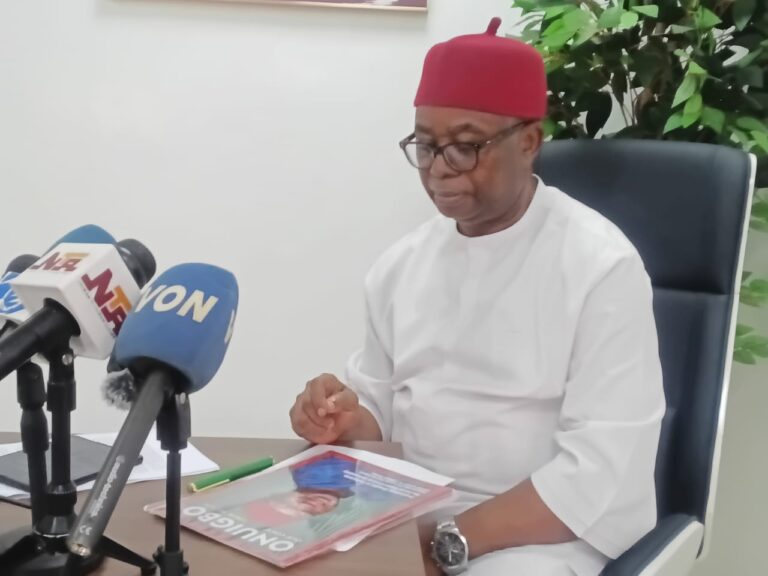
As Nigeria continues to battle the COVID-19 pandemic, the deputy minority leader, House of Representatives, Toby Okechukwu, has said it is time for the country to look inward in sourcing for solutions to her challenges.
Okechukwu, who spoke in an interview with select journalists in Abuja, said among others that the country has not been optimising her institutions in addressing national challenges.
Recently, you moved a motion urging the House of Representatives to probe the deployment of local medical and and pharmaceutical researches in finding solution to COVID-19 pandemic in the country. What informed that motion?
I am not very rich in medical vocabulary. But when I heard about pandemic, I looked it up in the dictionary. It presupposes something that has universal application; that affects everybody. Which means if you have any issues here, every other person has it.
From day one, I thought that there should be an approach that each country should pursue. It is in our enlightened self interest that look, this is an approach we would take to solve our problem, if help doesn’t come from elsewhere.
So, for over three months I was not seeing any significant effort in that direction, particularly in research and coordination of efforts in that direction. The visibility of our research institutions, pharmaceutical research institutes and medical research institutes were completely absent.
At the last count, during an interview recently, the NAFDAC DG said it was only one request from some of the people who have worked on this, local solution or cure to COVID-19. So, I just concluded that there is some level of absent mindedness here, that we are not getting it right.
So, I now felt that it was important that we check the status of our research institutions, particularly the pharmaceutical research institutes and medical research institutes, on their preparedness with regard to the fight against COVID-19 and other diseases.
You would appreciate that it is not only COVID-19. We have lassa fever and it has killed a good number of Nigerians. I don’t know what the number is now. And it is in 25 states and it is widespread. That is what is called in medical parlance epidemic. So, it is a huge challenge and I felt that there should be a home-grown solution.
There are some of these issues that we should optimize the opportunities they offer and that was why I felt that it was important, the House acting on its own constitutional powers should interrogate some of these agencies and find out what the challenges are.
Nigeria is in possession of some herbal extracts from Madagascar that can take care of COVID-19. Are you perturbed that Nigeria hasn’t come up with anything like that?
I am happy that Madagascar is working in the direction of finding a solution. I don’t know what clinical protocol they have gone through to come to that conclusion. But you can see indication of an effort.
My worry is, like what I said earlier, dependence on foreign help. There is some kind of over excitement in Nigeria about it and the issue with it is that Madagascar set up a programme, tried to find a local solution to it, found it and it has been exporting it to other countries.
Whether it has been sanctioned by their clinical protocols in their country, but before you use anything here, it has to be licensed by NAFDAC. So, my happiness is that it solves the problem but my unhappiness is that those same roots or herbal properties are prevalent here.
So, if it is true that could deal with it, you would say what were Nigerians thinking that they didn’t do same or approach some other solutions.
And the advantage we have in this hemisphere is that our forest are still as God created them. Some of these other people have completely deforested their own.
Many of these medications or approaches to cure are usually from how rich an environment is. They are not purely synthetic. You need to make your findings through things God has created and we have them in abundance here. So, my worry about it is that we are not doing what we should be doing and that is because we are hoping that solution comes from oversees.
In your own estimation, what do you think that we should be doing?
What I think we should be doing is to optimise the use of our institutions. My expectation is that government particularly the Federal government through the Ministry of Health and the Presidential Task Force (PTF) on COVID-19, should have set up a team of professionals that would be looking day in and day out on how to deal with this pandemic in terms of medical research, in terms of pharmaceutical research.
My expectation was that they should set up a team of professionals from the pharmaceutical companies with a clear objective of finding solution to this problem. They should look at a cocktail of either existing drugs; to what extent can they mitigate the challenges we have?
Suddenly they told us they have been trying this HIV, Ebola drugs and all that and it is reducing the impact of the ailment by 31%. Those drugs are they not here? Why has somebody not attempted to work on them? These are existing drugs. Even the chloroquine they are talking about, they are depending on what people from oversees say. So, to what extent are we subjecting it to scrutiny? So, that is how to make progress.
So, my worry is not that I am not happy with Madagascar findings, even if its veracity is not yet authenticated. My worry is that we don’t appear to be working on something. We don’t have to be successful, even when you fail; you will know that there are some certain things you don’t try any more.
Funding has always been a challenge here. As a principal officer of the House that appropriates, speaking about research, do we now say we have a ray of hope coming from the national Assembly to help this research exercise?
The COVID-19 has affected our economy massively as well as other areas of our lives; what lessons can Nigeria draw from this pandemic?
First and foremost it is not just affecting our economy, it is affecting our health sector and the safety of Nigerians. The responsibility of government is the protection of lives and properties. We have not sufficiently protected lives, because we are losing our citizens unnecessarily.
Two is the economy. I think the effect on our economy is the temporary set back, because of our dependence on crude oil and it is not selling; if it is selling, it is selling at a cheap price. So, the lessons to draw from it will be to look inwards. Try to see what extent you can lock up yourself and say look these are the things I can deal with summarily.
So that you can now begin to talk about the things you want to bring in, where you don’t have competitive advantage. In oil, we have competitive advantage. The minimum we would done was to refine those products and sell them at N50 per litre.
We need to look inward, a pandemic presupposes that everybody has a problem.