Follow Us on Google
From Godwin Tsa, Abuja
The Abuja division of the Federal High Court has dismissed the suit filed by Sen. Adamu Bulkachuwa to stop the Independent Corrupt Practice and other Related Offences Commission (ICPC) and the Department of State Security Service (DSS) from investigating him over confession to influencing his wife’s decisions while she was serving as the President of the Court of Appeal.
Zainab Bulkachuwa was the President of the Court of Appeal between 2014 and 2020. She retired from the court after clocking the mandatory retirement age of 70.
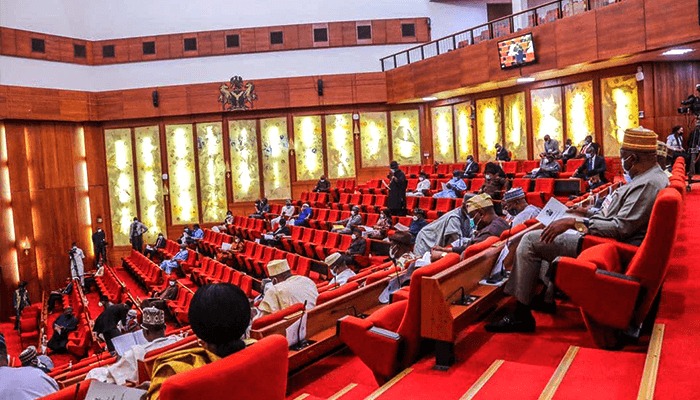
Speaking at the valedictory session of the 9th Senate on June 10, Sen. Bulkachuwa boasted of infringing on his wife’s “freedom and independence” while she served as president of the appellate court.
He bragged that he aided his colleagues in the Senate to obtain favour from his wife, who was superintending over the Court of Appeal that served as the final arbiter on appeals concerning electoral disputes in parliamentary elections in Nigeria.
“My wife, whose freedom and independence I encroached upon while (she) was in office, and she has been very tolerant and accepted my encroachment and extended her help to my colleagues,” said Mr Bulkachuwa, 83, during the senate’s proceedings.
In his judgment on Tuesday, Justice held that the suit lacked merit and ought to be dismissed.
Justice Ekwo said that Bulkachuwa, being a lawmaker, ought to understand the implication of the statement that he made on the floor of the Senate.
According to him, the legislative immunity which the plaintiff (Bulkachuwa) claims in this case does not avail him.
“It is the duty of every law-abiding citizen to assist and cooperate with law enforcement agencies in their quest to carry out their statutory function.
“It is only where a law enforcement agency breaches the fundamental right of a citizen in the process of carrying out their statutory function, then a cause of action could be said to have arisen,” the judge said.
Bulkachuwa had sued the Attorney-General of the Federation (AGF), the NASS clerk, State Security Service, ICPC and the Nigeria Police Force as 1st to 5th defendants respectively.
In the suit marked FHC/ABJ/CS/895/2023,
the former lawmaker asked the court to declare that he “is covered, privileged and protected by the parliamentary immunity as enshrined in Section 1 of the Legislative Houses (Powers and Privileges) Act 2017 and freedom of speech and expression made thereto is privileged.”
He also prayed the court to declare that without exhausting the internal disciplinary mechanism, recommendations and approval of the 9th House of Senate, no other law enforcement agent of the Federal Government, including the defendants can invite any member of the Senate for questioning/interview.
But Justice Ekwo said the utterance made by Bulkachuwa on the floor of the Debate on June 10 was not covered by Section 39(1) of the 1999 Constitution.
“The provision is that every person shall be entitled to freedom of expression, including freedom to hold opinions and to receive and impart ideas and information without interference.”
According to the judge, the clear words of Section 39 (1) of the 1999 Constitution (as amended) cannot be interpreted to mean that a person can say anything he likes.
“In a formal setting like that plenary session or committee proceedings of the Senate, It is not expected-a person who is privileged to voice any expression will utter words or express opinion or impart Ideas or gives’ Information that cannot be defended under the constitution.
“Upon studying the provision of Section 39 (1) of the 1999 Constitution (as amended), it Is my opinion, that the words uttered by the plaintiff on the floor of the Senate on Saturday, 10th June, 2023 was a confession of doing an act that is prohibited by law.
“When a person confesses that he influenced a judicial officer to help his friends and colleagues, such a person has gone beyond the limit of freedom of speech that is reasonably covered and protected by the provision of Section 39 (1) of the 1999 Constitution (as amended).
“A person who has used the opportunity given to him by the constitution to express himself freely and uses the opportunity to expose his actions or conduct which the law of the land criminalises, has unwittingly invited law enforcement agencies to question him.
“This is what the plaintiff did in this case.
“I therefore find that that the speech of the plaintiff on the floor of the Senate on June 10, was a confession of illegal act and Section 39 (1) of the 1999 Constitution (as amended) cannot be invoked to cover such and I so hold,” he declared.
The former lawmaker had sought a judicial interpretation of Section 1 of the Legislative Houses (Powers and Privileges) Act 2017, which confers immunity on him from any civil or criminal litigation in respect of any utterance he makes on the floor of the Senate in his capacity as a serving senator.
Adamu is also asking the federal high court in Abuja, to declare that ICPC’s invitation on the matter was illegal and oppressive.
He is also seeking; “A declaration by the court that the applicant is covered and entitled to the constitutional privileges and protection offered as freedom of speech/expression by Section 39(1) of the 1999 Constitution of the Federal Republic of Nigeria (as amended) and Parliamentary Immunity as enshrined in Section 1 of the Legislative Houses (Powers and Privileges) Act 2017.
“A declaration that the applicant is entitled to freedom of speech/expression by Section 39(1) of the 1999 Constitution of the Federal Republic of Nigeria (as amended) and as exercise by his other Senators’ colleagues and having not been so afforded by the leadership of the Ninth Senate, cannot be held liable for the unintended inference of an inchoate speech/statement/expression.
“An order of perpetual injunction restraining the respondents jointly and severally, particularly the 4th respondent (ICPC), acting directly or indirectly through their agents, officers, privies, assigns, and any other persons by whomsoever or however constituted from inviting, harassing, intimidating and/or compelling the applicant to appear before the respondents pending the hearing and determination of suit.”