Follow Us on Google
By Onyeka Nwelue
In 2015, I was one of the people who swore President Muhammadu Buhari was the best thing after Agege bread. I campaigned so hard for him. Hoped for a Messiah.
In 2018, during the campaigns, the Professor Kingsley Moghalu option became encouraging when the Opposition candidates met, and decided to field ONE candidate. Turned disheartening when the result was not acceptable to Professor Moghalu and some others. I shifted my support to Dr. Oby Ezekwesili when she threw her hat in the ring. Did that – or other potential entries – invalidate the previous exercise? Seemed logical. The situation turned fluid.
I was just everywhere, looking for a competent person, to lead Nigeria.
I campaigned for Sowore, too. I had just left psychiatry in Johannesburg, where I had been in and out. He had a town hall meeting with Nigerians in Pretoria. We first met up in Johannesburg and I told him of my travails. He was sympathetic.
There are competent people who can lead Nigeria.
This is why I openly threw my support for Peter Obi this year and, when he came to Oxford at the end of last year, I was the first person to get to Oxford Union Building to wait for him.
The election, my mother travelled from the UK to Nigeria to vote for Peter Obi. During her morning devotions, which echoed through the walls of my room, she would ask God to make Peter Obi win. On the day of the election when I called her, she told me that everyone in my village, Ezeoke Nsu, voted for Peter Obi. So, I kept hoping also that Peter Obi would become the President of Nigeria.
However, I didn’t realize that some of my actions, which I didn’t put much focus on, had consequences. Associating with some people, would get me scandalized, for sins that were overlooked for so long.
This leads me to David Hundeyin.
I met David Hundeyin for the first time on the 30th of January, 2023, at Heathrow Airport.
Prior to that, he was just this intriguing person and an unrelenting anti-establishment battle tank of a journalist who had made a name for himself in the Nigerian cyberspace with his series of investigative reporting and exposés on corruption and criminality in high places in Nigeria; with some of his most notable works being Cornflakes for Jihad and a damning report on president-elect Bola Tinubu’s drug-running past.
David Hundeyin also did a report where he touched on Flutterwave’s allegedly unethical company practices. The report sparked fierce debate on Twitter when it dropped; and it also cost Flutterwave in terms of investors.
One of my closest friends was among the managing heads of Flutterwave. If anything, I had more reason to view David from a position of dislike than to be a friend to the man whose report caused heavy losses to the business of someone I love and deeply care about.
My decision to make him a James Currey Fellow was founded on the strength of his works. It was due to the rare consistency in the quality of his journalistic art. A quick look at previous Fellows of the James Currey Society Fellowship and Workshop will throw up names of creatives, tech heads and academicians who are currently out in the world, churning out quality bodies of work. The narrative that the James Currey Fellowship is a reward or a token dashed out to close acquaintances is not only untrue, but it is also a malicious attempt at discrediting the talents and hard work of the fellows.
I was well aware that Hundeyin wasn’t exactly liked in certain quarters: I admit I underestimated just how deep their resentment for him went; and just how far they were willing to go to see to his decimation, even if it meant trying to bury a project that was founded to give voice to Nigerian and African writers. But, I am also one never to blame anyone for my failure.
I already established the James Currey Prize for African Literature before going to Oxford, so it will continue and won’t die. The inaugural winner of the James Currey Prize for African Literature, didn’t get to become a Fellow at the African Studies Centre, but he has gone on to become a successful writer. I have never interfered in the decision of the jury. This is why they have selected the best of the best.
I saw my time at the University of Oxford as an opportunity to project the extraordinary work of some of the brightest Africans of this era; and to show the world the fearlessness and tenacity, despite their respective sacrifices, with which they have pursued and executed their noble objectives. These are values that the indefatigable James Currey is known for.
Hundeyin has been living off the grid, because his work and exposés have put him in the eye of the storm that is Nigeria’s vicious and vengeful political elite. I reached out to him and told him I would like to publish his thoughts. He replied, and we began to communicate via email. Then, I asked for his CV and letter of motivation to send to the University of Cambridge to see about the possibility of his becoming an Academic Visitor there. After some weeks, we got the good news that it had been approved. I remember him asking, ‘How did you do it?’ I said, unlike the country we both came from, the United Kingdom is progressive, and things work differently there.
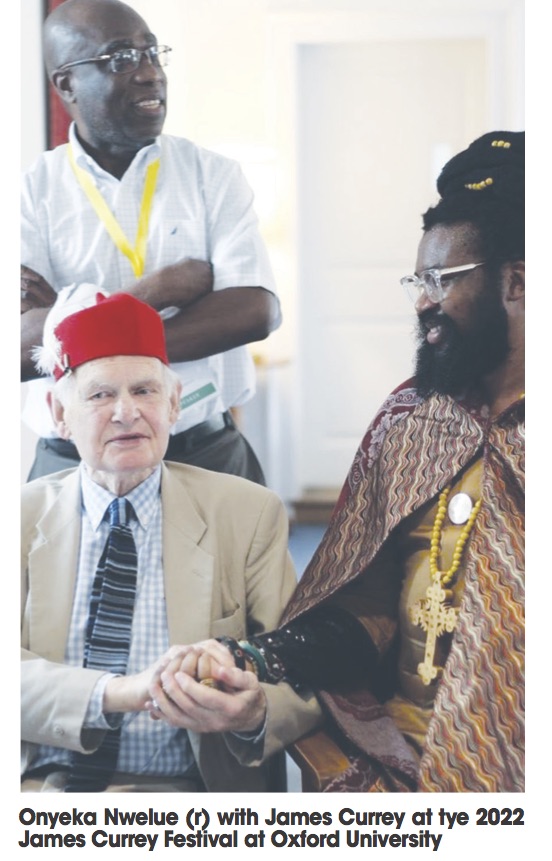
Prior to this, I had built a relationship with the man James Currey, as he was strongly anti-Apartheid in South Africa and had to leave the country for his personal safety. I took Hundeyin to see James Currey because I felt that both men had a lot in common, especially with regard to being anti-establishment voices and being forced to speak from the safety of another country.
Let us not forget James Currey took care of Zimbabwe’s Dambudzo Marechera. Do we know the story of how he was excommunicated in Oxford and made a pariah? I always prayed not to end up that way.
Does anyone know how much I love South Africa and my obsession with the country? South Africa is a model for the fight against suppression.
The inaugural James Currey Fellow at the University of Oxford, Stephen Embleton, is a very hardworking and humble white male from South Africa who was on the shortlist for the James Currey Prize for African Literature. I published his book, Bones & Runes, through Abibiman Publishing, and I also published the first volume of the James Currey Anthology, which he edited under Abibiman Publishing. I never met him until he arrived in Oxford. I chose him also and recommended him to the University, and he was approved as an Academic Visitor. Mr Embleton is now family and not a Fellow or friend. He has met my family, including my mother, and I have had dinner with his wife. He currently designs most of the covers of books published by Abibiman Publishing.
How did people miss that part? So, contrary to the allegations that the James Currey Fellowship is awarded to people I know closely, the truth is actually the other way around. These friendships came after the James Currey Fellowship, not before.
The idea of publishing books by James Currey Fellows is to help to fund their one-month stay in the UK through the sales of their books. There have been suggestions that the scheme is for people I have financial associations with. But that is another false and malicious claim.
Printing a book costs money. Housing a James Currey Fellow in Oxford costs a lot of money. That is in addition to the weekly stipends. Publishing their works will help. There is no external funding for it. At no point have we expected, demanded or received money from 85-year-old James Currey.
The winner of the 2022 James Currey Prize for African Literature, Rosemary Okeke, was meant to come in September, but she did not want to be signed by us and was not ready to be published by Abibiman Publishing. She said she only wanted to work with a woman, which I found puzzling and bizarre, considering she had willingly participated in the award process. Now the same woman has been painting a picture of her being a victim who did not get her prize when, in essence, she absurdly wanted to impose her own terms and conditions on the Fellowship.
Since the sponsored piece by Cherwell, Mr Hundeyin has publicly defended me, graciously clarifying distortions and half-truths through his Twitter handle. I am grateful for that, and I will reiterate that I did not recommend him as an Academic Visitor to the University of Cambridge because he is my friend. We were not friends then, but I will gladly call him a friend now. He has proven himself to be an unstoppable voice, not only in the Nigerian investigative journalism scene, but also as a Nigerian, using his influence to highlight societal ills and government failings to push for a better country.
I have no worries about David Hundeyin’s ability to survive the dark, despicable antics of the establishment seeking to crush him. Unlike me, David does not have a legion of supporters, who would attach their names in his defence; he is probably lonely and feels abandoned and sad.
I hope his over 600,000 Twitter followers are not just ghosts! I hope they are people who can support him, morally, financially and otherwise. Truth is, he does not have the same kind of support system that I enjoy. How lonely is he? Do we just enjoy his work and let him struggle alone? How many of us can come to his rescue, if shit hits the fan?
I have gone into retirement, from active working life, in a rustic town in North America, where I have access to great psychiatric help, where there are people who are truly humane, where disabled people are taken well care of, to take care of my frail health, my struggle with mental illness, which I have never hidden from the public.
From being mentally disabled to physically disabled, struggling with diabetes, a bad kidney and a mental illness, one has to hide, if he must stay alive.
I underestimated the disdain for Hundeyin, as I hold Britain in high esteem. What has happened, has happened.
Under the auspices of the James Currey Society, I hosted people from diverse backgrounds: the fantastic JJ Omojuwa, Chief Keith Richards, Ekezie Kennedy, Dame Peace Anyiam-Osigwe (which was our last meeting), Professor Leslye Obiora, Chief Uche Nworah, the Lagos State Commissioner for Tourism, Art & Culture, Pharm. (Mrs.) Uzamat Akinbile-Yussuf and many more.
Even when IPOB UK came for me, the University of Oxford protected me.
I was never strongly warned not to host Hundeyin. I was not. I thought we were on a progressive ground, where it didn’t matter.
So, as his friend now, I am more than honoured to lend my voice to his defence and state, for the record, that everything I have helped him with, he more than earned ten times over by virtue of his hard work and his sheer talent.
With all my heart, I wish him good luck, bigger recognition and the validatory backing of more honourable and truthful institutions.