Follow Us on Google
By Kehinde Aderemi
In a bold step to transform Nigeria’s inland waterways, Caverton Marine Limited has gone all out to ease water transportation across the country.
From fossil fuel to electric ferry, the marine aviation logistics company has changed the ugly narrative, building Nigeria’s first-ever electric ferry boats called Omibus.
With the support and partnership from Lagos State Government, Caverton Marine has brought life to the waterways.
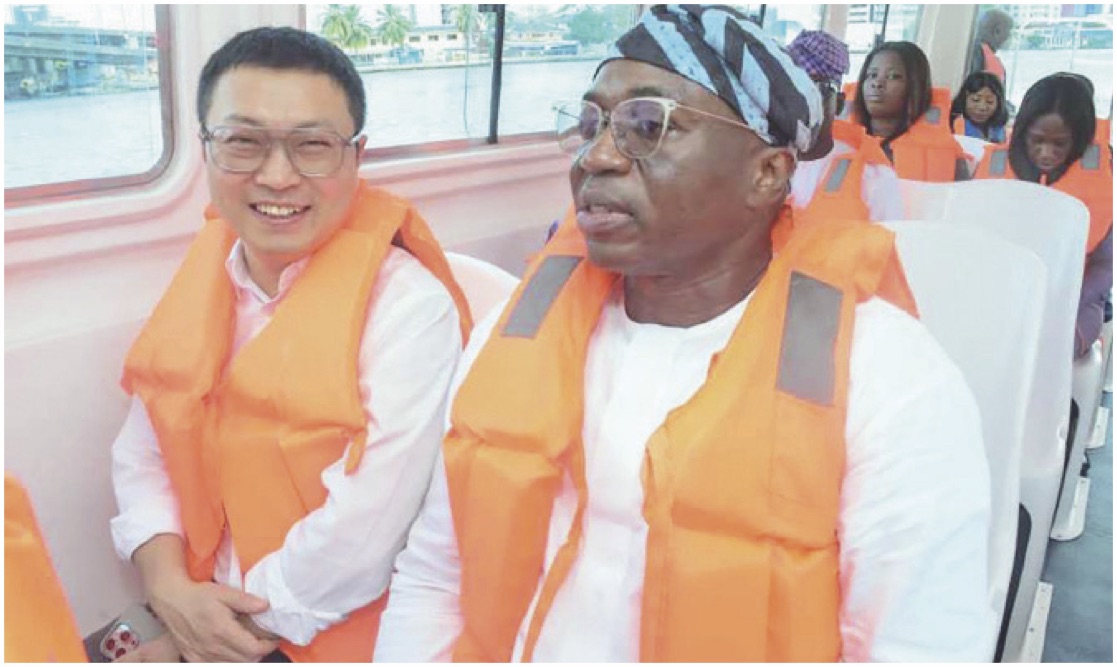
Recently, the Caverton Marine team had an encounter with journalists at the company’s headquarters, located at Ozumba Mbadiwe Street, Victoria Island, Lagos.
It was at the Demo week, tagged Omibus sea trial, where the Chief Executive Officer, Mr. Olabode Makanjuola, told reporters that the Omibus electric ferry was the first of its kind in Africa.
“We are particularly very proud because this is a Nigerian initiative with support from our friends from China. This is a Nigerian project, and it is something that Nigerians should be proud of.
“The Omibus journey started about six years ago, when we were trying to address the challenges of water transportation in Lagos State generally. We looked at how we could improve the lives of average Lagosians in terms of commuting.
“With the support of Governor Babajide Sanwo-Olu, we were set. We decided to develop our first-ever 40-passenger electric ferry.
“Upon successful construction of that ferry, we were commissioned by the Lagos State Government to build 25 ferries, of which 15 have already been delivered and are operational right now. If you look across to the Famolo ferry terminal, you’ll see some of those ferries lined up there.
“Today, you can get to see, hear, feel and experience how we have used Omibus to transform Nigeria’s inland waterways. You will not hear the sound of the electric engine. Electrification is not sustainability; it is a part of sustainability and something we are very passionate about at Caverton Marine,” he said.
Makanjuola also explained how Lagos State Government has helped in fulfilling the laudable vision
“As a marine and aviation logistics company, I have always been very passionate about water transportation. For the Lagos State Government, it is part of the THEMES Agenda, creating intermodal transportation, and we see water transportation as the final leg or the final piece of the puzzle.
“It’s a journey that we’ve been on for a long time. In fact, we have been working on it for five or six years. And altogether, we even worked with administrations going all the way back to His Excellency, President Bola Tinubu’s administration as Lagos State governor. We have been working to modernise water transportation to make it safe for Lagosians.
“So, when the administration of Babajide Sanwo-Olu came on board and they were pushing this intermodal system with the rail networks, we took it upon ourselves that we needed to actually raise the bar for water transportation and actually now see how we can provide better, safer and more decent water transportation system in Lagos.”
He pointed out that during the sea trial,the vessel reached a verified top speed of 30 knots and completed multiple endurance runs, including a long-range voyage to Koko Beach.
“After a full day of testing, the battery remained at 40 per cent state-of-charge, demonstrating strong energy reserves and stable thermal behaviour.
“The propulsion system was supplied by Explomar, while all integration, assembly, and trials were conducted locally at the GRP Workshop in the Naval Dockyard Limited. This vessel represents the first electric ferry of its class to be assembled and sea-trialed in Africa,” he said.
According to the Caverton Marine boss, the electric Omibus, is a passenger ferry designed to operate entirely on electric propulsion, eliminating carbon emissions and significantly reducing operational noise and maintenance costs compared to traditional diesel-powered ferries.
He explained further that the new innovation came with an in-depth overview of the vessel’s technology, battery management system, and operational advantages.
This, he stated, is a momentous step towards a cleaner, more efficient transportation network for Nigeria.
“The Integrated Electric Propulsion of electric ferries were built for local waters. The prototype combines a Caverton-built FRP passenger hull with a modern electric propulsion package supplied by Explomar.
“The new innovation, works with dual electric motors which provide strong acceleration and high-speed performance, powered by a modular lithium battery pack with a robust BMS and inverter system.”
Makanjuola also highlighted the data behind the transportation dynamics in Lagos, maintaining that the company’s stance was backed by data showing that Lagos has at least 21.8m passengers moving around yearly, which leads to a chaotic transportation system and traffic challenges in a very complex mega city like Lagos.
He also outlined the project’s three-year journey, beginning with Lagos State’s commitment to enhancing water transportation as an alternative to congested road networks. The session was the first in a series of 10 demo sessions through which journalists, marine experts, regulators, investors, among others, will be taken through the Omibus experience.
“However, the average four hours Lagosians spend commuting a distance of about 80 km by road can be covered in less than 40 minutes by ferries on water,” he assured.
In his remarks, Senior Special Assistant to the President on Marine and Blue Economy, Professor Busayo Fakinlede, commended Caverton Marine for the feat, noting that it underscores the company’s forward-looking credentials.
“It is a very big achievement to be able to move from rickety boats plying the waterways into more sustainable and more stable boats, fibre-reinforced plastic electric boats.
“This is a great leap, and it is the kind of initiative that the Minister of Marine & Blue Economy, Mr. Gboyega Oyetola has always championed in the sector.
“The ministry will continue to support such laudable systems that will lead to eradicating boat mishaps in the country, and also, this is what we talk about when it comes to zero emissions. This is part of that development; the minister is not just advocating maritime infrastructural development but for water transportation in a sustainable and affordable way,” he stated.
Caverton Marine Projects Manager, Kunmi Agbaje said the scheme is built on what he described as intentional engineering, which ensures fair distribution of weight for the ferries while prioritising safety, comfort and the environment.
Agbaje added that the ferry, a variation to a 30-seater instead of a 40-seater due to the weight, means lighter boats in the end and reached 33 knots from sea trial while the battery weighs 750 kilos.
He said the ferry boats have low engine noise, and they are environmental-friendly.
“With low engine noise, passengers on the ferry boat can actually have phone calls on their way to work.
“Another good advantage of the new ferry boat is that it eliminates pilfering, which is sometimes, the case with some of the local operators. They tell their bosses they are buying 50 litres of fuel while they buy only 30 litres, which is not possible with an electric engine.
“Obviously, there are also issues regarding sustainability, cost savings, which means maintenance for electric cars is way lower over the course of 10 years, compared to petrol.
“So, you have a ferry with regular speed, suitable for passengers and can cover three hours, ultimately meaning greater safety, faster experience, yet quieter experience.
In his remarks, Executive Director of Explomar, Mr Jonathan Wang, said the engines are built to last and can run for about three hours on one charge.
Wang, who also represented the Chinese company that builds engines for high performance electric boats, stated that there are different chargers of different specifications, ranging from 7KW to 120KW, with ferries installed with a smart control and monitoring system similar to modern EV dashboards for real-time battery health, route range, and emergency alerts.
“We are very honoured to be working with Caverton Marine regarding the opportunity to build this first electric ferry in Africa and the partnership has attracted a lot of attention from other countries across Africa. The electric ferry is good for water transportation in Africa and we are happy to be part of the initiative.
Also present at the session were officials from the Lagos State Debt Management Office, Ministry of Marine and Blue Economy, Ministry of Defence and the Nigerian Content Development and Monitoring Board.
From design to assembly, the Omibus project model has shown what is possible when indigenous shipbuilding capability aligns with policy support and international technology partnerships.
The ferry, built at Caverton’s marine yard, led by veteran naval architect, Mohammed Ibrahim, who serves as Caverton Marine’s General Manager on Production.
Transitioning from fuel engines to electric propulsion required extensive redesign. The original Omibus ferries carried 800-liter fuel tanks, now replaced by two 750-kg high-density battery packs, each delivering 125 kWh of clean power and soon to be upgraded to 180 kWh.
“With the introduction of Omibus electric ferry boats, it is reasonable to say that the innovation is in line with the transportation vision of Governor Babajide Sanwo-Olu’s administration owards establishing an alternative and sustainable mode of transport in Lagos State,” he stated.