Follow Us on Google
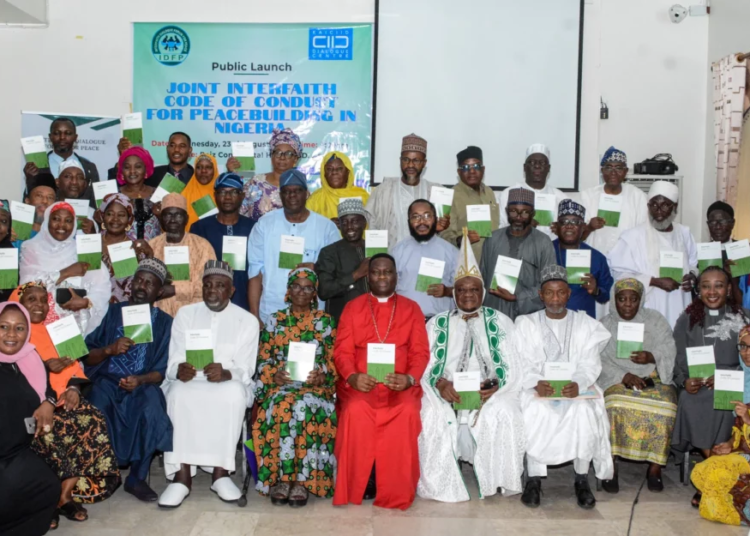
The Christian Association of Nigeria (CAN) and the Nigerian Supreme Council for Islamic Affairs (NSCIA) have led a renewed national drive for peace with the launch of an Interfaith Code of Conduct (ICoC) aimed at tackling hate speech, religious violence and deepening peaceful coexistence across the country.
The Code was ratified by religious leaders at the end of the 8th General Assembly of the Interfaith Dialogue Forum for Peace (IDFP), held in Abuja, on the theme: “Hate Speech and Violence: The Role of State and Non-State Actors in Nation-Building.”
The conference, which was convened by the IDFP in collaboration with CAN, the NSCIA and the Institute for Peace and Conflict Resolution (IPCR), with support from the International Dialogue Centre (KAICIID), brought together the President of CAN, Archbishop Daniel Okoh; the President-General of the NSCIA and Sultan of Sokoto, Alhaji Muhammadu Sa’ad Abubakar III; religious leaders, government officials, peacebuilding experts, civil society organisations, journalists, women and youth representatives.
Participants described the Interfaith Code of Conduct as a practical framework for promoting responsible religious leadership, discouraging inflammatory rhetoric and fostering national cohesion amid Nigeria’s religious, ethnic and political diversity.
They stressed that the Code was developed in response to growing concerns over hate speech and violence, which continue to threaten peace, democratic consolidation and social harmony in many parts of the country.
The conference featured a panel discussion on the current Nigerian context and how the Code can serve as a practical tool for addressing harmful narratives, preventing conflict and strengthening collaboration among religious leaders in nation-building.
Speakers urged faith leaders to move beyond declarations of goodwill by integrating the Code into sermons, community dialogue, media engagement, youth and women’s initiatives, peace education and other grassroots interventions.
Developed through a Nigerian-led interfaith process with the support of KAICIID, the Code outlines 10 guiding values for Christian-Muslim engagement. They include mutual love and respect, protection of the sacred, respect for human dignity, rejection of hate speech, peaceful conflict resolution, justice, integrity, transparency, accountability, respect for lawful authority and compassion.
Other News
The Code is also expected to guide the conduct of journalists, educators, traditional rulers, civil society organisations and public institutions whose actions and communication influence religious relations and public discourse.
Participants emphasised that journalists, in particular, have a responsibility to report religious issues professionally, avoiding sensational or divisive narratives capable of escalating tensions or reinforcing stereotypes.
Acting Secretary-General of KAICIID, Ambassador António de Almeida Ribeiro, described the launch as a significant milestone in Nigeria’s peacebuilding journey.
“For us at KAICIID, this moment is deeply meaningful. Since the establishment of the Interfaith Dialogue Forum for Peace back in 2015, we have been privileged to accompany and be part of the journey Nigerian religious leaders have been doing as they continue to demonstrate that dialogue is courage. This Code speaks to the heart of our shared humanity. It reminds us that every person carries dignity,” Ribeiro said.
Participants also called for the widespread dissemination of the Interfaith Code of Conduct across churches, mosques, schools, traditional institutions, media organisations and government agencies.
They also advocated sustained training and community-level implementation to ensure the Code becomes an effective instrument for preventing conflict, countering hate speech and promoting peaceful coexistence across Nigeria.
The conference concluded with a commitment by state and non-state actors to develop a multi-stakeholder action plan for integrating the Code into community engagement, peacebuilding initiatives and institutional processes at the national, state and local levels.