Follow Us on Google
By Jacob Agbekorode
There something interesting about Lagos becoming a sister state to California. Not because Lagos needs California to validate its importance. Far from it. Rather, because the partnership offers an unusually useful mirror through which Nigerians can see Lagos for what it has become.
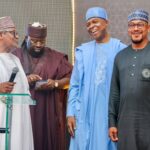
The agreement, recently signed in Sacramento between Lagos State Governor Babajide Sanwo-Olu and California Assembly member Matt Haney, provides for cooperation in technology, creative industries, trade, climate, infrastructure, health and education.
“Lagos is a city-state of more than 20 million people, on a coast where the Atlantic meets the lagoon,” Sanwo-Olu said.
“If she were a country, she would be among the largest economies in Africa. She is where Nigeria banks, trades, films, sings and codes. Nollywood is her studio. Afrobeats is her voice, and I gather it has been heard in Los Angeles once or twice.”
The California Legislature, following the adoption of Assembly Concurrent Resolution 129, described Lagos as one of the most dynamic regions on the African continent and identified it as a major hub for technology, entertainment, finance, maritime trade, entrepreneurship and urban development. It also highlighted the striking parallel between Lagos’s Nollywood and Afrobeats ecosystem and California’s Hollywood-centred creative economy.
That comparison deserves more attention in Nigeria. As California is not simply another American state, so is Lagos not just another Nigerian state. Lagos and California are separated by an ocean and thousands of kilometres. Yet the similarities are striking. Both are coastal economic powerhouses. Both have large, youthful and diverse populations. Both are magnets for migrants and entrepreneurs. And both are important gateways for international trade. That is precisely what makes the new sister-state relationship so interesting.
Also, despite having the smallest landmass out of all the 36 states in the country, Lagos accounts for roughly a third of Nigeria’s national GDP. Lagos also identifies as Nigeria’s financial, technology and entertainment hub, in addition to being the leading gateway through its seaports. According to data released by the National Bureau of Statistics (NBS), Nigeria generated N3.63 trillion in internally generated revenue in 2024 through its 36 states and the Federal Capital Territory (FCT). Lagos State alone generated N1.26 trillion, nearly 35% of the total.
Lagos has become the place where Nigerian businesses can test ideas against one of Africa’s most demanding markets. In fact, the Financial Times has described Lagos as central to Africa’s technology ecosystem. It noted that 23 of Nigeria’s 28 fastest-growing companies in its 2025 ranking were based in the state. However, the point is not that Lagos is California. It isn’t. But that is precisely why the comparison matters. The question is whether Nigeria should begin treating Lagos as the kind of strategic subnational economy that requires a different policy framework. This is where the long-running argument over special status for Lagos becomes relevant. The argument is not new.
In 2021, Sanwo-Olu called for a Special Economic Status for Lagos during the constitutional review process, arguing that the state’s contribution to the national economy, its population and its limited landmass created unusual burdens. He also linked the issue to the broader prosperity of Nigeria, arguing that Lagos’s fortunes and Nigeria’s fortunes are closely connected.
The fact that Lagos is a megacity cannot be overstated. Over the years, Lagos has earned a name for itself as a financial centre, a technology ecosystem, a cultural capital and a major international city. Those responsibilities overlap, whereas the institutions and constitutional arrangements governing the state were not necessarily designed around such a concentration of functions.
Other News
Consider the pressure created by population alone. Millions of people live, work, trade and commute through Lagos every day. Goods entering Nigeria through its ports eventually move into other states. Financial decisions made in Lagos affect businesses across the country. That creates an important policy question. Should Lagos, carrying national and continental responsibilities, have institutional arrangements designed specifically around those responsibilities?
The truth is that Lagos is not merely important to Nigeria. It is increasingly important to Africa. Its ports connect Nigeria to international commerce. Its entrepreneurs increasingly think of Lagos not as the end of a Nigerian market but as the beginning of an African one.
The California partnership therefore presents Lagos with opportunities. It could become a laboratory for how an African megacity builds international partnerships directly around the industries that will define the next generation in the spheres of artificial intelligence, digital finance, clean energy, climate resilience, transportation, healthcare, creative industries and education.
But for Lagos to be the continental trailblazer it seeks to be, it must develop better fundamentals. It must seek to ensure reliable electricity, efficient transportation, mass housing, environmental protocols, affordable healthcare, world-class education and digital governance. California has developed globally significant ecosystems in many of these areas, and that is where the California relationship could become consequential. Lagos has its own strengths and its own constraints. The opportunity is to connect the two intelligently.
And perhaps Nigeria should learn something from the Lagos-California relationship too. Why is an American state recognising Lagos’s global economic and cultural significance while Nigeria’s constitutional conversation still largely treats Lagos within the ordinary template of a Nigerian state?
That is not an argument for Lagos being above Nigeria. It is an argument for asking whether Nigeria’s federal structure adequately reflects the country that actually exists. Special status, if pursued, would therefore need to be carefully defined. Would it mean fiscal arrangements? Infrastructure responsibilities? Greater autonomy over transportation and urban planning? Or special federal investment?
Those questions matter because sentiment alone cannot produce sound constitutional engineering. There would also be legitimate questions about equity. Nigeria has 36 states, each with its own development challenges. Any special arrangement for Lagos would need transparent criteria, clear responsibilities and a demonstrable national benefit rather than simply being a reward for economic size. That is where the debate should go. Not Lagos versus Nigeria. But Lagos as a super engine within Nigeria.
California’s importance to America does not make it less American. Its global ambitions are part of the country’s economic power. Its international connections also create opportunities that ultimately benefit the broader American economy. Lagos can aspire to something similar.
Lagos has always been restless and that is its strength. The California partnership has arrived at an interesting moment. It gives Lagos wings to fly. Also, by extension, the partnership gives Nigeria an opportunity to look inward and reconsider the institutional framework through which its most internationally connected city operates
Nigeria’s next challenge is to turn that raw energy into a globally competitive urban system. If it succeeds, Lagos will not need to become Africa’s California. It will become Lagos, the great African megacity Nigeria would be proud of. And perhaps that is ultimately the most important conversation the California partnership has opened.