Follow Us on Google
By Maduka Nweke
The Federal Mortgage Bank of Nigeria (FMBN), in its 2024 report, estimates the nation’s housing deficit at a dizzying 28 million units, a figure that highlights the deepening crisis in Nigeria’s real estate sector.
Yet, beyond the statistics lie complex challenges that continue to frustrate efforts to bridge the gap.
From the rising cost of construction and building materials to the cumbersome process of obtaining government approvals and the constant interference of ‘omoniles’ (land touts), real estate operators are being squeezed on all sides. Adding to their woes are building collapses, government demolitions, and recurrent flooding, which have become recurring nightmares for developers and homeowners alike.
Industry observers say the government’s approach often compounds the problem rather than alleviating it. Poor supervision, weak enforcement of building standards, and delayed regulatory intervention have all contributed to the worsening housing crisis.
“The tragedy,” one property developer lamented, “is not just that people build on wrong sites, but that authorities watch the work continue, only to step in after massive investments have been made and demolish everything. It’s discouraging and destructive to the sector.”
Experts argue that this pattern reflects a broader failure of governance. The inability of government agencies to monitor construction activities effectively and ensure adherence to approved plans continues to undermine progress. They insist that prompt intervention at the early stages of illegal construction would prevent unnecessary losses and restore investor confidence.
As Nigeria’s urban population swells and housing demand rises, real estate stakeholders are calling for stronger regulation, timely oversight, and better coordination among government agencies to create a more predictable and supportive environment. Without such reforms, the dream of affordable housing for millions will remain distant, while demolitions, collapses, and flooding continue to haunt the sector.
The boom in real estate would have surpassed intermittent inflation if reckless actions are checked. For example, there are few real estate companies that can build between 250 and 500 housing units in Nigeria in a year. This means that a lot of operators are struggling to live up to the stage.
Incessant demolitions
Despite the worrying housing deficit, the Lagos state government recently demolished about 17 houses near Oral Estate, before the Ikota River in Lekki, for allegedly encroaching on the river’s Right of Way (RoW). The Commissioner for the Environment and Water Resources, Tokunbo Wahab, who led a monitoring team to the site alongside journalists, said that the enforcement followed repeated warnings against illegal reclamation of the river’s alignment. Wahab explained that the Ministry had earlier received complaints about developers reclaiming parts of the Ikota River corridor for construction and resale to unsuspecting buyers. “We stopped them then, but were alerted again recently that the encroachment had resumed aggressively, with attempts to sell to unsuspecting buyers”. Nigeria lacks shelter for its teeming population that increases on a geometrical progression. The lack of accommodation to shelter the population is worsened by housing collapse and demolition by government or its agents and actions of denunciation.
Demolishing occupied buildings causes a housing deficit by eliminating existing homes, often without providing adequate replacements, which displaces residents and reduces the overall housing supply. This is exacerbated when demolitions are driven by profit, leading to the destruction of potentially removable buildings and the construction of new, unaffordable housing that displaces original occupants. This is why most people raise eyebrows whenever state governments embark on demolition of already occupied buildings. This is the reason; the Lagos dtate government’s action in enforcing physical planning laws within its territory, including the Trade Fair Complex at Ojo and other areas was interpreted by experts as a reckless show of power.
The State Commissioner for Physical Planning and Urban Development, Oluyinka Olumide, who maintained that physical planning laws must be followed was not wrong according to some experts, nonetheless, the inability to take action when less damages and losses would have been incurred is what everyone is totally against. The Director of Public Affairs of the Ministry Mr. Mukaila Sanusi in a statement noted that although the Trade Fair complex was situated on Federal Government land, developers on the land must obtain planning permits from the state government and comply with its physical planning laws. “We have acted to stop the development of unapproved and unsafe buildings in the complex. A livable, organised and sustainable environment is vital to achieving our T.H.E.M.E.S+ Agenda,” according to the Commissioner. He said that the complex had a long history of ignoring building regulations and had failed to cooperate with the government in its efforts to achieve voluntary compliance. According to him, the state had, since November 2023, asked developers in the area to regularise their building approvals with the state Ministry of Physical Planning and Urban Development, but many failed to do so.
Supreme Court’s angle
A decision by the Supreme Court in that case is that: Urban and regional planning and physical development in Lagos State are residual matters, falling under the exclusive legislative and executive powers of Lagos State Government and not the Federal Government. The same applies to other states and their respective governments; The Federal Government’s Urban and Regional Planning Act, by the Supreme Court’s decision, became void to the extent that it seeks to apply outside the Federal Capital Territory, Abuja to the various States in the country. While the Federal Government, through the National Assembly, lost the power to legislate on physical planning matters outside the Federal Capital Territory, individual states, including Lagos State, gained autonomy over their physical development strategies and land use planning. The decision of the Supreme Court did not go beyond the foregoing and neither did it specifically authorize the Lagos State Government to go into the Trade Fair Complex and demolish private or Federal Government property within the complex. The apex court certainly did not consider or void or nullify either the Lagos International Trade Fair Complex Management Board Act or the Public Enterprises (Privatization and Commercialization) Act both of which remain extant. It is not clear to what extent, if any, the Lagos State Government engaged the management of the Lagos International Trade Fair Complex Management Board, the management of the Bureau of Public Enterprises, the National Council on Privatization chaired by the Vice President of Nigeria or the Federal Minister of Industry, Trade and Investments before seemingly invading this Federal Government property and carrying out the demolitions.
Poor communication/sensitisation
Due largely to the modus operandi chosen by the Lagos State Government, it was obvious that recent action of the state government smacks of hatred, jealousy and intimidation. This became open considering that aside from the Trade Fair demolition, there was also the 6th Avenue demolition in Festac and various other properties marked for demolition in Amuwo-Odofin for not meeting what the State Agency did not notice while the construction was going on. If reports and statements attributed to officials of the Lagos State Government in the mainstream and social media are to be believed, it appears that the demolitions were unilateral actions taken by the State Government without engagement with the Federal Government of Nigeria and its relevant agencies, particularly the Lagos International Trade Fair Complex Management Board which is both the statutory and also contractual landlord of the owners of the demolished properties.
There is also no indication yet that the Bureau of Public Enterprises and the National Council on Privation were in the loop in this action by the Lagos State Government. If the above represents the reality of the situation, then this could be seen by many, particularly the victims, as amounting to a very grave and brazen abuse of power and authority by the Lagos state government in its sheer unilateralism and negation of the most basic tenets of intergovernmental relations and coordination in a federation such as we have in Nigeria.
Lagos’ demand handover of Complex
It is a matter of public knowledge that the Lagos State Government since the days of President Bola Tinubu as Governor of the State had been making a case to the Federal Government for the handover of the Lagos International Trade Fair Complex to the State. The Alhaji Femi Okunnu Commission set up by the Lagos State Government under the Governor Ambode Administration in its recommendations urged the State Government to demand the handover of the Complex to the State Government and the State Government issued a White Paper accepting the recommendation. That a former Governor of Lagos State is now the President of the Federal Republic of Nigeria should caution the State Government to respect the rule of law, the due processes of law represented in its own physical planning and development laws in existence. This will help to enforce the efficacy of the Trade Fair Complex Management Board Act and the Public Enterprises (Privatization and Commercialization) Act. It should not resort to controversial demolitions which some consider being unilateral, devoid of due process, a violation of the rule of law, inhumane and a subtle attack targeted to a particular set of people.
Housing collapse
Going by the incessant building collapse in Lagos State, it became obvious that just as the state government agencies looked the other way while large estates were started and completed, the buildings that later collapsed were also not supervised thereby cordoning irregularities that would have caused a stop mark on the ongoing construction. These agencies allegedly neglected their supervisory roles only to heap the blame on the developers or the owners of the buildings. This is seen by most experts as a misplaced action on the part of the State Government.
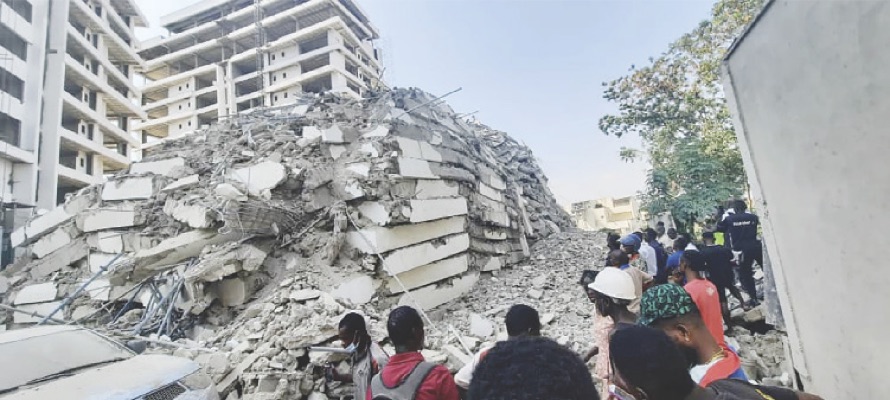
For instance, the collapse of four – storey building under construction at 335, Borno Way, Yaba, Lagos State at about 7 pm on Friday, 12th September, 2025, negated the efforts to protect Yaba area from the ravaging building collapse menace in the state. If the government agencies were alive to their duties, the collapse would have been nipped from the bud. But negligence and corruption that hindered the agencies from taking the right actions at the right time resulted in the catastrophe we are all beholding today. This was a terrible and painful way of making people lose their ‘world’ (lives and properties). But the issue is that it will not teach any lesson as reports and observations of the National Emergency Management Agency (NEMA), Lagos State Emergency Management Agency (LASEMA), Fire and Rescue Service, Lagos State Building Control Agency (LASBCA), Lagos State Ambulance Service and the Police that always keep sleepless nights, working laboriously round the clock in the rescue operations have become a ritual without any effect.
This informed the decision of some experts to blame the government agencies for negligence that resulted in inefficiency. An official forensic investigation of this collapsed building is expected to establish the factual cause(s) of the collapsed building, which will help teach a lesson against recurrence. Relevant ministries, agencies, and departments such as the Ministry of Physical Planning and Urban Development, Ministry of Housing, LASBCA, Lagos State Materials Testing Laboratory, Safety Commission, Built Environment professional Bodies, Developers Associations and artisans should be involved in the stakeholders’ meeting. A Coalition against Corruption and Bad Governance (CACOBAG) recently complained about what it calls misplaced treatment meted to property owners in Lagos State. In its latest save our soul (SOS) letter sent to the Governor of Lagos State Mr. Babajide Sanwo-Olu, the group decried the system of punishing property owners instead of punishing Lagos State Building Control Agency (LASBCA) which it said is the real culprit when building instructions are defiled. There are Lagos State Building Control Agency (LASBCA), Nigerian Institute of Building, Shelter Rights Project and others.
It is sad and an irony that agencies of Government which people rely on are actually the ones mortgaging the lives of Nigerians due to lackadaisical attitudes and corruption. It is in this regard that CACOBAG has to write an open letter to the governor in order to prevent further collapse of buildings which, in most cases, sent promising Nigerians to early grave. CACOBAG is saddened that in respect of buildings that are being demolished in Lagos State, it is the building owners and tenants alone that are being punished, leaving the compromised officials of the Lagos State Building Control Agency (LASBCA) to enjoy the proceeds of their crime.
Marking 176 estates as illegal
Not too long ago, the Lagos State Government declared 176 estates “illegal” primarily because according to them, they were developed without the mandatory planning permits and layout approvals from the Ministry of Physical Planning and Urban Development. These estates, located mainly in areas like Eti-Osa, Ajah, Ibeju-Lekki, and Epe, they argue operate in violation of urban planning regulations, and the government gave them a 21-day ultimatum to regularize their documents. This action is part of a broader effort to ensure sustainable urban development in the state. Lagos state said the estates were deemed illegal for not obtaining the necessary layout approvals from the Ministry of Physical Planning and Urban Development. The government stated that operating without these approvals compromises the state’s sustainable development goals and its T.H.E.M.E.S Plus Agenda. REDAN members expressed worry when Lagos State Government listed the 176 members as not having or suggesting that its member estates do not have the requisite documents to provide sustainable and safe housing for citizens of Lagos State. REDAN members, many of whom are long-standing, internationally verified and respected estate developers and professionals, have been negatively affected by the public notice, which suggests that all the over 170 estate developments in Lagos State listed have no proper documentation, leading the residents in these estates and investors to panic. REDAN members were traumatised by the notice, which has not only caused some doubt in the minds of investors but has led to a significant decline in business for the real estate sector, which in turn leads to further losses of revenue for the state.
Incessant flooding as a result of government’s inaction
As a result of government actions and inactions, floods can lead to housing collapse by damaging foundations, weakening structures through water saturation, and applying immense force from moving water. This is particularly true for buildings with poor construction quality, weak foundations, or those built in flood-prone areas without proper design considerations, such as inadequate anchorage or materials. Professionals have warned that except there is a reorientation on locations, design and foundation methodology in flood prone areas, many buildings still risk collapse in view of the incessant rainfall across the country. There have been weeks of pounding rains, which swamped major cities, leaving homes and facilities isolated by flood water. As the floods stay weeks or even months to recede, some buildings become weakened and exposed to the weather. Most of the buildings that had collapsed recently in some locations in states are multi-storey, which could suggest problems of soil structure and weak foundations. For instance, a two-storey building recently caved in and collapsed at number 22, Nkisi Aroli Street, Onitsha, Anambra state amidst the heavy rainfall. Four persons were confirmed dead after a house built on a hill collapsed on another in the Otun Araromi area of Isheri-Magodo, Lagos State. Similar circumstances were recorded in Abuja, when one storey building under construction behind the Apo Mechanic Village reportedly collapsed with about four people trapped. Also, there were reports of such instances in Ondo, Kogi and others that were not reported across the country. The Sun Newspaper investigation revealed that most of the existing building structures and those under construction are hardly designed to withstand flooding conditions such as scour and erosion due to floods, quick rise and drawdown of floodwater and prolonged denudation or inundation. Insufficient anchorages for storage tanks, sealed conduits and pipes, and other structures that may suffer from lateral movement and floatation during flood conditions are also some of the current realities. Essentially anchorages and connections in the structures need to be designed and executed to withstand the influence of vertical loads, uplift forces, and lateral loads. Building beams needs to be well connected to piles, columns, piers and foundation walls using suitable means such as bolts and welds. While moisture-resistant building products are also the first line of defense against rotting and mold, especially in tackling problems that could devalue homes and cause serious health issues and even death of occupiers, efforts to checkmate all these should start from the onset.