Follow Us on Google
By Adewale Sanyaolu
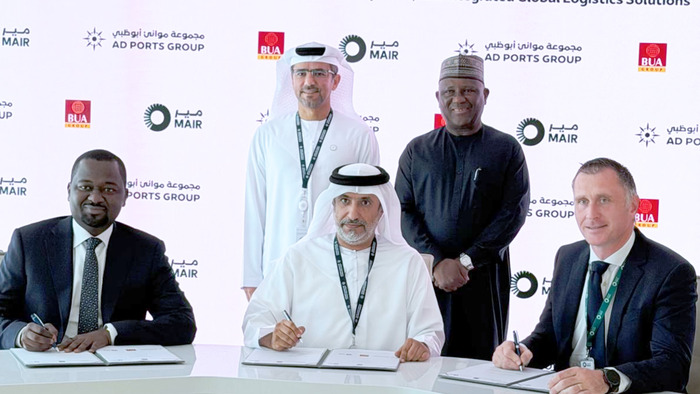
BUA Group has signed a key Memorandum of Understanding (MoU) with AD Ports Group and MAIR Group to develop an integrated sugar, agro-processing and maritime logistics platform linking West Africa to the Gulf.
Founder and Chairman of BUA Group, Abdul Samad Rabiu, described the agreement as a milestone in the company’s global growth strategy, noting that the vision extends beyond trade to building “globally competitive industrial platforms” that can sustain long-term food security objectives.
Officials at AD Ports Group highlighted the strategic role of Khalifa Port as a catalyst for industrial-scale investments tied to food and trade resilience, reinforcing Abu Dhabi’s ambition to consolidate its position as a global logistics and
The agreement signals a deliberate push to institutionalise a structured Nigeria–UAE food trade corridor, anchored on industrial-scale refining, aggregation, storage and export logistics. At the heart of the collaboration is the ambition to streamline supply chains, reduce post-harvest losses, improve quality traceability and create predictable export flows into the Middle East and Asian markets.
For BUA, one of Africa’s largest diversified industrial groups with investments spanning sugar, flour, cement and infrastructure, the MoU represents a calculated international expansion beyond domestic manufacturing. By plugging into the UAE’s advanced port infrastructure and global shipping connectivity, the company is positioning itself to scale exports while deepening value addition at source.
Other News
The partnership will leverage the infrastructure backbone of Khalifa Port and the global maritime network managed by AD Ports Group, creating what executives describe as a vertically integrated agro-industrial and logistics ecosystem.
MAIR Group will provide strategic support in structuring the integrated production-to-distribution model.
Beyond commercial ambition, the deal aligns with the UAE’s Food Security Strategy 2051, which seeks to secure diversified and resilient supply chains, while dovetailing with Nigeria’s agricultural transformation agenda aimed at boosting domestic processing and export capacity.
If executed at scale, the initiative could materially improve trade efficiency between West Africa and the Gulf, lower transaction costs, and create a structured export pipeline for processed agricultural commodities, a development that would strengthen Nigeria’s non-oil export base while reinforcing the UAE’s long-term supply security.
In strategic terms, the MoU lays the groundwork for more than a supply agreement; it is a cross-border industrial platform designed to convert agricultural production into a resilient, high-value trade corridor.