Follow Us on Google
By Chinenye Anuforo
A new report has raised the possibility that the $5 trillion reparations demand previously advanced against Britain and other former colonial powers could be far below the actual value of the damage suffered by Africa.
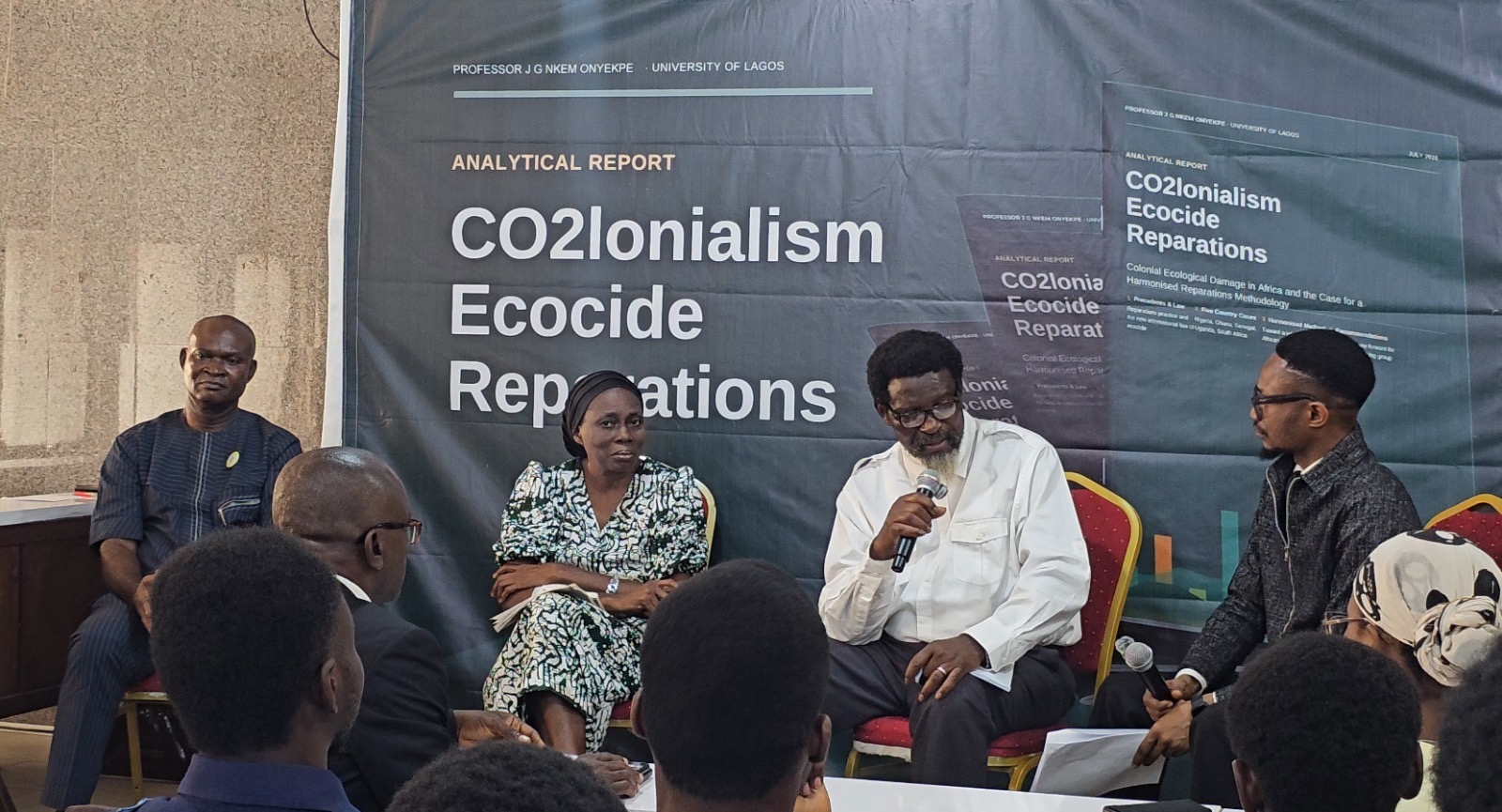
The report, titled “CO2lonialism-Ecocide-Reparations,” argues that Africa’s reparations debate should go beyond the historical consequences of slavery and include the ecological damage and large-scale resource extraction associated with colonial rule.
The report was unveiled on Friday at the University of Lagos by Professor J.G. Nkem Onyekpe, Head of the Department of History and Strategic Studies, University of Lagos, before academics, legal experts and public activists.
According to Onyekpe, colonialism created a form of ecological debt through the systematic appropriation of African land, natural resources and energy, with consequences that have continued long after independence.
He said putting a monetary value on such damage could significantly alter the scale of Africa’s reparations claims.
Onyekpe pointed to a peer-reviewed 2022 estimate which valued resources appropriated from the Global South through unequal exchange at more than $10 trillion in 2015 alone.
He argued that applying a similar methodology retrospectively to the period of colonial rule and across affected African countries could produce a figure running into hundreds of trillions of dollars.
“If the same order of logic—that large-scale, structurally unequal appropriation of resources is capable of rigorous monetary valuation—were extended backward across the full duration of colonial rule and across the full set of affected African states, the resulting figure would run into the hundreds of trillions of dollars, and quite possibly beyond,” he said.
A professor of geography at the event, Professor Oscar, also argued that existing estimates of the value of colonial ecological damage could be far below the actual figure.
“Some people estimate the value of the damage to be $5 trillion, some say $20 trillion, others say $30 trillion. The value is far higher than that,” he said.
The new argument could have implications for the $5 trillion reparations demand previously associated with Nigerian Senator Ned Nwoko.
Nwoko had called on Britain and other former colonial powers to pay at least $5 trillion in reparations over the consequences of colonial rule.
However, the UNILAG report suggests that once environmental destruction, resource extraction and unequal exchange are incorporated into the calculations, the $5 trillion figure could represent only a fraction of the potential value of Africa’s claim.
The report is expected to be submitted to the African Union’s Committee of Experts on Reparations (AUCER) and Legal Reference Group on Reparations (AULER), which form part of the continent’s emerging reparations framework.
The authors believe the inclusion of ecological damage could provide the AU with a broader basis for assessing the economic consequences of colonialism and developing a common African position on reparations.
The report also comes amid growing international attention to the legal concept of “ecocide” and efforts to strengthen legal mechanisms for addressing large-scale environmental destruction.
According to the authors, developments since 2021 have created a more favourable environment for examining environmental devastation within the context of international justice.
They cited, among other developments, the work of the Independent Expert Panel on the legal definition of ecocide, European initiatives addressing serious environmental destruction and developments concerning the International Criminal Court.
The report also highlights a July 2025 decision by the African Union to establish an ad hoc committee to examine the classification of “massive destruction of environmental ecosystems” as a crime.
For the authors, the development provides an important African institutional basis for placing ecological destruction within the reparations conversation.
Nauru precedent
The report further relies on the Certain Phosphate Lands in Nauru case involving Nauru and Australia before the International Court of Justice as an example of how environmental damage connected to colonial exploitation can become the subject of an international legal dispute.
The case involved environmental devastation linked to phosphate mining during the colonial period.
Dr. Karibi-Whyte, a jurisprudence and international law expert who spoke at the launch, said the Nauru case demonstrated that claims relating to colonial-era environmental destruction were not merely theoretical.
“The Nauru case proves that such claims are not merely theoretical but are grounded in established international law,” he said.
“Africa is now building on that precedent to address a harm that is orders of magnitude larger.”
The report’s emergence adds a new dimension to Africa’s growing reparations campaign, shifting part of the debate from historical human and economic losses to the long-term environmental consequences of colonial exploitation.
For Nigeria and other African countries, however, a major challenge would be determining how such ecological debt could be measured, apportioned among former colonial powers and translated into legally enforceable claims.
The AU’s reparations mechanisms could therefore face a major task if ecological damage becomes part of a common continental claim: establishing a credible methodology capable of withstanding legal, economic and historical scrutiny.
The report was presented against the backdrop of the African Union’s broader reparations agenda, following its declaration of 2025 as the Year of Reparations and its efforts to develop mechanisms for coordinating the continent’s position.
If the ecological-debt argument gains acceptance, Africa’s reparations campaign could move beyond the question of what colonial powers owe for historical exploitation to a much broader question: what is the present-day economic value of the environmental wealth extracted and ecosystems damaged during colonial rule?