Follow Us on Google
BY PHILIP NWOSU
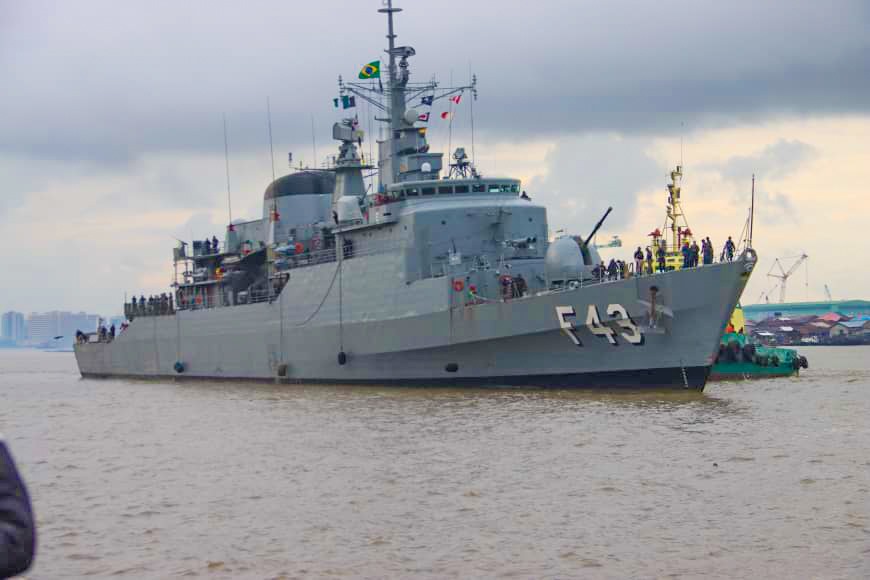
In a significant display of international cooperation and maritime diplomacy, the Brazilian Navy warship, Frigate Liberal arrived at the bustling port city of Lagos on September 2, 2023.
This visit marks a pivotal moment in the longstanding relationship between Brazil and Nigeria, as the naval vessel carries out its mission to strengthen bilateral ties, foster cultural exchange, and promote maritime security.

The F. Liberal is part of Brazil’s Naval Force, and its arrival in Lagos is part of a broader tour across several African countries. The ship’s visit to Lagos holds substantial symbolic value, showcasing the commitment of both nations to deepening their diplomatic and economic relations.
As a maritime nation with a strong naval tradition, Brazil, it was learnt, recognizes the importance of safeguarding international waters from piracy and criminal activities. Rear Admiral Andrea Felix who led the Brazilian Navy to Lagos said the force had been actively involved in efforts to enhance security and stability in the Gulf of Guinea, contributing to both regional and global maritime security.
Some of the key initiatives and contributions of the Brazilian Navy to the Gulf of Guinea includes; Maritime Patrols and Surveillance which had necessitated the deployment of the force’s assets, such as frigates and patrol vessels, to conduct regular patrols and surveillance in the Gulf of Guinea. These operations help monitor maritime traffic and deter pirate activities.

Apart from that Capacity Building and Training which has provided training and capacity-building support to the navies and coast guards of Gulf of Guinea countries. This includes training in areas such as maritime law enforcement, search and rescue operations, and naval tactics.
Information Sharing: Brazil actively participates in regional and international forums dedicated to combating piracy in the Gulf of Guinea. Information sharing and intelligence cooperation are crucial aspects of these efforts, helping to coordinate responses to piracy incidents effectively.
Multinational Operations: Brazil has taken part in joint naval operations with other nations in the Gulf of Guinea, such as the United States, France, and Spain, to strengthen the collective fight against piracy. These operations demonstrate a commitment to international cooperation and the importance of a united front against piracy.
Brazil and Nigeria have a history of friendly relations that extend back many decades. Both countries are members of BRICS (Brazil, Russia, India, China, and South Africa), a grouping of major emerging economies. This association has allowed Brazil and Nigeria to collaborate on various international issues, including sustainable development, trade, and security.
The visit of the F. Liberal to Lagos is a tangible demonstration of Brazil’s commitment to fostering stronger ties with African nations, particularly Nigeria, which is the largest economy on the continent. The ship’s presence is expected to facilitate discussions on a wide range of topics, from trade and investment to cultural exchange and education.
One of the key aspects of this visit is the focus on maritime security cooperation between Brazil and Nigeria. Both countries have extensive coastlines and significant maritime interests. The Brazilian Navy has a wealth of experience in patrolling and safeguarding its maritime borders, and it has been actively involved in international maritime peacekeeping operations.
The Brazilian Navy’s expertise in maritime security is highly valuable to Nigeria, as the country grapples with issues related to piracy, illegal fishing, and smuggling in its coastal waters. Collaborative efforts in this area are expected to enhance the security of the Gulf of Guinea, a vital maritime region that plays a critical role in global trade.
Beyond the strategic and security aspects of the visit, cultural exchange and diplomacy also take center stage during the F. Liberal’s stay in Lagos. The ship’s crew, including naval officers, will have the opportunity to engage with local communities, participate in cultural events, and share their experiences. Likewise, Nigerians will have the chance to learn more about Brazilian culture, traditions, and naval heritage.
Cultural exchange initiatives often serve as a bridge between nations, fostering mutual understanding and goodwill. By engaging in such activities, Brazil and Nigeria can promote people-to-people connections that go beyond mere diplomatic relations.