Follow Us on Google
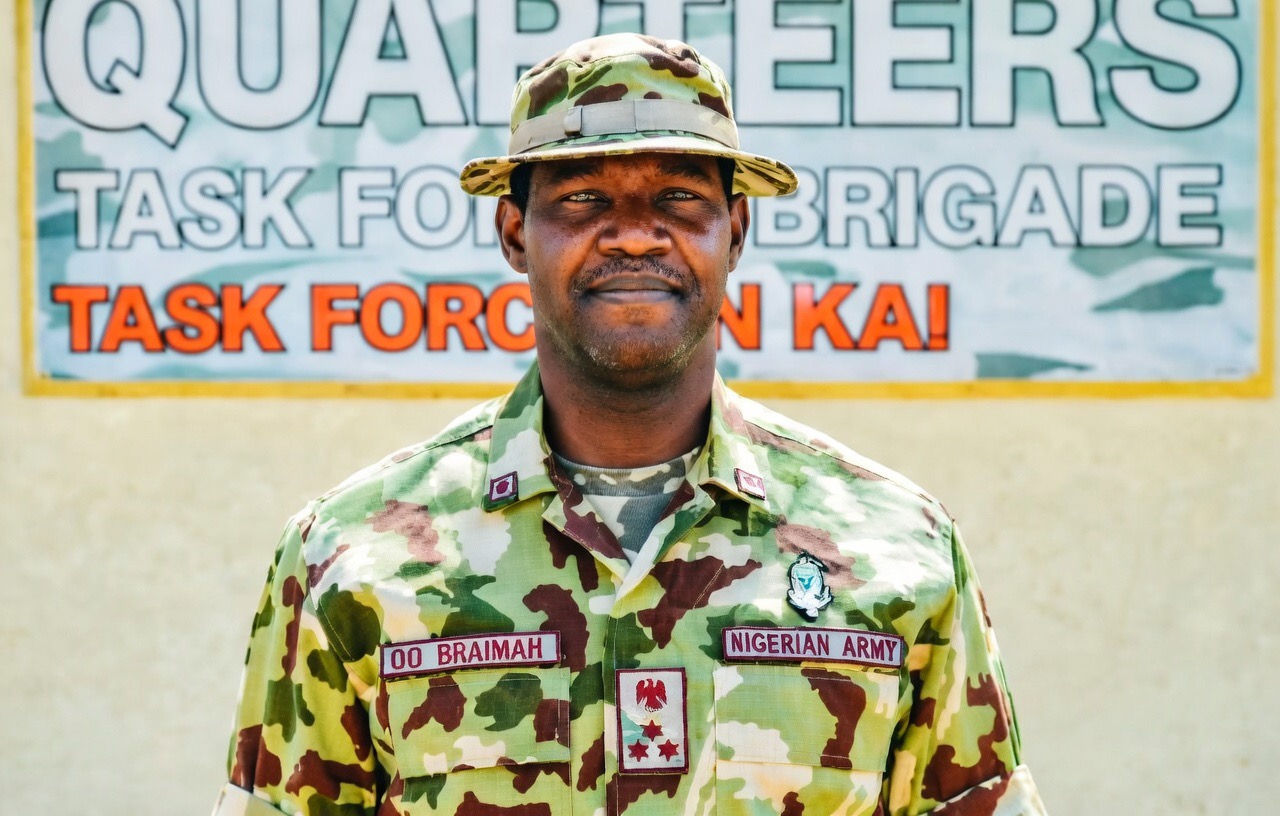
By Ebuka Ukoh
A country that cannot protect its foot soldiers does not hold out any promise of safety to ordinary citizens. That is the hard truth Nigeria must confront now.
The untimely felling of Oseni Omoh Braimah, commander of the 29 Task Force Brigade, Maiduguri, in a coordinated attack on a military base in Benisheikh in April 2026 is not only a tragedy, but also an alarm. It is a signal that the line between order and breakdown is thinner than we are ready to admit.
When a Brigadier-General falls inside a fortified base, the question is no longer whether Nigeria faces insecurity; it is whether the country can maintain its security. Another question is whether the system built to contain it is holding at all.
When a man dies, it should remind you of your own fragility, your own mortality, and the thin line between life and death. No title, rank or office can erase that fact. The Braimah tragedy was not an isolated failure.
In November 2025, Musa Uba, who was commanding the 25 Task Force Brigade, died at the hands of fighters linked to the Islamic State West Africa Province in Borno State. The militants ambushed, captured, and executed him. Two senior officers…two high-level losses…all within months.
These are not routine battlefield casualties. The men were senior commanders operating within layered security environments, supported by intelligence, personnel, and infrastructure. The deaths point to something deeper than individual vulnerability. They point to systemic strain.
When the shield fails
Military bases are designed as anchors of control. They concentrate force, intelligence, and logistics. They are meant to project strength and reassure surrounding communities that the state is present and capable.
The attack in Benisheikh, Maiduguri, challenges that assumption.
Reports indicate a coordinated assault that lasted several hours, overwhelming defences and inflicting significant casualties. In such scenarios, response capacity becomes critical. Reinforcement timelines, air support, and communication chains are not abstract concepts; they are essential components of effective military operations. They determine whether a base holds or falls.
Other News
When a position of this scale is breached, the question becomes unavoidable. Where was the support in the first place?
Raising this question is not to diminish the courage of those who fought. It is to examine whether the system around them functioned as it should because courage without support becomes sacrifice. And repeated sacrifice without systemic correction becomes recurrent failure.
The implications extend beyond the military. If a hardened installation can be overrun, what confidence can civilians draw about their own safety?
Nigerians as victims
The Nigerian today is not simply struggling; he is exposed, living within layered uncertainty. At the individual level, one is exposed to violence, exposed to uncertainty, exposed to a system that appears increasingly unable to guarantee the most basic function of a state…the protection of life and property.
Communities in conflict-prone regions navigate the constant risk of attack. Urban centres contend with crime and instability. Rural populations face exposure with limited protection.
The effect is cumulative. Each incident adds to a sense that security is not guaranteed, protection is uneven, and response is unpredictable.
Language matters in this context. When perpetrators of violence are described in softened terms, it creates distance between the act and its consequence. For those affected, there is no distance… It is only a loss.
A father does not experience his death as a statistic. A community does not rebuild with numbers. The danger is not only violence itself. It is the normalisation of that violence. When deaths are reported, absorbed, and quickly replaced by the next headline, a threshold begins to shift.
What once shocked begins to feel expected. And expectation reduces urgency.
Trust under pressure