Follow Us on Google
By Israel Olawunmi
In 2017, American music legend, Jay-Z, released ‘4:44’, which is perhaps the most introspective album of his career. It was an unusual record for a man who had spent decades perfecting the mythology of invulnerability. Here was Shawn Carter — popularly known as Jay-Z — older, richer, and suddenly willing to interrogate himself.
The album spoke about marriage, infidelity, fatherhood, ego, inheritance and the damage that successful men can carry into the homes they have built. ‘Family Feud’, one of the standout tracks on the album, speaks about division within the rap culture, particularly the needless antagonism between generations of rappers. Arguably, the most memorable line in the song is: “Nobody wins when the family feuds…we all lose when the family feuds.”
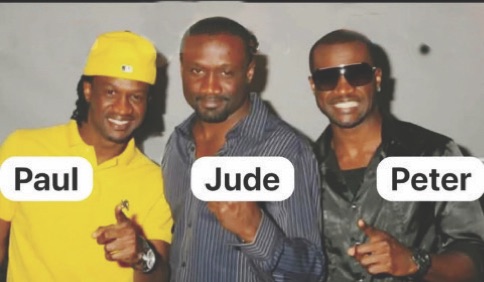
Watching Peter, Paul, and Jude Okoye now, it is difficult to think of anything more appropriate or fitting.
I am not particularly interested in choosing an Okoye brother to support. There is already enough of that happening. Peter has his camp. Paul has his. Jude has defenders. Every new video produces prosecutors, judges, and juries across Nigerian social media before breakfast.
In the story Peter has told, and particularly through his increasingly detailed public accounts, he is the person who most readily attracts sympathy. His case is emotionally compelling. He speaks as someone who believes that the people he trusted most were also the people from whom he had the greatest reason to protect himself from. The allegations concerning money, royalties, management, and the structure of the P-Square business are not trivial.
There have been allegations of financial wrongdoing against Jude, which he denies. In one strand of the dispute, an Economic and Financial Crimes Commission (EFCC) prosecutor told an Ikeja court that the commission had no evidence supporting Peter’s specific allegation that Jude and Paul fraudulently withdrew $800,000 from the P-Square account. The evidentiary gap does not, by itself, resolve the broader dispute. This still does not prove Peter’s broader story is false. Essentially, my point is Peter may very well be the most injured party and still not emerge from this as a winner. Peter Okoye may be winning the argument, but this does not necessarily mean he is winning.
There is an understandable logic to Peter’s emotion-laden videos, but look at what happens next: a clip becomes a meme. A man’s anguish becomes a trending sound. The entire issue or parts of it become a skit. A family tragedy becomes national entertainment. These do not make the viewers wicked. It is simply what the internet does. It metabolises everything. And this is where Peter’s apparent victory begins to look strangely expensive. It is a Pyrrhic victory. He cannot recover the privacy of what has now been revealed.
None of this is to fault Peter for choosing to speak out. Sometimes, silence protects the wrong people. Sometimes, the person who has been publicly misrepresented has every right to answer publicly. There is an especially unfair tradition in African families of demanding silence from the injured person in the name of “peace,” when what is really being protected is reputation. Peace without truth is merely quiet. But there is also a remarkable difference between telling the truth and surrendering the entire interior of your family to an audience that has no obligation to treat it gently.
The internet never enters a family feud solely as a mourner. It enters as a market. A market does not need to hate suffering to profit from it. It merely needs suffering to attract attention. Influencers enter. Content creators enter. Bloggers enter. Commentators, this writer included, enter. Sleuths enter. Amateur forensic accountants enter. Self-appointed mediators enter. VeryDarkMan and other internet characters become participants in conversations to which they were originally strangers. Public commentators who began as spectators become characters in the story themselves. Every response video keeps another name in circulation. And in an attention economy, circulation itself has value. They cash in on it, unfortunately.
So, ask again: who is winning the Okoye feud? Peter, perhaps, in the court of public opinion. But what of Paul and Jude? And what kind of victory is available to any of them now? The bloggers? The skit makers? The aggregators? The influencers and content creators? The anonymous accounts collecting impressions from another family’s sorrow? Evidently, they are closer to winning than any Okoye. Peter may gain sympathy. Jude seemingly has had his reputation injured. Paul might have lost some affection, too.
Peter and Paul may have already lost something harder to price: the uncomplicated meaning of being twin brothers. This is a terrible place for any family to arrive. Chinua Achebe gives us an older formulation of this tragedy in ‘Arrow of God’: “Have you not heard that when two brothers fight, a stranger reaps the harvest?” He similarly tells us, “When brothers fight to death, a stranger inherits their father’s estate.”
Jay-Z’s punchy, memorable line, “Nobody wins when the family feuds” does not mean that Peter should abandon legal remedies. It does not mean wrongdoing should be forgiven without accountability. It does not mean brothers must remain business partners because they share blood. Family is not a licence to exploit people, and reconciliation should never become another word for compulsory proximity.
A just ending may not even require P-Square to reunite. Perhaps it requires proper accounting. Perhaps restitution, if wrongdoing is proved. Perhaps an apology. Perhaps boundaries. Perhaps reconciliation without renewed spectacle. Painfully, this may be one of those conflicts in which being proved right cannot restore everything that was lost.
Peter may ultimately win in this matter. And still, somewhere beneath the applause, there will remain two brothers who once danced beside each other, another brother who helped manage the empire they built, parents who are no longer here to call their sons into the same room, children inheriting stories about uncles and fathers, and a family name that millions of strangers now discuss as entertainment. This is clearly not victory!
For their sake, one hopes the Okoyes eventually find a way to bring this chapter to a dignified close. Not with anything more dramatic or entertaining, but with truth, accountability, and enough grace to stop feeding tomorrow with the injuries of yesterday.
When the noise eventually dies, the memes will move on. The influencers and content creators will find another controversy. The algorithms will eventually find another sorrow to circulate. Yet the Okoyes will still be the Okoyes. And Jay-Z’s old line will remain, uncomfortable in its simplicity: “Nobody wins when the family feuds.” Perhaps because, in some wars, the final tragedy is not that one brother loses, but that by the time the winner is declared, there is less of a family left to return to. There are victories the law can recognise, victories the public can applaud, and victories the bank can measure; then there are losses for which none of them has a remedy. The stranger may reap the harvest, but it is the brothers who must live with the field when the harvesting is done.
· Israel Olawunmi, a legal practitioner, writes via email: [email protected]