Follow Us on Google
“Democracy is worth dying for because it’s the most deeply honourable form of government ever devised by man.” —Ronald Reagan
By Daniel Kanu
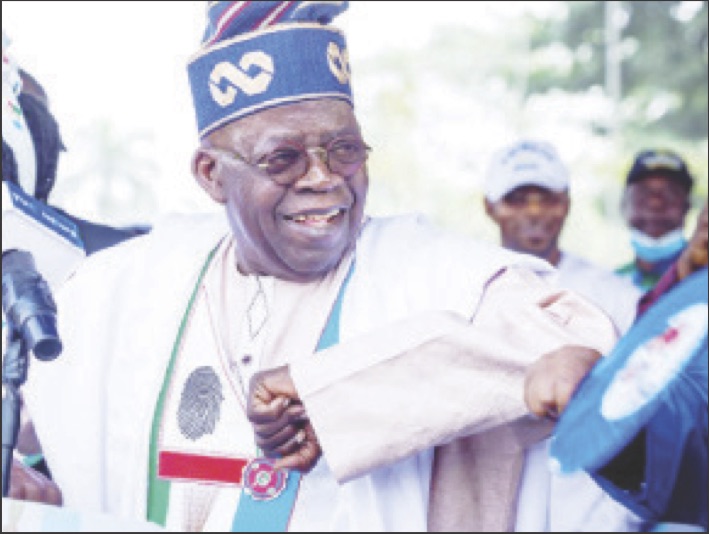
After a tension-soaked wait, amid protests, the Independent National Electoral Commission (INEC) in the wee hours last Wednesday declared Asiwaju Bola Tinubu, presidential candidate of the ruling All Progressives Congress (APC) as the winner of the controversial Saturday, February 25, election.
“That Tinubu Bola Ahmed of the APC, having satisfied the requirement of the law, is hereby declared the winner and is returned elected,” Prof Mahmood Yakubu, INEC chairman, declared, in an announcement watched by an eager nation and many across the world.
The Commission also on Wednesday went ahead to issue Tinubu a Certificate of Return.
The election is arguably, Nigeria’s most hotly contested and high-stakes presidential election.
The announcement of Tinubu as the president-elect, if he survives the legal fireworks that are envisaged to come in the days ahead from the opposition camp, will perhaps, put a fitting finale to a lifelong ambition of the former Lagos State governor, who had summed up his presidential race with the famous Yoruba word, Emilokan, meaning “it’s my turn”.
At the moment, he stands on the threshold of history to be counted either as a true democrat or an opportunist.
The drama before his announcement got intense on Tuesday with protests trailing the conduct of the presidentail election in some states.
Opposition parties have already called for the cancellation of the election, alleging that it was marred by widespread violence, rigging, intimidation of voters, doctoring of results, and violation of the laid down electoral process, which was communicated by INEC.
In specifics, the Labour Party (LP), Peoples Democratic Party (PDP) and African Democratic Congress (ADC) last Tuesday said that the deliberate refusal of Prof Yakubu to upload results electronically as stipulated by Section 60 of the Electoral Act 2022 is unacceptable.
The three parties said that the results so far released by INEC showed “monumental disparities” between what the party agents signed at different local government areas in the states and what INEC officials announced in Abuja.
They said that the manual transmission of results compromised the integrity of the process and demanded a cancellation of the election, while asking the electoral chief to step down.
Since his announcement as the winner, Tinubu, no doubt, has shown humility in all his recent speeches so far, both at the acceptance of the Certificate of Return ceremony or at his party secretariat; in fact, everywhere.
He has made penetrating statements on peace and reconciliation, promising to sustain the collective democratic attainment and even loftier aspirations of the country.
He has vowed to run an all-inclusive government, just as he has extended an Olive branch to his aggrieved competitors in the election while inviting Nigerian youths to his rescue agenda.
Tinubu said that he would work with everybody. He has promised to be a fair leader to all Nigerians and would work tirelessly to make the country better.
As a professed unifier who has been among those at the forefront of democracy, he has vowed to hit the ground running with the task of rebuilding Nigeria.
Part of his statement reads: “Our destiny as a people and nation depends on our ability to shed the artificial restrictions of bias and prejudice so that we live fully unto our democratic creed that no one is innately superior or entitled to greater rights and opportunities than any other Nigeria.
“For this to be a victory at all, it cannot simply be a victory for one man or even one party. It must become a victory for all Nigerians who are committed to a greater society.
“This great project called Nigeria beckons to us all. It is bigger and more important than any partisan divide. To my supporters, I ask you to continue to have faith in the mission that we have articulated.
“To those who didn’t support me, I ask that you not allow the disappointment of this moment to keep you from realising the historic national progress we can make by joining hands and hearts in common endeavor to pull this nation through.
“In a phrase, I am asking you to work with me. I may be the president-elect, but I need you. More importantly, Nigeria needs you. My heart and my door are open to you”.
One of Tinubu’s close associates, Kashim Ibrahim-Imam, has testified that Tinubu is imbued with all the qualities that Nigeria needs at this critical juncture of its political and economic journey.
“Tinubu is an astute manager of men and resources, in fact, a magnet for talents, and thus the safest pair of hands for the present turbulent economic currents,” he noted.
Unarguably, Tinubu has succeeded in teaching politicians the value of never giving up even when all odds are stacked against one in political struggles.
Even if he is defeated in the courts and sacked from the presidential seat, Tinubu, no doubt, has transformed into a political colossus whose name will remain a reference point in political doggedness and stratagem in the annals of the history of the country.
Some political commentators argued that in a democracy, the process is key and more important than the end result. This perhaps may be the reason the opposition would want to use the entire democratic clasp to seek redress.
At the moment, protests have continued to build- up as the opposition parties have vowed to use every available peaceful, democratic, and legal means to challenge what they described as a “stolen mandate”.
Whether Tinubu will be thrown-out from the exalted presidential seat will be known after the expected fierce legal battle ahead.
Bola Ahmed Tinubu was born on March 29, 1952.