Follow Us on Google

In the beginning
The Boko Haram insurgency, which has claimed the lives of over 20,000 people, with a further displacement of another two million, is the most challenging armed conflict directly involving the Nigerian state since the civil war. The escalation of the Boko Haram insurgency to a full-blown war, beginning from the year 2010, has exerted enormous pressure on the Nigerian state and its national security agencies. The gallant officers and men of the armed forces who are engaged in the counter-insurgency war have made steady progress, which, ultimately, led to the downgrading of the lethal capabilities of the Boko Haram group. The sacrifice of the officers and men under arms to secure our nation has been huge working under a democratic civil political authority, which initiates defence and security policies that are sometimes implemented in a manner that is more political than strategically tactical. The consequences of these policy implementation flaws are manifest in the poor state of defence and security infrastructure, leading to poor architecture and weak response mechanism to such security challenges as the Boko Haram insurgency.
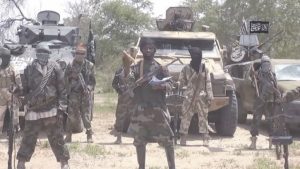
The Boko Haram insurgency appears to be intractable largely because the political leadership of Nigeria has not been able to properly situate the fundamental basis and motive of the terror group. For example, the President Goodluck Jonathan administration viewed the insurgency through the narrow prism of partisan politics as clearly seen in the muddling up of the post-election violence with the Boko Haram insurgency. This view was clearly demonstrated when, in 2012, in Asaba, Delta State, on the occasion of the South-South Economic Summit, then NSA Gen. Andrew Owoeye Azazi attempted to link the power struggle within then ruling PDP over rotation of the seat of presidency to the North but Jonathan insisting on running.
“In discussing the relationship between national security and development, let me say that one cannot do without the other,” the NSA said. “The issue of violence did not increase in Nigeria until when there was a declaration by the current President that he was going to contest. PDP got it wrong from the beginning. The party started by saying Mr. A can rule, and Mr. B cannot rule, according to PDP conventions, rules and regulations and not according to the constitution. That created the climate for what is happening or manifesting itself in country. Is it possible that somebody was thinking that only Mr. A could win, and if he did not win he could cause a problem in the society?
“Let’s examine all these issues to see whether the level of violence in the North East just escalated because Boko Haram suddenly became better trained, better equipped and better funded, or something else was responsible.”
Apparently guided by the Azazi conspiracy fallacy, the Jonathan administration initially believed the insurgency to be politically motivated, aimed at discrediting him and his administration. It was believed to be the North’s response to loss of power and, hence, regarded as self-inflicted. The current administration is in a hurry to succeed where its predecessors failed. To this end, it has identified corruption and indiscipline as largely responsible for the intractability of the Boko Haram insurgency. This realization has been matched with a renewed determination to defeat Boko Haram. The officers and men of the armed forces, under the new political leadership, have recorded spectacular successes in the reinvigorated war effort, culminating in the fall of Camp Zero, the operational headquarters of the terror group in the Sambisa savannah. However, the continuous attack on civilian and military targets after the fall of Sambisa is indicative of the fact that the Boko Haram insurgency is not yet over. The President Muhammadu Buhari, like its predecessors, was not able to clearly and properly situate the Boko Haram insurgency in a way that enabled government to initiate and implement defence and security policies to enhance the war effort and bring it to a conclusive end.
Other News
Before the beginning
Boko Haram is not Islamic but Muslim. The Boko Haram insurgency has its root cause in radical Islamic ideology whose seeds were sown in mainstream Islam and watered by mainstream Islamic authorities. The northeastern state of Borno and environs, which is the modern successor state of the Kanem Borno Empire and today the cradle of the Boko Haram insurgency, was part of the historical Western Sudan. Together with the contiguous Hausa city states, this region was well known for Islamic revivalist and reform movements as evidenced in the number of jihads and counte-jihads that occurred throughout the 19th century. Therefore, northern Nigeria is a fertile ground for nurturing the seeds of radical Islamic ideology. There are three major doctrines that are fundamentally driving radical Islam. These doctrines are not Islamic but Muslim.
1] The concept of the Caliphacy; the majority of Muslims aspire to live under a unified global Muslim community under the leadership of a guided theology presided over by a Caliph or successor to the Holy Prophet Muhammad SAW. This doctrine is entrenched in mainstream Muslim theology and Muslims are living with the dilemma of living in a secular country while aspiring to be governed by Sharia law and by a Muslim ruler. Boko Haram insurgents are merely putting to practice the already entrenched doctrine of an Islamic state. The fact that the Caliphate system does not separate religion from the state means that Boko Haram insurgency is, fundamentally, a violent conflict between faith and citizenship. The declaration of war on the Nigerian state, annexation of territories and proclamation of an Islamic state is only a fulfilment of this doctrine. The Caliphacy, which has eluded the Muslim ummah, has been a major source of strife and bloodshed, leading to a schism into Sunni and Shia divides. Islam as an empire of faith cannot be presided over by a single authority. Islam is divinely guided by Almighty Allah SWT, who doesn’t need a helper. The elusiveness of the Caliphacy is a clear manifestation that it is not Allah’s will. If Allah wills a thing, he but says to be and it is.
2] The unresolved question of People of the Book; among mainstream Islamic authorities, there has been a clear deviation from the original position of Christians, Jews and Sabians from their designation as People of the Book, worshippers of God and believers to outright unbelievers. This belief that People of the Book are unbelievers portends a great danger to the peaceful coexistence of a multi-religious Nigeria. People of the Book have been portrayed as mortal enemies of Muslims and Islam. The implication of this is that citizens of the same country consider one another as enemies. This explains why the Boko Haram insurgent group targets Christians and their places of worship. This, however, is in direct contravention of the will of Allah SWT as contained in this verse from the Quran: “Those who believe (in the Qur’an), and those who follow the Jewish (scriptures), and the Christians and the Sabians, any who believe in Allah and the Last Day, and work righteousness, shall have their reward with their Lord; on them shall be no fear, nor shall they grieve.’’
3] The unresolvable question of Bid’a [innovation]; there is a consensus among Muslims over the prohibition of innovation in Islam. However, religion is a subjective interpretation of faith and hence there is no consensus on what acts of some Muslims constitute innovation. The Takfiri doctrine, which is the most radical of all three highlighted here, is the denouncing of fellow Muslims as unbelievers on account of the practice of Bid’a. This is why Boko Haram targets fellow Muslims who don’t believe in their own unique ideology because they consider them as unbelievers.
After the beginning
The major challenge of the post-insurgency era is to prevent another insurgency. If there is any lesson learnt from the history of radical Islam, it is that succeeding terror groups appear bolder and more deadly than the one before. The Taliban in Afghanistan rose in the 1990s to diminish the famous Mujahideens, heroes of the Soviet-Afghan war. Today, ISIS has emerged deadlier than all before it. Boko Haram can’t be declared defeated until the ideology driving radical Islam is defeated ideologically. The role of the military is to contain the menace of radical Islam and not to defeat the ideology. Boko Haram is a Muslim problem that can only be solved by Muslims in the long run. Muslims must take full responsibility for what has gone wrong with the beautiful religion of Islam by taking deliberate steps at scripturally combating the poisonous ideology that is fast tearing mankind apart.