Follow Us on Google

While intervening in the ensuing melee between President Tinubu and the Catholic Bishops’ Conference of Nigeria (CBCN), Senator Shehu Sani, a veteran civil rights activist and chieftain of the ruling APC, tweeted thus, “From the era of Military rule and throughout the period of Civilian governments, the Catholic Bishops have a consistent history of telling truth to power. They have never been partisan. Every president they visited, they bring him a gift of Bitter Kola instead of Olive Oil.”
The sense in the poetic application of bitter kola and olive oil in the face-off requires analytical dissection. First, olive oil is used for cooking, conditioning of hair, body freshness, and keeping of human heart healthy. In the Bible, olive oil was used to anoint kings, priests, and prophets. Its spiritual significance today connotes cleansing, consecration and activating of God’s power for specific intervention. In this case, the visit to the Aso Villa by the bishops with bitter kola was neither for a liturgy nor the annual Chrism Mass.
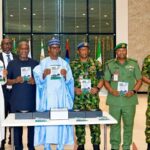
The state of the nation is in dire straits and the heavily-guarded presidential palace appears to have walled off Mr. President from the realties that households grapple with. And as the indisputable moral forces, the bishops decided to convey the true state of affairs to him. That was why they went opted for bitter kola souvenir.
Why bitter kola? Bitter kola can be useful in at least two ways. One is preventive. The other is defensive. It is believed in West African traditional setting that bitter kola can intercept spiritual attacks and neutralize spells. Medically, bitter kola defends human body against unwanted intruders. Its anti-bacterial and anti-viral components take on any pathogen around the body. In fact, “the intense bitter taste forces the salivary glands to work overtime, immediately hydrating a dry, scratchy, or hoarse voice.”
In essence, while the bishops were protected from any form of spiritual docility inside Aso Villa – (Remember Dr. Reuben Abati’s piece in October 2016, titled, The Spiritual Side of Aso Villa), the defence mechanism also made sure that they didn’t lose their voices as the bitter kola blocked any attempted infiltration into their chasubles and albs.
In meetings, public gatherings, or visitations to unsafe places, some people prefer to put bitter kola in their pockets. Others chew them to fight-off food or drink poisoning. Perhaps, the bishops that visited Aso Villa went with bitter kola in their pockets as it wouldn’t be a good etiquette to be chewing them right before Mr. President. Whichever way, they survived the charming and alluring environment of the State House. They were immune from the usual mealy-mouthed emasculation witnessed when in contact with pomp of power. The bishops were not carried away; they didn’t lose their common sense; they didn’t get frozen by the blowing air-conditioners which could ‘de-radicalize’; they didn’t forget the cries of deprivations of ordinary Nigerians who have oversubscribed the church’s welfare pulse.
Other News
Hence, from the get-go, the bishops had a prepared speech which was researched, written, fine-tuned and validated after wide consultations. No room for frivolities. No unnecessary off-the-cuff niceties. No genuflection induced by eyeball-to-eyeball contacts. They understood the mood of the nation and carefully plotted their way to the zenith of public policy. They knew that they had a mission to speak for the voiceless. And satisfactorily, they struck the right chord.
How were the bishops able to provoke Mr. President? They gave him discomfort by deploying bitter kola to treat the infectious ring of praise-singing courtiers at the Villa. So, he drawn out of the cocoon of all-is-well, deceptive reports and listened to what he had been starved of. It was no longer about what he supposedly reads in ten newspapers each day or, the television stations we were told he watches always. He was barefacedly served the cold realities on the ground.
As those who oversee the spiritual affairs of approximately 35 million Catholics in Nigeria, the bishops have a full grasp of where the shoes pinch their members – who might be part of the over 100 million multi-dimensionally poor Nigerians. They tasked the president on conducting a transparent, free, fair, and credible elections in 2027 and expressed concern about the country drifting into a one-party state. They urged him to do something about religious freedom and inter-faith balancing in the national political economy. They charged him to curb insecurity ravaging the land. On economic hardship, the CBCN President, Archbishop Mathew Man-Oso Ndagoso noted that, “Our nation is bleeding. The citizens are suffering and crying. You have said a couple of times that you hear their cries and feel their pain. But words are not enough…”
It was however, the Arise News interview by Cardinal John Onaiyekan, two days later the visit, that let the hell loose. He said: “When the nation is bleeding, you cannot expect a polite meeting with the head of state…We knew that this was different from the kind of statements that our President keeps receiving from all kinds of people…there are many people hanging around Mr. President, giving him a rosy picture of what the country is, which it is not.” Instantly, Onaiyekan became the target of trolling by president’s henchmen. They accused him of being Peter Obi’s man. They defended the president’s position: that INEC is neutral; that the economy is doing well; and that all is fair in politics.
The metaphor of bitter kola is instructive in the two contrasting scenarios that took place during the World War II. While Adolf Hitler was holed up in his bunker and cut off from the happenings outside the world, except for limited courier messages and radio broadcasts, Winston Churchill, a two-time PM of UK, had a 24/7 Map Room where accurate intelligence about troops positions and enemy movements, were analysed and brought to the attention of the King and the War Cabinet. In the end, Hitler did not survive the War, but Churchill did, and even stayed for another 20 years. The enduring lesson is that leaders should not resent bitter truth.