Follow Us on Google
By Essien Obong
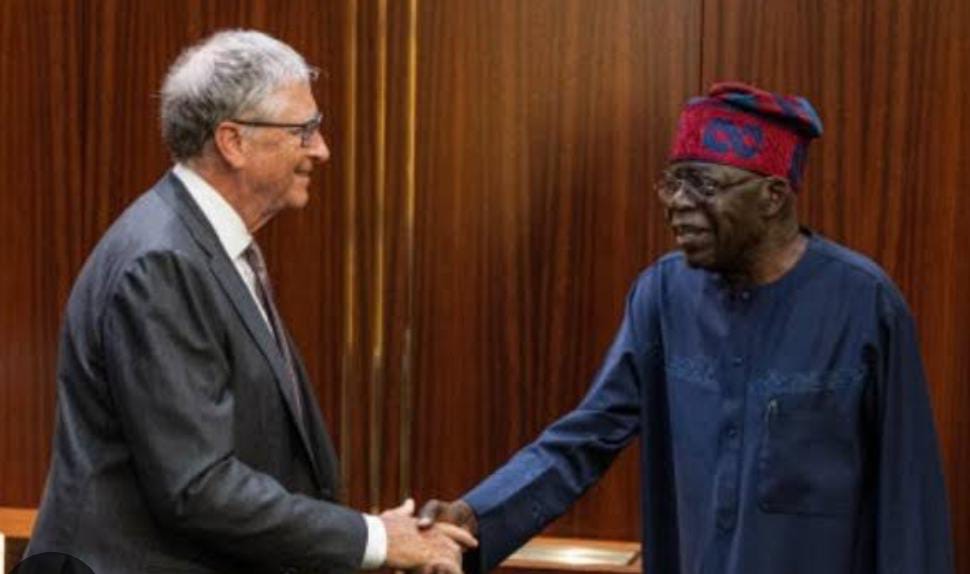
When Bill Gates met President Bola Ahmed Tinubu in Lagos on June 3, 2025, the encounter was more than a meeting between a former technology executive and a head of state.
Gates was in Nigeria as one of the world’s most prominent philanthropists and as the co-chair of the Gates Foundation, an organisation that has invested billions of dollars in health, agriculture and development programmes in the country.
At the meeting were Aliko Dangote, Chairman of the Dangote Group; Nigeria’s Minister of Health and Social Welfare, Professor Muhammad Ali Pate; and the Minister of Special Duties and Intergovernmental Affairs, Zephaniah Jisalo.
President Tinubu used the occasion to confer on Gates the Commander of the Order of the Federal Republic (CFR), one of Nigeria’s highest national honours.
Describing Gates as an “asset” and “a good man” who had consistently supported poor and disadvantaged people, the President praised his contribution to Nigeria and to humanity.
But beyond the ceremony and the photographs lies a broader question about the growing role of large philanthropic organisations in Nigeria’s public policy.
How much influence can a private foundation acquire when it becomes one of the country’s major development partners?
A major development partner
The Gates Foundation has worked with Nigerian institutions for years across areas including primary healthcare, nutrition, agriculture and digital financial services.
The Foundation says its work with governments is focused on areas such as technical assistance, research, evidence and policy support. It also states that it does not fund political campaigns. That distinction is important.
Working with government on public policy is not the same thing as participating in electoral politics. Funding an organisation that advocates for better healthcare is not, by itself, evidence of support for a political party or candidate.
Nevertheless, the scale of the Foundation’s engagement raises legitimate questions about the relationship between philanthropy, public policy and democratic accountability.
By 2024, Gates said its cumulative commitment to Nigeria had exceeded $2.8 billion, making the country its largest national commitment in Africa.
The money has supported programmes involving vaccination, maternal and child health, nutrition, agriculture, health-system strengthening and other development priorities.
The Foundation’s reach also extends beyond federal government institutions. Its grants have supported Nigerian civil-society organisations, professional bodies, research institutions and advocacy groups working on health and development.
This creates a network of partnerships that reaches from government ministries to state institutions and civil society.
The question is not necessarily whether such partnerships are legitimate. The more difficult question is how their influence should be understood and scrutinised.
Where does the money go?
The Foundation’s publicly available grant records provide examples of the scale of its engagement.
In 2024, it committed $50 million to Nigeria’s Federal Ministry of Health and Social Welfare to support implementation of health-sector reforms, including the government’s Sector Wide Approach.
A separate grant of approximately $1.48 million supported implementation of health reforms and their adoption at subnational level.
Another grant to the Nigeria Governors’ Forum was designed to support work involving health commissioners and reforms aimed at improving maternal and child health.
The Foundation has also funded civil-society organisations working on health advocacy and public accountability.
One such organisation is Nigeria Health Watch, which has received Foundation funding for programmes intended to increase public knowledge and accountability around the Sustainable Development Goals.
These grants demonstrate the Foundation’s involvement in policy and public debate.
They do not, however, by themselves demonstrate electoral activity.
That distinction matters, particularly as Nigeria approaches the 2027 general elections.
The development question
There is another question that deserves attention: what measurable results have these investments produced?
Nigeria continues to face serious challenges in healthcare despite decades of domestic and international investment.
Malaria remains a major public-health problem. Maternal and newborn mortality remain high, and Nigeria continues to account for a substantial proportion of maternal deaths globally.
These outcomes cannot be attributed to the Gates Foundation.
Nigeria’s health system involves federal and state governments, international donors, multilateral institutions, private organisations and communities. Population growth, poverty, insecurity, infrastructure, health-worker shortages, access to care and numerous other factors affect outcomes.
Government spending has also increased substantially over the period.
The appropriate question, therefore, is not simply whether billions of dollars have been spent.
It is what those investments have changed.
The politics of influence
Philanthropy inevitably operates within political environments.
A foundation that provides funding, expertise and technical assistance to government institutions will develop relationships with officials and policymakers. Organisations receiving grants may also become participants in public debates about government policy.
None of this necessarily amounts to partisan political activity.
But it does raise an important democratic question: how should citizens scrutinise the influence of private philanthropy when it becomes deeply involved in public institutions and policy-making?
That question is particularly relevant in Nigeria, where public institutions often depend on international development partners to finance or technically support programmes that governments themselves are expected to deliver. The issue is therefore larger than Bill Gates.
It concerns the role of wealthy individuals, philanthropic foundations and international development organisations in shaping public priorities in developing countries.
Looking towards 2027
As Nigeria moves towards the 2027 elections, health, agriculture, technology, poverty reduction and social protection are likely to remain important issues in political debate.
Organisations funded by development partners will continue to conduct research, engage policymakers, educate the public and advocate for policy changes.
The existence of those activities should not automatically be interpreted as electoral intervention. At the same time, their activities should be open to legitimate public scrutiny.
Nigerians have a right to know who finances organisations participating in public-policy debates, what those organisations are funded to do, what safeguards exist against partisan activity, and how the impact of development programmes is measured.
The Gates Foundation’s role in Nigeria therefore presents a broader question than whether one philanthropist is seeking political power. It is a question about accountability.
When private philanthropy becomes large enough to influence public policy, who ultimately decides the priorities?
When governments depend heavily on external expertise and funding, where should the boundary between partnership and influence be drawn?
And when billions of dollars are committed to solving problems that remain stubbornly persistent, how should success be measured?
Those are questions worth asking before 2027—not because there is evidence that philanthropy is secretly determining Nigerian elections, but because the growing influence of private capital in public affairs deserves transparency, scrutiny and informed public debate.