Follow Us on Google

The rising spate of child malnutrition in Nigeria appears to have triggered some remedial actions from the country’s health authorities. Hence, Nigeria is a primary priority country in an initiative by a United States-based organisation, Operation End Starvation (OES), to launch an annual $1 billion funding drive to tackle acute child malnutrition and starvation across sub-Saharan Africa. OES is an initiative of the Eleanor Crook Foundation.
The target of the partnership with Nigeria is an estimated 6.4 million children said to be suffering from acute child malnutrition in the country. It is also to strengthen government interventions in maternal health, breastfeeding support for mothers, nutrition, and food security. The Federal Ministry of Health and Social Welfare and the First Lady, Mrs. Oluremi Tinubu, coordinate the initiative, which integrates with local frameworks like the National Community Food Bank Programme across the six geopolitical zones.
As the Chief Executive Officer of OES, Williams Moore, put it, “The foundation is impressed by Nigeria’s focus on combating acute malnutrition and we are seeking partnership for this global ‘Operation End Starvation’ programme.”
We commend the United States government and other international philanthropists who contribute to the funding of the programme. We also commend Mrs. Tinubu who has been in the forefront of the efforts to end child malnutrition in Nigeria. She not only hosted a delegation of the OES led by the Coordinating Minister of Health and Social Welfare, Prof. Muhammad Pate, but has also partnered with the government to establish frameworks to combat malnutrition. This includes National Community Food Bank Programme introduced recently in the country.
Earlier in the year, Mrs. Tinubu had urged traditional and religious leaders to support the food bank progamme, which aims to identify and register eligible families with children under six years of age. It operates through the nationwide network of Primary Health Centres. Under the programme, caregivers are expected to receive food vouchers that could be redeemed for locally grown nutritious food at food banks established close to health centres.
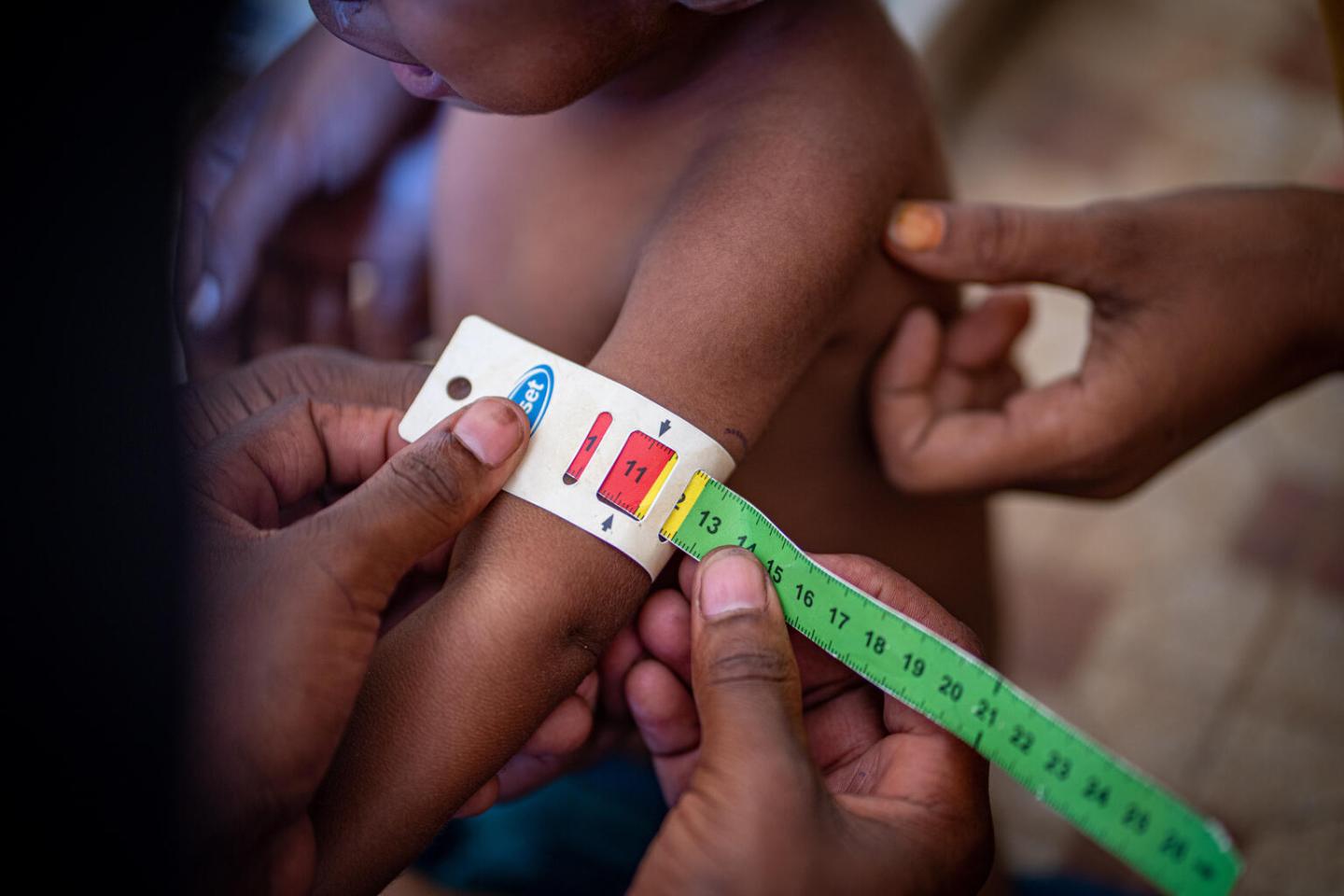
It is pertinent to note that about 45 per cent of under-five deaths globally are caused by malnutrition. In Nigeria, about two million children under five are said to suffer from severe acute malnutrition. Sadly, only two out of 10 affected children reportedly get treatment.
The disease is more prevalent in the Northern part of the country where insecurity has affected farming and access to nutritious foods. In 2024, Médecins Sans Frontières treated over 300,000 malnourished children in Bauchi, Borno, Kano, Katsina, Kebbi, Sokoto, and Zamfara States. In 2025, UNICEF collaborated with the European Union to give treatment to over 20,000 and 14, 000 children under five in the North-East and North-West respectively.
Other News
UNICEF had estimated that Nigeria was the number one country with the highest burden of stunted children in Africa and second worldwide. In percentage terms, the 2023-2024 National Demographic and Health Survey (NDHS) put it at about 40 per cent for Nigerian children under five. The same survey notes that about eight per cent of these children suffer wasting, which means they are thin for their height. Those who are underweight or thin for their age are 25 per cent.
This presents the country in a very bad light. With its abundant resources, Nigeria should be among the wealthiest countries in the world. Unfortunately, it has continued to fail its citizens in every aspect of life. Poverty rate is over 60 per cent. Many families do not know where the next meal will come from, as prices of food items are very high. This is why over 11 million Nigerian children experience severe child food poverty. Globally, over 180 million children under five suffer severe child food poverty.
Malnutrition comes with many health and economic challenges. Many of the children suffering it die from common childhood diseases because their immune system is poor. Some of them have stunted growth, reduced attention spans, and lower intelligence quotients. Sometimes, they become withdrawn and irritable and may struggle to talk or walk.
Economically, Nigeria is said to lose over $1.5 billion annually because of malnutrition. The losses are engendered by high health care costs and deaths as well as reduced productivity.
The problem should be frontally tackled to stem stunting and poor cognitive development. Since insecurity is one of the hidden drivers of child malnutrition, the federal and state governments should provide security to farmers to encourage them to go back to farms and also invest in agriculture to tackle the avoidable menace.
Government should make nutritious foods accessible and affordable to the people by bringing down food inflation. It should adequately fund the Ministry of Health to enable it to frontally tackle the disease in all ramifications.
Nursing mothers should endeavour to breastfeed their babies exclusively for the first six months. This helps them to develop strong immunity. Relevant government agencies should embark on enlightenment campaign to educate parents on the dangers of having many children they cannot cater for. All relevant stakeholders should not relent in the efforts to stamp out malnutrition from the country.