Follow Us on Google
By Oludayo Olorunfemi
In about four months, Ekiti will return to the polls to re-elect our governor, Biodun Abayomi Oyebanji (BAO). It is significant to note his unanimous adoption as the flag bearer of the All Progressives Congress (APC) in Ekiti State. In contemporary Nigerian politics, renomination is never automatic, even for sitting governors within the ruling parties. Consensus within the party speaks of deeper values, political stability anchored on broad-based acceptance among party faithful. Beyond party arithmetic lies the more compelling story of tangible governance.
In December 2025, Ekiti witnessed a defining moment when the maiden commercial flight landed at the Ekiti Agro-Allied International Cargo Airport. The airport project has traversed administrations from Engr. Segun Oni to Kayode Fayemi, to Ayodele Fayose, back to Fayemi, and now to Biodun Oyebanji. With each government came revisions, debates over cost, project viability, and shifting implementation strategies. Yet on that historic day, all past governors sat together. Symbolism met substance. Ekiti projected unity. The message was unmistakable: development must outlive politics.
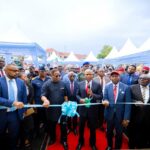
Last week, I drove on the recently commissioned ring road in Ado-Ekiti. We joined the road just after Ekiti State University (EKSU) along the Ado–Ifaki Road and arrived at the Ado–Ijan Road in under ten minutes. As our elders say, iroyin o to afoju ba (no report matches the reality of sight). That road is more than asphalt. It is economic architecture. It seamlessly opens neighbouring communities of Afao, Are, Iworoko, Ifaki, and Oye into Ado-Ekiti and onward to the Ekiti Knowledge Zone (EKZ). That corridor already hosts multiple higher educational institutions. What the ring road has done is remove the friction of distance. It has shortened travel time, reduced transport costs, and created the physical conditions for knowledge exchange, research collaboration, and academic mobility. This is how infrastructure catalyses human capital development.
Already, housing estates are springing up along that axis. One notable development is Ojaja Park, owned by HRM Adeyeye Ogunwusi, the Ooni of Ife. Real estate does not speculate blindly; it responds to signals. Roads send strong signals. The time to invest in Ekiti is now. Imagine a world-class conference centre along that corridor capable of hosting international, national and regional events. With proximity to the cargo airport, access roads, academic institutions, and emerging residential estates, the ecosystem is forming organically. The ring road has opened a new vista for the entire state.
Other News
Beyond Ado, other ongoing road projects, both intra-city and inter-city and federal, are strengthening Ekiti’s connectivity to sister states; Ondo, Osun, Kwara, and Kogi. Regional integration is no longer aspirational; it is infrastructural. There is even a conversation about a proposed rail line that would pass through Ekiti en route to Northern Nigeria. Whether imminent or medium-term, such prospects reflect a state increasingly positioned within broader national logistics networks. These projects are not accidents or mere coincidences.
They are possible where there is political stability, continuity of governance, disciplined fiscal management, and a master blueprint for sub-national development. Sustainable infrastructure requires more than groundbreaking ceremonies; it demands financial engineering, stakeholder coordination, and leadership alignment. It takes a team. It takes a leader who understands his role not merely as administrator, but as unifier and burden-bearer, one willing to pursue long-term gains even when immediate applause is muted. Governance often requires decisions whose raison d’être becomes clear only in retrospect. Today, the trajectory is visible. A more connected Ekiti. An economically integrated Ekiti. A knowledge-driven Ekiti. A state positioning itself as an agro-logistics and hospitality destination. A state whose infrastructure is beginning to match its intellectual capital. The future looks bright, green, flourishing, and prosperous. Ekiti is open for business.
Indeed, BAO lẹ́kansi!
•Oludayo Olorunfemi, a lawyer, writes from Idemo Quarters, Oke Ayedun Ekiti