Follow Us on Google
•37 students bag first degree, 19 MSc, 11 PhD
Chancellor of Ballsbridge University, Prof. Idahosa Charles, has challenged graduates of the institution to use their degrees to make a difference in their communities, professions and nations.
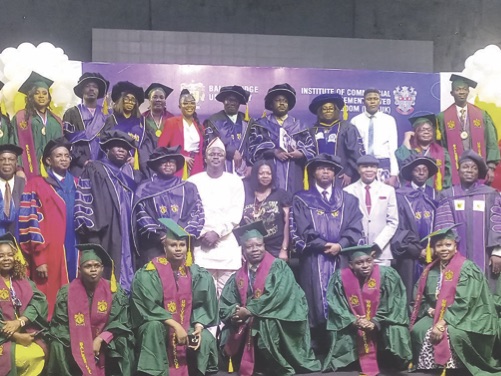
Prof Charles stated this at the 2025 joint convocation/induction ceremony of Ballsbridge University in which 37 students bagged first degrees, 19 graduated with MSc/MBA and 11 obtained PhD/DBA in different fields of studies.
Charles, who was represented by Dr. Marius Ahonon, Registrar of ESCAE-Benin, further tasked the graduates to embrace technology, innovation and global competition.
He stressed that the university will continue to champion education that transforms lives, education that is global in perspective but rooted in human values.
“Our mission is not only to produce graduates with degrees, but citizens with purpose, empathy, and vision. Go into the World and make a difference in your communities, in your professions, and in your nations,” Charles noted.
The chancellor urged the graduates to be creators, not just seekers of jobs; solution-builders, not complainers; your courage, and your contribution.
In his remarks, the Pro-Chancellor of Ballsbridge University, Prof. Joel Abba, described the occasion as more than a ceremony but a renaissance of intellect, a symphony of achievements, and a testament to human resilience and determination.
“You came as seekers of knowledge; today, you ascend as ambassadors of wisdom and virtue. Through diligence and devotion, you have transformed challenges into chapters of triumph.
“Carry your knowledge as a lantern that leads, your character as a compass that guides, and your integrity as a crown that dignifies,” Abba added.
The pro-chancellor reminded the graduates that the world beyond awaits their impact as a panacea and should let their intellect inspire innovation, compassion build communities, and their courage confront injustice.
“As ambassadors of Ballsbridge University and ICM-UK, go forth as torchbearers of truth, pioneers of progress, and guardians of moral excellence,” Abba noted.
He described the university and the institute as citadels of learning, where excellence is not merely pursued but personified.
Chairman of the event, Prof. Amusa Adetunji, stressed that the university is not recognized by structure or facilities by students’ performance and research outcome.
Adetunji, former Vice Chancellor, Southwestern University, Ogun State, said the existing universities in the country are not enough based on the 200 million population of Nigeria and that the teeming youths must be provided university education.
According to him, students who passed through e-learning are doing well, “I have taught in physical and online institutions, graduates of online programmes performance better.”
Prof. Adetunji lauded Ballsbridge University for taking advantage of the Federal Government transborder education, noting that many of the graduates are working and would not have chance to attend full time programmes.
The convocation lecturer, Dr. Ezeogu Kayode Chukwuemeka, said from the beginning, Africans were taught to think about other ideas despite the fact that knowledge started from Africa.
The lecture is titled: Closing the Thougth Gap: Cognitive and Educational Intervention for Africa’s Future Competitiveness, Ezeogu observed that the crisis of inherited cognition, while pronounced in the African context, is neither unchangeable nor exclusive to the continent; rather, it is a challenge amenable to systematic redress through intentional transformation of educational and cognitive frameworks.
He said progressing beyond patterns of intellectual dependency requires a deliberate cultivation of environments that privilege autonomous thought, rigorous inquiry, and the critical reassessment of established knowledge.
“By systematically nurturing individuals who are empowered to analyze, experiment, and reinterpret their realities, societies establish the groundwork for authentic innovation and meaningful engagement with global complexities.
Such transformation cannot be realized through superficial policy adjustments or rhetorical advocacy; instead, it necessitates a comprehensive realignment of pedagogical approaches, institutional priorities, and cultural values—foregrounding intellectual autonomy and cognitive diversity as foundational elements of national development,” noted.
According to him, the advancement of African knowledge systems presents challenges, which demanded an elevated sense of responsibility among the continent’s intellectual custodians.
Three persons were inducted into the Institute of Commercial Management (ICM) UK as fellows while seven prominent Nigerians were conferred with honorary PhD honoris Causa.