Follow Us on Google
By Damiete Braide
Once branded the “Point of No Return”, a passage of sorrow through which millions of Africans were uprooted and sold into slavery, Badagry is rising again, not as a monument of loss, but as a living, breathing symbol of healing, reconnection, and a new African renaissance.
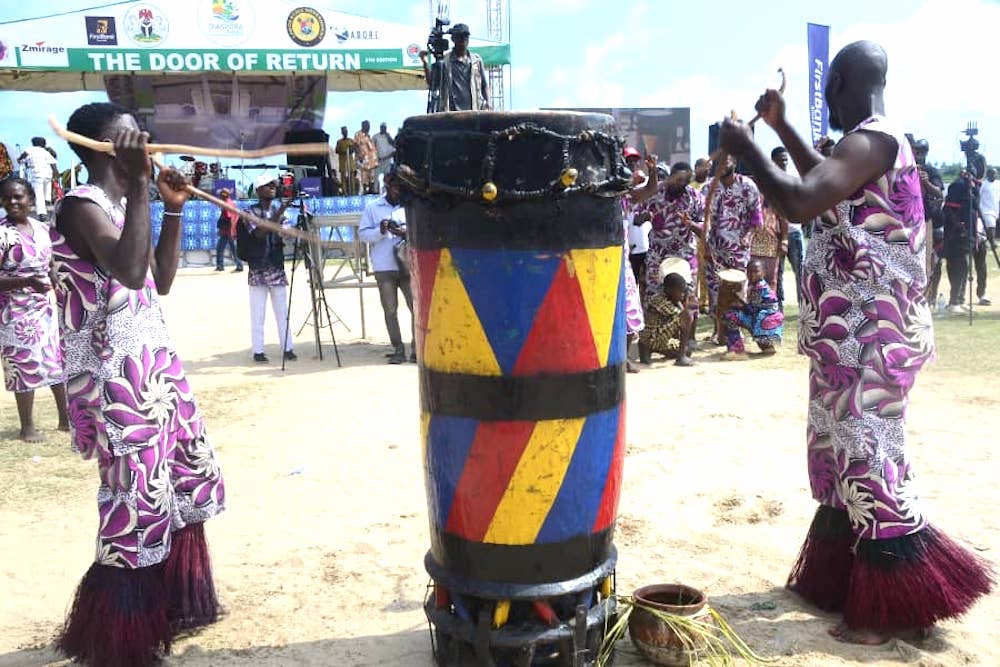
This transformation became vividly evident during the 5th Edition of the Door of Return and Badagry Diaspora Festival, an enchanting convergence of memory, culture, diplomacy, and spiritual homecoming.
Organised by the African Renaissance Foundation (AREFO) in conjunction with the African Door of Return Experience (ADORE), the Lagos State Government, and the Badagry Local Government, this year’s festival was a spiritual and cultural spectacle. It attracted returnees and dignitaries from Brazil, Cuba, the United States, the United Kingdom, and other parts of the global African diaspora. With vibrant chants, royal displays, and emotional reconnections, every moment echoed a renewed African heartbeat, reuniting past and present, sea and soil, diaspora and homeland.
In a keynote address that rippled through the crowd, Nobel Laureate Prof. Wole Soyinka reframed the festival’s profound meaning. It was, he asserted, not merely a commemorative event, but “the opening chapter of a global return.” He emphasized that the African story is incomplete until it is told not only from the homeland but also through the experiences of its dispersed descendants, those who are now choosing to return, to reclaim, to heal.
Soyinka will lead a historic intercontinental voyage from Brazil to Badagry in 2026, a powerful reverse journey of the slave route. But this time, it will be a triumphant return of dignity, healing, and ancestral reunion. “What started as a memorial has now evolved into a movement,” he said, capturing the shift from grief to glory in Africa’s modern narrative.
Mrs. Abike Dabiri-Erewa, Chairman of the Nigerians in Diaspora Commission (NiDCOM), reinforced this shift with heartfelt optimism. She announced that over 2,000 African descendants from Brazil and Cuba will embark on the 2026 voyage. “They return not as captives,” she emphasised, “but as kings and queens.” For her, the festival is not only cultural or ceremonial, it is a rite of healing, a spiritual reconnection, and a reversal of history’s darkest act.
The Lagos State Government, represented by the Special Adviser on Tourism, Arts, and Culture, affirmed its commitment to turning Badagry into a heritage tourism hub of global repute. In a landmark announcement, it revealed plans to construct a permanent Door of Return Monument, a global beacon of reflection and rebirth. “What was once a passage of pain now becomes a gateway of power, pride, and prosperity,” the state declared, signalling a state-backed revival of cultural tourism and transcontinental reconnections.
Among the most emotional testimonies was that of Dr. David Anderson, an African American returnee and founder of A.D.O.R.E. He recalled his first journey to Nigeria in 2018, during which he received what he described as a prophetic vision, not of sorrow, but of restoration. “This shall no longer be called the Point of No Return,” he declared passionately. “It is now the Joy of Return.”
Moving beyond symbolism, Dr. Anderson announced plans to build a cultural and healing resort on the 10 acres of Badagry land he has already acquired. His goal is not only to preserve memory but to reshape it, to ensure that those returning do so not with the burden of inherited trauma, but with the joy of rediscovery, empowerment, and belonging.
The voices of the diaspora resonated deeply throughout the festival. Brazilian citizen Eliza Macimento spoke of the emotional weight of standing on the soil that many of her ancestors were forced to leave centuries ago. “This is not just symbolic, this is healing,” she said, her voice resonating with generations of sorrow, and gratitude. Another Brazilian visitor, Carolina, echoed the sentiment, saying she brought her children so they could feel connected to a homeland that has long lived only in their blood and imagination. “This journey,” she said, “is how we begin to heal the wound of history and end the battle against racism.”
Legendary musician Jeffrey Daniels of Shalamar stirred the crowd with a unifying message that transcended borders. “Africa is not just history, Africa is destiny,” he proclaimed. “Wherever we come from the Americas, the Caribbean, Europe, we are one people. The real journey,” he declared, “is to return not only physically, but mentally.”
Cuban Ambassador, Miriam Morales Palmero, delivered a moving tribute to the unbreakable bond between Africa and Cuba. Drawing from Cuban historian Fernando Ortiz, she declared: “Cuba without the blacks would not be Cuba.” The energetic rhythms and Afro-Cuban spirit that permeate the island’s identity, she said, are living testaments to the endurance of African culture.
Local leaders, including Hon. Bonu Solomon and Hon. Babatunde Hunpe, expressed unreserved governmental support for the movement. They described Badagry not just as a historic site, but as sacred ground, a place where prophecies of return are being fulfilled at last. “Badagry,” said Hon. Hunpe, “is no longer a place of departure. It is now the global capital of return.”
The festival itself was an explosion of African aesthetics, sacred rituals, royal pageantry, boat regattas on the lagoon, ancestral masquerades, the haunting presence of Zangbeto, and the rhythm of drumbeats that seemed to awaken something ancient, something collective. Every act, every chant, every dance told a story of identity reclaimed and wounds beginning to close.
As the sun set on the historic coast, one message was unmistakably clear: the Door of Return is not merely about confronting the past. It is about rewriting it. Reclaiming it. Redeeming it.
From sorrow to strength, from forceful exile to intentional homecoming, Badagry has begun its rebirth, not only as a landmark of memory, but as a launchpad for a Pan-African future built on pride, healing, and unity.
The tide has turned. Africa no longer waits for its lost children; she is calling them home. Not as slaves, but as leaders. Not as victims, but as visionaries. The Door of Return has opened, and this time, it’s not a point of no return, but a profound beginning.