Follow Us on Google
By Moses Akaigwe
Policy inconsistency, difficulty in encountered in renewal of bona fide manufacturer status, low capacity utilisation, dwindling demand, forex scarcity and high interest rate on loans rank high among the challenges encountered by auto plants in Nigeria.
The challenges were identified by automakers during a tour of some assembly plants in Lagos and other locations in the South-West visited recently by the director-general of the National Automotive Design and Development Council (NADDC), Mr. Joseph Osanipin.
At both Honda Automobile West Africa Ltd (HAWA), Ota, Ogun State, and DAG Industries Nig Ltd (assemblers of Bajaj motorcycles and tricycles) in Lagos, the DG was informed that these unfavorable factors interplay to hamper growth and development in plants.
Speaking during the visit, managing director of HAWA, Mr. Takashi Nakajima, mentioned lack of purchasing power and related low patronage as major challenges the plant is facing.
Nakajima, therefore, called for stricter restriction on the importation of used vehicles, and provision of auto finance with favourable interest rate in order to stimulate demand, adding that HAWA has enough installed capacity to satisfy the market.
Making a presentation moments after the arrival of Osanipin and the NADDC team, the head of sales and marketing at HAWA, Mr. Remi Adams, listed, among other hitches, the daunting hurdles the company faces in the renewal of its manufacturer certificate required in clearing goods and duty billing at the ports.
He also complained of high duties on the imported components and fully built Honda cars, avoidable delays and the difficulties encountered in getting the Customs to release the vehicles, which leads to high demurrage resulting in higher price tag at the showrooms.
Adams lamented a situation where duly imported vehicles are still impounded by the Customs on the road after being cleared.
Apart from the assembly of vehicles, which commenced about 10 years ago, a different section of the Honda plant also assembles motorcycles for distribution to different parts of the country.
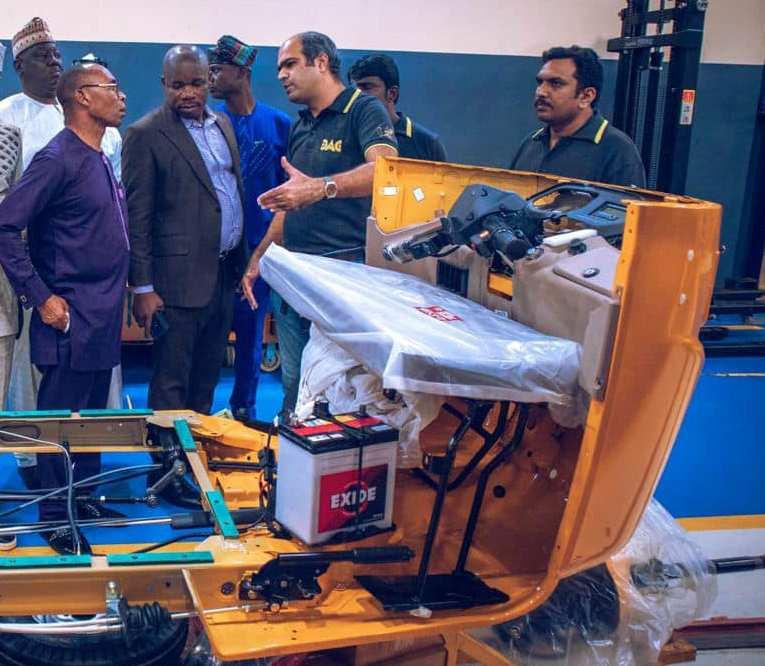
As was done at Honda Ota, the NADDC team was taken through the DAG Industries’ motorcycle and tricycle sections of the Bajaj assembly plant by the Plant Head, Mr. Mazhar Abbas, in company of his deputy, Mr. Arun Bhatia, and Mr. Sundararaj Muthu, Head, Supply Chain Mamnagement.
Describing the Bajaj plant as the biggest in Africa, Abbas said the range of modern equipment were installed to produce about 2,000 motorcycles a day and about 1,000 tricycles a month, lamenting, however, that due to demand fluctuations, only a fraction of the capacity is currently being utilised.
Unfavourable laws, especially the prohibition of the use of motorcycles for commercial purposes in various parts of the country, reduces demand and production activities, Abbas stated.
Reacting to some of the issues raised, including the problems encountered in relating with the Customs at the ports, the Director General said that proper synergy with relevant ministries and agencies is needed in addressing some of the challenges in the automotive industry.
“ We need to work with other agencies, we need to work with other Ministries and apply inter Ministerial approach in creating a kind of desks for the stakeholders, so that when there are challenges, they will be able to report immediately instead of moving from one agency to the other”.
The NADDC DG said he embarked on the tour of the assembly facilities to ascertain the available capacities and potentials as the industry begins the implementation of the Nigerian Automotive Industry Development Plan (NAIDP 2023-2033) for which an inter-agency and inter-ministerial committee was inaugurated recently.
He disclosed that he was also on a mission to ascertain the level of commitment to after-sales support by the various automakers.
Osanipin highlighted the immense potentials in the local auto industry and harped on the importance of human capital development in revamping the industry.
He also observed that the level of local content is low in the various plants, noting, however, that some of them had already started providing training programmes and bringing in experts to empower the Nigerian youth with the technology necessary in assembling vehicles, as well as the skill needed in converting fossil fuel-powered vehicles to Compressed Natural Gas (CNG).
“On CNG-powered vehicles, Nigerians are already embracing the new initiative and hopefully by the time more of it are on the road, alot of investors would key into the conversation process” he added.
He reaffirmed the Council’s commitment to aligning with President Bola Ahmed Tinubu’s “Renewed Hope Agenda” in promoting local production of vehicles and components.
“The core stakeholders are ready to embrace the initiative of migrating from SKD to CKD. And this has a lot of advantages, for example- it will generate more employment opportunities, contribute more to the economy and higher percentage of local components” he said.
“Overall, we now know that we have the capability, all we need is to do some things differently in developing the auto sector” he concluded.
Other automotive plants visited by the NADDC included Origin Tech Group, Cedric Masters Auto, Jet Motors, and Proforce Limited in Ode-Remo, Ogun State.
Incorporated in 2008 as a subsidiary of O’la-Kleen Holdings Limited, Proforce has become the pioneer and only total defence provider in West Africa.
With the Director General during the tour were Sani Uma, NADDC Deputy Director, Policy and Planning; Pastor Lambert Ekewuba, an NADDC Council member/Executive Director, Motorcycle Manufacturers Association of Nigeria (MOMAN); and Mrs. Felicia Oyebolu, Deputy Director, Press and Protocol .