Follow Us on Google
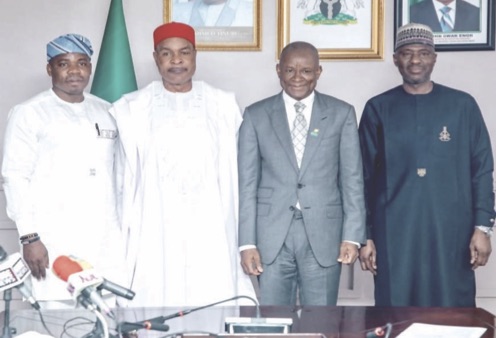
• Eneukwu prioritizes NAIDP
By Moses Akaigwe
The Nigerian Automotive Industry Development Plan (2023-2033) and the recently enunciated Nigeria First policy were both on the front burner on Wednesday when the new Governing Board of the National Automotive Design and Development Council (NADDC) was inaugurated in Abuja.
Adressing the members, the Minister of State for Industry, Trade and Investment , Senator John Owan Enoh. emphasized the imperative of implementing the Nigeria First Policy, even as the Chairman, Chief Emma Eneukwu, placed the NAIDP on top of the new board’s priority scale.
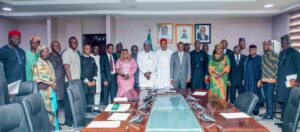
Also speaking at the inauguration ceremony hosted by the Minister of State, the NADDC Director-General ,Oluwemimo Joseph Osanipin, committed to ensuring a further increase in the volume of locally produced vehicles, which rose to nearly 12,000 in 2024, from about 4,000 a year.
Osanipin was hopeful that if the momentum was sustained, Nigeria would soon start exporting vehicles.
Earlier while addressing the new Governing Board members, Enoh had charged them to play a pivotal role in transforming Nigeria’s automotive sector.
He described the inauguration as a significant milestone in the Federal Government’s renewed push to revamp the auto industry under the Renewed Hope Agenda.
He said that the NADDC is of strategic importance in the drive to build a competitive and sustainable automotive sector capable of creating jobs, advancing technology and boosting national productivity.
According to him, the appointment of the new board underscores the government’s commitment to repositioning the sector through sound policies, infrastructure development and stakeholder collaboration
“The board represents a diverse pool of expertise and experience, encompassing various facets of the automotive industry, academia and public service.
“I urge you to approach your duties with dedication, diligence and a forward-thinking mindset, without interfering in the day-to-day administration of the council,” he said.
Enoh outlined key areas of focus for the board, including strategic planning, policy formulation, infrastructure development, stakeholder engagement, skills development and investment attraction.
He also emphasised the need to promote local content development and encourage the adoption of Compressed Natural Gas (CNG) and electric vehicles as part of Nigeria’s energy transition strategy.
“The Nigerian automotive industry possesses immense potential. We have a large domestic market, a skilled workforce and a growing economy.
“Realising this potential requires collective effort,” he said.
He commended the NADDC Director-General for his visionary leadership and consistent drive to reposition Council as a catalyst for sustainable mobility, innovation, and industrial growth.
The minister called for strategic alignment between the Council’s management and its new board to ensure that automotive policies are not just developed—but codified and executed for long-term impact.
In his remarks, the Permanent Secretary of the Federal Ministry of Industry, Trade and Investment, Amb. Abba Rimi, stated “We have been working with the Director-General in the absence of the board, and he has proven to be a worthy appointee of Mr. President.”
The caliber of people appointed on this board aligns with Mr. President’s mandate and his promise to Nigerians that very soon, we will have vehicles made in Nigeria, not only for local use, but also for export to other African countries and the rest of the world.
Responding on behalf of the board, the Chairman, Chief Emma Eneukwu, expressed their gratitude to President Bola Tinubu for the appointments, describing it as a call to national service.
Eneukwu pledged that the board would fully align with the Renewed Hope vision of President Bola Tinubu to restore investor confidence, drive industrial development and deliver practical results to Nigerians.
“This appointment is not just a personal milestone, it is a call to national service at a critical time in our country’s economic transformation journey,” he said.
He reaffirmed the board’s commitment to ensuring the full implementation and review of the NAIDP.
“We will encourage local manufacturing and assembly of vehicles and promote value chain development to generate jobs and skills nationwide.
“We also promise to support the adoption of CNG, electric and alternative fuel vehicles in line with global sustainability standards.
“We shall strengthen partnerships with investors, academia and research institutions to drive innovation and industrial competitiveness,” he said.
Eneukwu assured stakeholders of transparency, collaboration and performance, stressing the board’s readiness to ensure that council makes a measurable impact in the auto sector.
In his remarks, the Director-General expressed optimism that the newly inaugurated governing board would play a key role in accelerating the sector’s development.
Osanipin said that the board’s broad representation of key industry stakeholders would foster stronger collaboration, quicker response to sectoral needs, and more effective policy execution across the entire automotive value chain.
The Director General, who has since assumption of office in October, 2024, been working towards the NAIDP getting legislative approval and signed into law, disclosed that the Council was focused on increasing the volume of vehicles produced locally, rather than the number of production plants.
“It is not the number of production plants that really matters, but the production volume of a particular plant.
“We want to boost the volume of production, not actually the number of people manufacturing.
“The production volume has increased significantly since the we assumed office, with the number of new assembly vehicles produced annually doubling from 3,000 to 4,000 to close to 12,000 before 2024.
“Before we came in, at the time we were doing about 3,000 to 4,000, which has increased now, we have done close to 12,000 before 2024,” Osanipin said.
He hinted that the council was working towards enduring the auto industry begins the export of made-in-Nigeria vehicles and automotive machines in the near future.
“We will begin to export made-in-Nigeria vehicles, made in Nigeria, all these automotive machines.
“We’ll be in a position to be exporting very durable ones and not the ones that people won’t have confidence in,” he said.
According to him, NADDC governing board is expected to work closely with industry stakeholders to drive growth and innovation in the sector.
“We need to work together, so it’s easier for us to relate with all the stakeholders.
“Sometimes, because they (the board members) represent different stakeholders, you have all the stakeholders needed in this industry there.
“So, it’s easier for us to relate with all the stakeholders, and we need that collaboration to be able to work because we have raw material council in the board, we have the local content manufacturers (ALCMAN), we have vehicle assemblers (NAMA), we have bicycle makers, we have motorcycle assemblers (MONA), we have the SON (Standards Organisation of Nigeria),” the NADDC boss concluded.
Apart from the Chairman (Chief Eneukwu), and the DG, Joseph Osanipin (Board Secretary), other
members of the NADDC board are:Bawo Charles Omagbitse (Nigeria Automotive Manufacturers Association, NAMA);
Chief Elder Robert Ugbaja representing Manufacturers Association of Nigeria (MAN); Eberiekwe Savings Chidubem (Raw Materials Research & Development Council, RMRDC) and Engr. Onucheya Enebi Shuaibu (SON).
Others are Racheal Serumi Ugye (Nigerian Society of Engineers, NSE); Mrs. Olumuyiwa Ajayi-Ade (Federal Ministry of Industry Trade and Investment): Rev. Lambert Ekewuba (Motorcycle Manufacturers Association of Nigeria, MOMAN); Henry Emenike Ezine (BIMAN); and Chief Anselm Ikekuba (Automotive Local Manufacturer Association of Nigeria, ALCMAN).