Follow Us on Google
By Henry Akubuiro
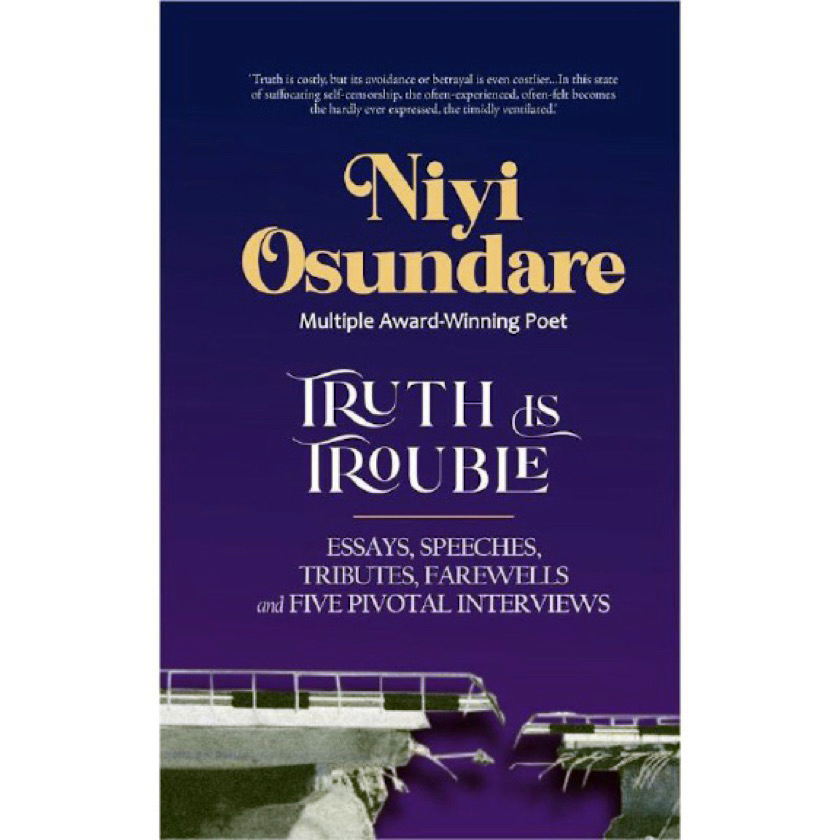
Truth is Trouble, Niyi Osundare, Bookcraft, Ibadan, 2026, pp. 536
Professor Niyi Osundare’s golden years have been marked by a relentless pursuit of intellection and a humanist agenda. With his verses, he has carolled about love, nature, a better world and, in equal measure, pilloried the harum-scarum of civilisations. Standing firmly on the pedestal of truth, Osundare has persistently vouchsafed an augury of hope for humanity battling with a faded light of reason. Straddling cultures for decades, beyond private encounters of the universe in books, have left a long-lasting impression on how he sees the world and the multiple rings of the Word. Osundare, one of Nigeria’s finest poets and literary scholars, will turn 80 years old by March 2027. Already, he has set the tone for an epochal vista with a new offering, Truth is Bitter, a collection of essays, speeches, tributes, farewells and five pivotal interviews.
Truth is Bitter offers us a periscope with which we see the many facets of Osundare – his intellectual rigour, his cosmopolitan vision, and his emotional undertow. It is a coalescence of some of the finest scholarly pieces written over decades, plus a select number of conversations with journalists and scholars, the latter offering rare insights into the world of Osundare, his reimagining of ideas, interpretation of social disequilibrium, and the flux of history. The 536-page book is divided into five parts: Troublesome Truths, Troublesome Muses, Troublesome Terrains, Reluctant Farewells, and Five Pivotal Interviews. The beauty of this work is that it offers the reader, who might not have seen all the pieces together in one tome. It makes understanding Osundare easier and researching him more profitable.
For a moment, dive into a pool without hitting the rock bottom. From the opening pages of this enthralling read, it’s hard not to be waylaid by Osundare’s felicity of expressions – a hallmark that he stamps on every scribal fabric he puts out to the public. Writing in “Forethoughts of Critical Race Theory, Troublesome Books, and Grievance Aesthetics,” the writer asks thought-provoking questions about knowledge and literature, and the place of the writer in a convulsing world. The writer is like a flutist who produces diverse purring sounds to suit different occasions. We are all different, yes.
Writes Osundare: “We speak and write differently, because we think and mean differently. We mean differently because we are born and bred differently. We cry differently because we laugh differently. We die differently because we live differently. But difference is no deficit; similarity is no synonym of sameness. Those who think that many/all is a problem, let them consider the stifling circumscription of one/only” (p.3).
Osundare’s ink doesn’t flow with a languorous dispatch in his essays. It flows with compelling reasons from a tested fountain, marshalling out points with copious references. Osundare agrees that literature must have a “local habitation” before it can ever have a ‘’name’. In his piece on “African Literature and Africa’s Body-Politics”, the poet designates Africa, our “local habitation”, as the site of some of the most gruesome tragedies in human history and one of the contemporary world’s most gruesome tragedies in human history and one of the world’s most beleaguered arenas. He, however, submits that the legendary rot and chaos in its Republic of Politics is constantly challenged by the excoriating energy and moral vision of its Republic of Letters. For him, “What Country-Hide conceals beneath the shrouds, Country-Seek has been trying to unravel with the tip of the pen. Africa’s journey,” then, “to modernity is lit by the sparks from the clash of these two momentous phenomena” (p 37).
Osundare’s Truth is Trouble tells about truths that are sometimes hard to swallow. For instance, he raises concern on the cold neglect of African and literature in the literary marketplace:. ” At what major bookshops in the world outside Africa today would you find African books on dignifying, conspicuous display? When was the last time you read in The Times of London or The Washington Post a review of an African book written by those living on the continent? (and here, I mean the serious, mind-engaging type, not a table safari ‘’write-up’)? He also queries when last did a major literary engagement get a mention in the international media. He laments that Africa’s 100 Books of the Century Project, done decades ago and witnessed by former South African African president, Nelson Mandela, and anti-apartheid activist, Desmond Tutu, never got the same global hype like the millennial/centennial “Best Books’ lists compiled in Europe and the United States.
Similarly, Osundare is worried that the Noma Award, Africa’s most prestigious book award, is hardly known beyond the continent, despite the immense integrity and reputation of this award. Thus, “we are dealing with a world that has lost interest in Africa, a world that has lost interest in Africa, a world that sees Africa as nothing more than the Conradian heart of darkness, a prehistoric pity and abyss of silence” (p.43). Even in Africa itself, writers living on the continent think, unfortunately, that the best place to be is outside Africa and nothing compares to international laurels secured from the West.
Osundare treats this vaxious subject in “African ‘’Relocations and the Perils of Dis-Placement” in which he deconstructs the malaise of ignorance and wider delusions pervading the literary groove. He laments that very few African writers have made it to the global rostrum of validation despite changing locations. It is a painful reality he wants our young writers to realise.
In other essays, Osundare invites the reader to see the ancestral limitations in African and Carribean literature, the impediments and possibilities in the dialogue between Africa and Europe. In the second path of the book, Osundare writes on Fagunwa, Amos Tutuola, Achebe’s Things Fall Apart, Wole Soyinka, Alioune Diop, Mariama Ba, and Antonio Jacinto. Part Three of the book dwells on ideas, the mind, nature, internationalist ideal, global crisis and the writer. The poet dedicates the fourth chapter to farewells to iconic men of letters – Eldred Jones, Abiola Irele, Isidore Okpweho, Kofi Awoonor, Buchi Emecheta, Gabriel Okara, Maya Angelou, and Gabriel Garcia Marquez – plus cultural icons like Susan Wenger and Victor Uwaifo, and personal friends from other fields.
Osundare, through his quill, waxes lachrymal in wishing the legends goodbye, but he sees their deaths as deathless, for their words live continuously in the world.
Five pivotal interviews occupy the fifth part of the book, including interviews done by Ademola Adesila, Kabir Garba, Dave Brinks, Yinka Fabowale, and N. Oguanah. He gives a last word that sums up the African tragic experience on page 514: “Right now, in many African countries, the past is bitter than the present. We must all strive to make sure that this horrible present is not better than our future” (p.514).