Follow Us on Google
By Aminat Orisatoye
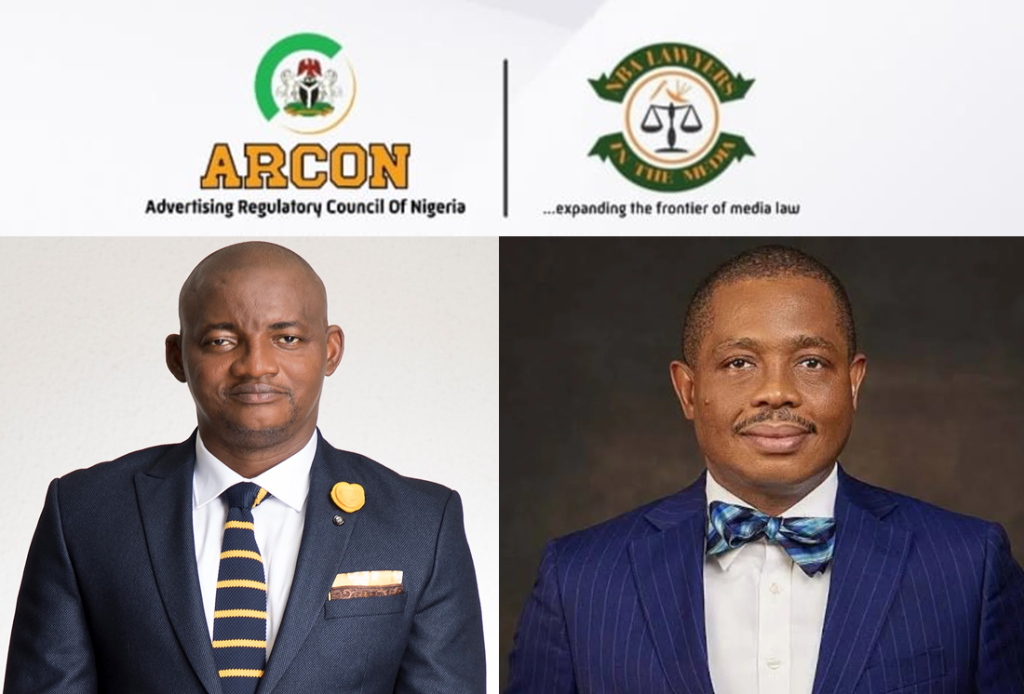
The Advertising Regulatory Council of Nigeria (ARCON), in collaboration with the Nigerian Bar Association- Lawyers in the Media Forum (NBA-LIM), recently enlightened advertising practitioners on Nigeria’s advertising law and its implementation under the Advertising Offences Tribunal (AOT).
Themed: “The Nigerian Advertising Law: The Role of the Advertising Offences Tribunal (AOT),” the session brought together regulators, legal practitioners, and industry stakeholders.

The town hall focused on deepening understanding of Nigeria’s advertising law and the functions of the Advertising Offences Tribunal.
During the event, stakeholders agreed that the advertising industry could no longer rely solely on self-regulation due to the growing complexity of digital media.
Justice A. Aluko, who represented the Chief Judge of the Federal High Court, commended ARCON’s proactive steps in establishing the tribunal.
He described the initiative as a bold evolution that would usher in a new era of truth and accountability in the Nigerian advertising space.
In his keynote, legal luminary, Mr. Akinlolu Kehinde (SAN) described the AOT as a necessity born from the realities of a digital economy.
Kehinde explained that advertising is no longer a persuasive art but the “economic bloodstream of the nation.”
Citing a report by PwC, he revealed that Nigeria’s advertising industry was valued at over ₦600 billion in 2024.
He further projected that the figure would exceed ₦890 billion by 2028, underscoring the sector’s vast economic importance.
According to him, with exponential power comes exponential risk, especially in the age of digital misinformation.
He warned that a single misleading post could reach millions within seconds and cause real-world harm.
“A deceptive health advert can endanger lives, while an unvetted financial message can drain savings,” Kehinde cautioned.
He identified three key problems that led to the establishment of the Advertising Offences Tribunal.
The first, he said, was the weak enforcement framework that left Nigerians exposed to fraudulent and harmful advertising content.
The second was the slow pace of traditional court processes, which could not keep up with the speed of digital advertising.
“By the time a civil case concluded in court, the campaign had ended and the perpetrators had vanished,” he observed.
The third problem, he added, was a deficit of expertise in traditional courts to handle complex advertising disputes.
Other News
These challenges, Kehinde said, necessitated the birth of a specialized tribunal under the ARCON Act 2022.
He emphasized that the tribunal’s hybrid composition was intentional, combining legal and industry expertise.
“Advertising cases require not just legal knowledge, but understanding of creative processes, market behavior, and consumer psychology,” he said.
Chairman of the Advertising Offences Tribunal, Justice Cicilia Olatoregun, described the tribunal as the linchpin of a transformed enforcement regime.
She stressed that the tribunal was equipped with competent staff, transparent processes, and robust case management systems.
According to her, the AOT is already proving its effectiveness through its swift and disciplined approach to justice.
“Since its commencement in November 2023, we have handled 266 cases, resolved 201, and have 65 still pending,” she revealed.
Justice Olatoregun assured stakeholders that the AOT would deliver justice to all manner of persons without bias.
She urged legal practitioners to seize emerging opportunities in advertising compliance and defense.
“This is not just regulation—it is a call to build a thriving legal niche in advertising law,” she said.
She emphasized that the tribunal’s work transforms voluntary codes into binding, enforceable laws.
“The AOT ensures advertising remains truthful, responsible, and ethical,” she affirmed.
President of the Nigerian Bar Association, Mr. Afam Osigwe, urged lawyers to actively engage with the advertising law framework.
He noted that lawyers have a duty to help their colleagues in the media remain within the boundaries of professional conduct.
“The tribunal has authority to entertain all matters relating to violations of the ARCON Act,” Osigwe reminded participants.
Director-General of ARCON, Dr. Olalekan Fadolapo, reflected on the evolution of advertising regulation in Nigeria.
He recalled that the first effort to structure advertising as a reserved profession for Nigerians dated back to 1972.
Fadolapo explained that the Advertising Standards Panel (ASP) — not ARCON — vets advertisements before public release.
The ASP, he said, is composed of over 20 members drawn from key regulatory and professional bodies such as the CBN, SEC, and NAFDAC.
He reiterated ARCON’s commitment to sustained stakeholder engagement, legal alignment, and ethical compliance.
“Our goal is to balance creativity with compliance while promoting professionalism, protecting consumers, and strengthening trust in Nigerian advertising,” Fadolapo concluded.