Follow Us on Google
- AA, Accord, Hashim, Adebayo fault order
- NJC must investigate Justice Lifu’s judgment –HURIWA
From Godwin Tsa, Abuja
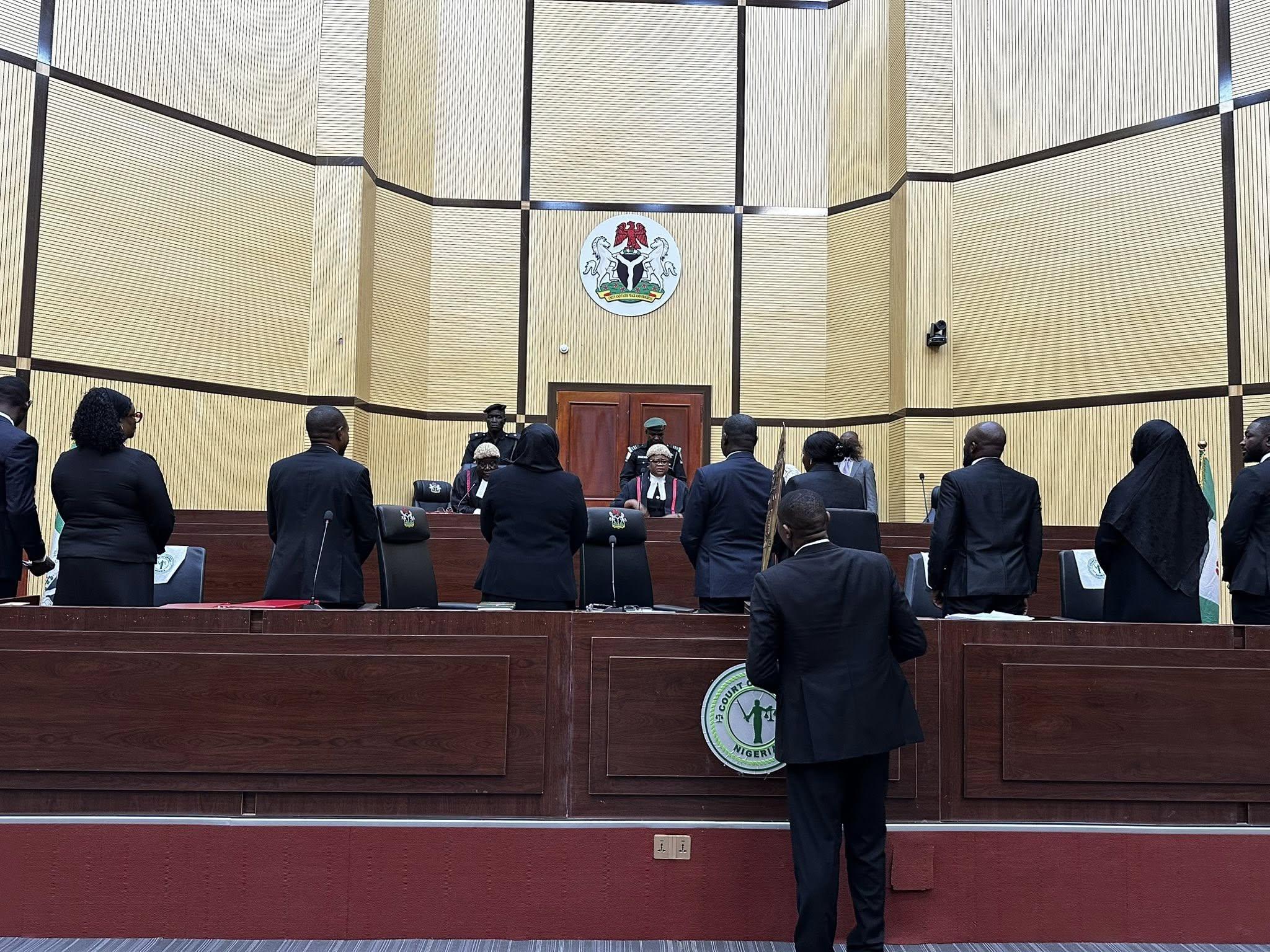
The Abuja Division of the Court of Appeal has ordered a stay of execution of the Federal High Court judgment directing the Independent National Electoral Commission (INEC) to deregister five political parties.
The court condemned the trial judge, Justice Peter Lifu, for what it described as judicial rascality.
In a unanimous decision, a three-member panel led by Justice A.B. Mohammed berated Justice Peter Lifu for flouting an order made on May 22, which had directed him to suspend proceedings before him, holding that his action amounted to an affront on the hierarchy of courts.
The appellate court held that the lower court’s conduct represented “the highest form of judicial impertinence,” stressing that the Supreme Court had previously held that a judge who acted in such a manner “is unfit for the bench as it amounts to judicial rascality.”
“Courts are enjoined to protect their integrity. This court has supervisory authority over the trial court. The decision of the lower court to proceed with the judgment despite the express order of this court is a brazen violation of the hierarchy of the court and the 1999 Constitution.
“This court has the duty to invoke its powers in ensuring that its orders are obeyed.
“The application for stay of execution is hereby granted. The enforcement of the judgment is stayed,” the appellate court held.
INEC was directed to deregister the African Democratic Congress (ADC), Action Peoples Party (APP), Action Alliance (AA), Accord Party (AP), and Zenith Labour Party (ZLP).
The high court had held that the parties failed to meet the constitutional threshold warranting their continued existence and participation in future elections, and had additionally ordered INEC to stop recognising them, barred them from submitting candidates’ nominations, and directed the parties to stop parading themselves as registered political parties.
The judgment, however, was rendered in direct defiance of a subsisting Court of Appeal order. A three-member panel led by Justice Mohammed Danjuma had, on May 22, 2026, granted a stay of further proceedings in the case pending the determination of an appeal filed by the Accord Party in Appeal No: CA/ABJ/CV/569/2026. An enrolled order of the court, signed by Deputy Registrar Josephine Ekperobe, stated:
“It is hereby ordered that pursuant to Order 4 Rules 16 and 11 of the Court of Appeal Rules 2021, the application filed on May 4, 2026, is granted staying further proceedings in Suit No: FHC/ABJ/CS/2637/2025, pending the hearing and determination of this appeal. This appeal is adjourned to October 27, 2026 for hearing.”
Notwithstanding that order, Justice Lifu proceeded to deliver judgment, directing INEC to deregister the five parties and barring them from participating in any future elections, including the 2027 general polls. With the appellate court ruling, that judgment is now on hold.
Meanwhile, the Human Rights Writers Association of Nigeria (HURIWA) has called on the National Judicial Council (NJC) to investigate the circumstances surrounding the Federal High Court judgment ordering the deregistration of five political parties, describing the ruling as a massive threat to constitutional democracy, judicial integrity, and Nigeria’s multiparty system.
In a statement by its National Coordinator, Emmanuel Onwubiko, HURIWA expressed alarm that the judgment was delivered in defiance of a subsisting order of the Court of Appeal, which had expressly directed a stay of proceedings pending the determination of an appeal already before it.
HURIWA said that if properly established, such disregard of a superior court order would constitute a serious constitutional infraction and a direct affront to the doctrine of judicial hierarchy.
“Why the haste to deliver such a consequential judgment when the Court of Appeal is already seized of the matter and has fixed a hearing date? Why proceed in the face of a reported subsisting stay of proceedings?” the association queried.
HURIWA noted with concern that the Federal High Court had increasingly been embroiled in controversies involving politically sensitive disputes, raising public apprehension about the neutrality and independence of certain judicial interventions in opposition party matters.
It said such recurring concerns must be urgently addressed to preserve public confidence in the judiciary. The association recalled that the Court of Appeal had in several politically sensitive matters consistently cautioned against judicial overreach, particularly in internal party disputes, and had in one instance arising from the Peoples Democratic Party (PDP) leadership crisis set aside a Federal High Court decision while reaffirming that courts must not allow themselves to be used as instruments for determining political outcomes outside clear constitutional and evidential boundaries.
HURIWA also referenced arguments by Ikenga Ugochinyere and other stakeholders concerning prior judicial pronouncements affirming the legal and registration status of the Action Peoples Party, as well as Supreme Court affirmations of the legal standing of registered political parties under Nigerian law. It warned that any attempt to undermine such settled positions without proper appellate reversal threatened legal certainty and democratic stability.
The association described the judgment as a legal aberration that was “totally fallacious in reasoning and dangerous in its implications for constitutional governance,” warning that judicial actions perceived as targeting opposition parties ahead of elections risked eroding public trust in the judiciary, deepening political tension, and weakening democratic institutions.
HURIWA called on the NJC to take decisive steps to curb judicial excesses capable of undermining constitutional democracy, while urging the Court of Appeal and other superior courts to ensure that the sanctity of appellate orders was fully respected in all legal proceedings.
Other News
“The judiciary remains the last hope of the common man and must never be reduced — whether by perception or reality — into an instrument of political engineering or partisan advantage,” the association said. Some stakeholders in Awka, Anambra State, have also said the judgment is capable of heating up the polity.
The stakeholders queried the timing of the judgment, saying it was coming few months to the 2027 general elections.
They said the development might result in massive protests and constitute a clog in the wheel of democratic process in the country.
Chief Chris Elumunoh, veteran journalist and former Chairman of Ohanaeze Ndigbo in Anambra, described the judgment as sensitive, calling for caution in its enforcement.
Elumunoh said the court verdict which was based on the poor electoral performance of the political parties and their failure to meet constitutional vote could create confusion. He noted that the judgment was coming few months to the off-cycle Osun governorship election.
The former Ohanaeze Ndigbo chairman called on the judiciary to live up to its billing as the last hope of a common man rather than creating political tension in the country.
He, however, said that there was no cause for worry, as the affected parties still have the constitutional right to challenge the judgment at the appellate court.
A legal practitioner and public affairs analyst, Mr Maxwell Ede, described the court decision as unfortunate.
Ede advised the affected political parties to seek redress at the Court of Appeal, expressing the hope that justice would be served.
To Mrs. Tochi Ifejirika, a civil servant, deregistering the five political parties may create unnecessary political unrest.
Ifejirika said that the beauty of democracy was having a good number of political parties contesting for elective positions, with the electorate having choices.
The Accord Party in Oyo State, in its rejection of the judgment of the Federal High Court, said in a statement by its Secretary, Olayinka Dairo that it had elected officials in states and so could not be spiked.
“We have like two or three councilors, and they are also elected. So all the reasons they have been giving that Accord is part of the parties that were deregistered is not realistic; I wonder why Accord is listed.”
Dairo said Accord had already filed an appeal against the judgment and will seek a stay of execution pending determination of the appeal.
When asked whether the appeal had been filed, Dairo replied: “definitely, 100 per cent.
“We have appealed the case in Abuja because we saw this coming earlier.”
In its own reaction, the AA, in a statement by its National Chairman, Chief Kenneth Udeze, said the timing of the judgment raised serious questions about democratic inclusion, particularly as INEC has already commenced preparations for the 2027 polls.
The party noted that the Court of Appeal had since stayed proceedings of the lower court, adding weight to its concerns about the propriety of the deregistration order.
“Multiparty democracy is the bedrock of our Constitution under Section 40,” the AA said. “Reducing the number of registered parties mid-cycle narrows voter choice and weakens political competition. Nigerians deserve more platforms to express their aspirations, not fewer.”
The AA argued that deregistering parties at this stage of the electoral cycle would disenfranchise their members, destroy years of party-building efforts and create avoidable political tension. It maintained that electoral compliance issues were better addressed outside active election cycles, with due process and adequate notice to affected parties.
The party further contended that where parties fall short on compliance, the appropriate remedy should be one that strengthens them rather than eliminates them, urging the courts, INEC and political actors to prioritise dialogue over deregistration during election seasons.
The AA consequently called on the judiciary and INEC to consider a stay or review of the judgment until after the 2027 elections, in the interest of electoral stability. It also urged the National Assembly to review laws governing party deregistration to prevent similar mid-cycle disruptions in future.
The party expressed solidarity with the affected parties and their members, while calling on civil society organisations and all Nigerians to defend Nigeria’s democratic space, warning that a healthy democracy could not be built on exclusion.