Follow Us on Google
• Says Atiku, Obi, others can’t stop Tinubu •Campaign council reveals northern dominance, South-South, South-West governors’ limited roles
By Beifoh Osewle and Fred Itua, Abuja
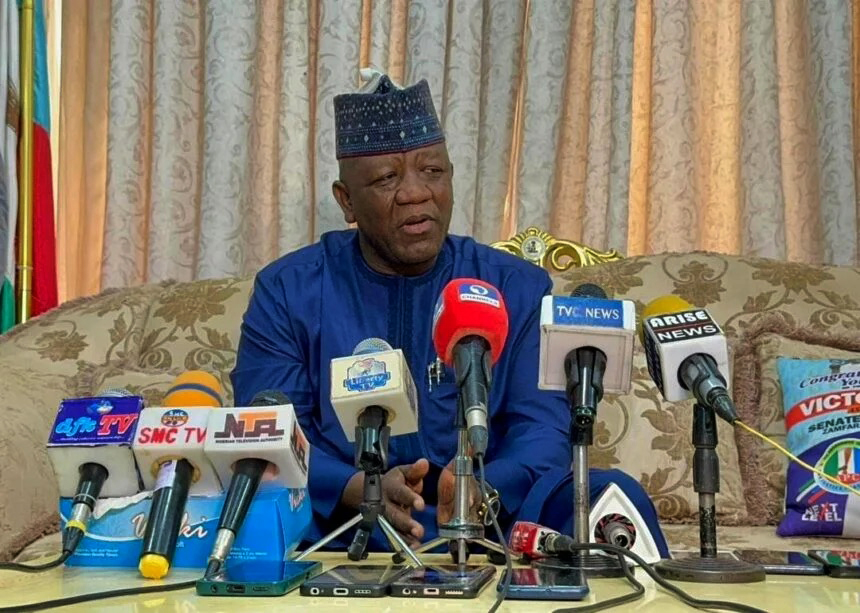
Director-General of the All Progressives Congress (APC) Presidential Campaign Council, Senator Abdul’Aziz Yari, has boasted that the ruling party will remain in power beyond 2031, declaring that former Vice-President Atiku Abubakar of the African Democratic Congress (ADC), former Anambra State Governor, Peter Obi of the Nigeria Democratic Congress (NDC) and other opposition figures cannot stop President Bola Tinubu’s re-election in 2027.
Yari, former Zamfara State governor, spoke in Abuja on his return from an overseas trip, where he was received by party supporters at the Nnamdi Azikiwe International Airport.
His declaration came against the backdrop of renewed opposition efforts to build a coalition capable of unseating the APC in 2027 and barely 24 hours after the Presidency unveiled the ruling party’s Presidential Campaign Council for the election.
“Today, we have seen him [Bola Ahmed Tinubu] as president today, and by God’s grace, he shall be the president come 2027,” Yari said.
He also expressed confidence that the APC would remain in government after Tinubu’s second term.
“We pray that our party will continue to be the party to lead the country after President Tinubu’s second term,” he said.
Yari assured Nigerians that the APC would fulfil the promises it made during the 2023 presidential campaign, saying the party’s continued support among Nigerians would depend on its ability to deliver on its commitments.
“I want to assure Nigerians that whatever promise we made during the campaign, we shall keep to our promises. Our party is synonymous with keeping to our words,” he said.
The former governor also prayed for divine wisdom for Tinubu as the ruling party begins its mobilisation for the 2027 election.
The confidence expressed by Yari comes as the APC’s campaign structure reveals a strong concentration of key operational positions among northern politicians and long-standing allies of the President.
Meanwhile, an independent review of the newly released membership list shows that several serving governors from the South-South and South-West are either absent from the council or occupy positions that are less prominent than those assigned to their northern counterparts.
Of the six APC governors now in the South-South following the wave of defections into the ruling party in 2025, only Cross River State Governor Bassey Otu and Delta State Governor Sheriff Oborevwori feature on the campaign council.
Otu is listed as South-South Zonal Campaign Coordinator, while Oborevwori is Director of Finance and Treasurer.
Governors of Bayelsa, Douye Diri; Rivers, Siminalayi Fubara; Akwa Ibom, Umo Eno; and Edo, Monday Okpebholo, are absent from the published list.
A similar pattern is evident in the South-West, where Lagos State Governor Babajide Sanwo-Olu is listed as Zonal Campaign Coordinator, while Ogun State Governor Dapo Abiodun is Director of Fundraising.
Other News
Ekiti Governor Biodun Oyebanji and Ondo Governor Lucky Aiyedatiwa, however, do not appear on the list.
At the top of the campaign structure, the Director-General, Deputy Directors-General and heads of major directorates, including finance, security, legal and media, are largely occupied by northern politicians and individuals regarded as long-standing allies of Tinubu.
Yari himself heads the council as Director-General, while Senate President Godswill Akpabio and Yobe State Governor Mai Mala Buni are among the Deputy Directors-General.
Sarki Yaki heads the security and intelligence directorate.
Imo State Governor Hope Uzodimma is the major exception from the South-East, emerging as secretary of the council, the fourth-ranking position after Tinubu, Vice-President Kashim Shettima and APC National Chairman, Prof Nentawe Yilwatda.
The composition effectively gives the campaign council a strong northern imprint, although several southern politicians have also been assigned positions with direct responsibility for mobilisation and campaign financing.
Governors Otu, Oborevwori, Sanwo-Olu and Abiodun, for instance, hold functional positions linked to zonal mobilisation, campaign finance and fundraising. Several senior southern politicians and National Assembly leaders also feature prominently, including Akpabio and Senate Leader Bamidele Opeyemi. However, the absence of many serving governors and some senators elected in recent off-season and rerun elections has provided an early indication of how the APC is balancing loyalty, political influence and campaign responsibilities ahead of the election.
Party sources who spoke on condition of anonymity attributed the composition partly to concerns within the presidency over the loyalty of politicians who entered the APC through recent defections.
One source said some politicians moved into the ruling party when it became politically convenient, suggesting that the presidency was not prepared to immediately reward such defections with command positions.
But another party source rejected the interpretation, arguing that the roles given to Otu, Oborevwori, Sanwo-Olu and Abiodun were not ceremonial and placed them in positions with significant influence over grassroots mobilisation and campaign resources. The composition has also generated questions over the inclusion of some serving public officials and individuals whose records have attracted controversy.
The appointment of Nigeria Revenue Service Chairman Zacch Adedeji as Deputy Director of Fundraising, for instance, has attracted criticism, with former Kogi West Senator Dino Melaye threatening legal action over an alleged conflict of interest.
Former Humanitarian Affairs Minister, Betta Edu, and former NSITF board chair, Ngozi Olejeme, have also faced scrutiny over unresolved allegations, while former presidential adviser Babafemi Ojudu has questioned aspects of the council’s composition. Despite the criticism, the APC leadership has maintained its focus on the 2027 contest.
The party’s preparations are taking place against a rapidly shifting opposition landscape, with Atiku, now aligned with the African Democratic Congress (ADC), Peter Obi and Rabiu Kwankwaso among the major opposition figures whose political movements could shape the contest.
The opposition has been exploring possible alliances and a common platform to prevent the APC from securing another presidential mandate, although disagreements over leadership, zoning and the choice of a presidential candidate have complicated efforts to forge a unified challenge.
Yari, however, appeared dismissive of the threat posed by the opposition figures, insisting that the APC was confident of retaining the presidency.
The campaign council is expected to oversee the ruling party’s nationwide mobilisation as it seeks to consolidate Tinubu’s position ahead of the 2027 election and lay the groundwork for continued APC control beyond his second term.