Follow Us on Google

Lionel Messi has cried before. Football has made him cry. Defeat has made him cry. Victory has made him cry. But this one is different. This is the cry of a boy who has lost his father. And perhaps the saddest part is that Messi did not lose his father alone. He lost him in the middle of a football story that was supposed to have one more glorious chapter.
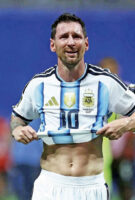
Jorge Messi died at 68. His son is 39, a father himself, an eight-time Ballon d’Or winner, a global icon, a man who has conquered almost everything there is to conquer in football. Yet suddenly, in the face of death, all those trophies look like toys.
What is a World Cup trophy to a man who wants to show it to his father and the father is no longer there to see it? That is the haunting question behind Messi’s extraordinary farewell to Jorge. Messi has written one of the most heartbreaking pieces I have ever encountered in the life story of a footballer. It is not really a football letter. It is a son’s letter. And perhaps that is why it hurts so much.
“Dad, I still can’t believe you’re gone,” he wrote poignantly.
The disbelief of a child. Look closely at the pictures of Messi and his father and you see a chip off the old block. The famous Messi face is there. The eyes. The quietness. The almost shy expression. The man who can make 80,000 people scream without saying a word.
Jorge was there before Barcelona, before Camp Nou, before the Ballon d’Ors, before the billions, before the GOAT argument. He was there when Lionel was just a small boy in Rosario with a football at his feet.
At four, Lionel was already playing football at Abanderado Grandoli, where his father coached him. Later came Newell’s Old Boys. Then the great journey to Barcelona at 13, when father and son crossed the Atlantic carrying a boyhood dream that looked, to many people, like madness.
Jorge was not merely the man who said, “Go and play football.” He became the man who accompanied the dream. He took his son to training after finishing work. He watched. He worried. He suffered. He celebrated. And he became Messi’s agent, handling the business side of a career that would eventually become one of the greatest in sporting history.
Father. Friend. Agent. Three jobs. One man.
That is what makes Messi’s story so poignant. Behind the world’s most celebrated football artist was an ordinary father doing extraordinary fatherly things.
There were disagreements, naturally. What father and son do not quarrel? How many of us have fathers we once thought were wrong only to discover, years later, that they were right?
That is the secret museum of fatherhood. We enter it when our fathers are gone. And then we discover that many of the things we thought were lectures were actually love wearing an uncomfortable uniform.
Messi’s father did not make him Messi. But he helped create the environment in which Messi could become Messi. The little boy with the extraordinary feet needed somebody to take him to training. The shy boy needed somebody to fight for him. The family needed somebody courageous enough to move to Barcelona when the future was uncertain. The football genius needed somebody to manage the business of genius.
And when the world finally discovered Lionel Messi, Jorge had already known him for years. Perhaps that is why Messi’s football has always seemed less like work and more like poetry.
Some footballers play football. Messi writes it. He writes with his left foot. A dribble is a sentence. A feint is a metaphor. A pass is punctuation. A goal is the full stop at the end of a poem.
He has spent a lifetime doing things ordinary footballers cannot explain. The ball seems to know him. Defenders come at him like angry men trying to stop a butterfly. Messi simply moves.
One touch. Two touches. A sudden change of direction. And suddenly, the impossible has happened. That is poetry. And behind the poet was the father. Which brings us to the tragedy of the 2026 World Cup.
Jorge had wanted Messi to play one more World Cup. His health deteriorated badly just before the tournament. For the first time, the father who had been there for so much of the journey could not be there.
But Messi went. Because Dad wanted him to. There is something devastating about that. A 39-year-old man, already a legend, still wanting to please his father.
Other News
Messi and Argentina marched all the way to the final. He had told his father they would get there so Jorge could travel and watch him. But the journey reached the final before Jorge could make it. And Argentina lost to Spain. The trophy went away. Messi had wanted to win it and take it home to his father. He could not. He later confessed that his legs had nothing left to give. Imagine that loneliness.
You have reached the summit. The whole world is watching. The trophy is there. But the one person you desperately want to see it is not there. This is where football stops being football. It becomes life.
Messi has revealed that after every match during the World Cup, he waited for his father’s message. It was when that message stopped coming that he understood just how bad things had become.
Think about that. Lionel Messi. The man whose name is on the backs of millions of shirts. The man whose goals are watched by hundreds of millions. After the final whistle, he was still looking at his phone waiting for one message: Dad. That missing message became the loudest silence in the world.
Solitude is not necessarily being alone in a room. Solitude is being surrounded by millions and missing one person. That is Messi’s solitude.
He has family. He has children. He has friends. He has teammates. He has fans everywhere. But nobody can replace Jorge. Nobody can be Dad.
Messi has admitted that he does not know how to continue without his father and now has serious doubts about how much longer he will keep playing football. That sentence should frighten football lovers.
The football poet has lost his first reader.
The extraordinary son has lost his ordinary father.
The champion has lost the man for whom another championship mattered most.
And Messi wept.
Not because he was weak.
Because he was human.
Because behind every great man there is often a smaller story nobody sees.
In Messi’s case, it is the story of a father getting off work, picking up his little boy and taking him to football practice.
The boy grew up. The boy became Messi. But somewhere inside Messi, that little boy never left the training ground. He is still waiting for Dad. Still waiting for the message. Still hoping to hear:
Well done, son.
And that, my friends, is perhaps the saddest poem Lionel Messi has ever written.
Not with his left foot.
With his tears.